

The Rover
Santa Fe, NM

New Mexico, the Land of Enchantment…or Atomic Spy Capital.
Contrary to my prior belief, New Mexico and its capital, Santa Fe, are beautiful. Stunning sunsets, art galleries, and famous green chiles. Ancient cultures of Catholics and Pueblo Native Americans lived side by side for centuries. You can buy a $7,000 leather jacket at Lucchese in downtown Santa Fe if you’re feeling froggy, but spy capital? Yes.
I knew little about Santa Fe before visiting, but the history just bled out of the 500-year-old chapels, adobe storefronts, and downtown streets where some of the most infamous Soviet operations in American history went down.
Nuclear fission came to New Mexico for one reason: there isn’t anything here. When you’re dealing with deadly radiation and the most violent explosions the world has ever seen, you need space. The extreme isolation and sparse population that kept the rest of the world away were exactly what drew the brightest scientific minds on the planet.
From the late 1930s until 1946, Santa Fe and its larger partner Albuquerque were the sites of some of the most intense spy activity in world history. No one knew about it for years — except the foreign agents involved.

Author and retired CIA operative E.B. Held calls Santa Fe a “sacred city” for Russian operatives. Soviet agents were so cocky that they reportedly had their pictures taken in front of the iconic Cathedral Basilica of St. Francis of Assisi. In broad daylight. On the main plaza.
When you think of nuclear espionage, the mind naturally drifts to WWII. But it didn’t stop there. Perhaps the greatest defector in US history, a dismissed CIA operative named Edward Lee Howard, escaped from Santa Fe in 1985 in a bold scheme to flee to the Soviet Union. Our parents were in high school when espionage was still being conducted on these streets. It wasn’t that long ago.
Most people don’t even know what goes on in New Mexico. That is exactly how the intelligence agencies prefer it.
Winston Churchill once said of the Soviet Union, “It is a riddle wrapped in a mystery inside an enigma.” New Mexico was where that enigma quietly did its most devastating work on American soil.
You can still visit these locations today, the same streets where the Soviets laid the groundwork to compete in the arms race and change the course of the Cold War.
The building Soviet agent Josef Grigulevich used to plan the assassination of Leon Trotsky still stands on Santa Fe’s central plaza. It’s a Häagen-Dazs ice cream shop. Nobody knows.
The spy meeting house in Albuquerque is now a bed-and-breakfast. 209 High Street, where David Greenglass handed over bomb secrets, is currently the Spy House B&B. You can sleep there tonight.
The biggest act of treason in US history happened on a bridge in Santa Fe. On June 2, 1945, Klaus Fuchs handed Harry Gold a packet containing bomb sketches, trigger details, the upcoming Trinity test location, and America’s intention to use the bomb on Japan. In a single meeting. The Soviets knew more about the Manhattan Project than Harry Truman did. The father of the Soviet bomb, Igor Kurchatov, later described the intelligence flowing out of New Mexico as “of tremendous, inestimable importance” to the Soviet state.
And then there’s Oppenheimer. His codename in Soviet intelligence files was “Chester.” The CIA investigated and concluded there was, in the words of the report itself, “room for an honest difference of opinion.” That isn’t a clearance. That’s a polite way of saying they never fully ruled it out. The man who built the bomb may have been feeding its secrets to the enemy the entire time.
New Mexico. The Land of Enchantment. Where you can walk the same streets where the Cold War was decided before Americans knew it had started.
The most interesting things I read this month:
The Iran “Excursion”
President Trump has called what the average person would call a war an excursion, a short military exercise with an end in sight. What it’s actually been is anything but that. We have heard every day that this will all be over soon. I regret to inform you that the President of the United States hasn’t picked up too many history books.
When you kick a hornet’s nest, you don’t get to decide when the hornets stop coming after you.
On February 28, 2026, the US and Israel launched Operation Epic Fury — a joint strike campaign targeting Iran's leadership, nuclear program, and military infrastructure. The operation included a decapitation strike that assassinated Supreme Leader Ali Khamenei during Ramadan. Killing the Supreme Leader during Ramadan is the equivalent of assassinating the Pope on Easter. Notably, just three days before the strikes, Iranian Foreign Minister Araghchi said a historic agreement to avert conflict was within reach. The attack came during active negotiations. Israel knew time was slipping away to eliminate the Ayatollah, but Trump couldn't resist being in charge of the situation, so the US jumped in alongside them.
Iran retaliated with hundreds of drones and ballistic missiles targeting US military bases across Bahrain, Jordan, Kuwait, Qatar, Saudi Arabia, and the UAE. If you are an ally of America, you are a target in Iran's eyes. Approximately 2,000 vessels and 20,000 seafarers are now stranded in the Strait of Hormuz. More than 1,750 people have been killed in Iran. Thirteen US service members have been killed. At least 1,094 people in Lebanon have been killed in Israeli strikes since March 2. More civilians have died on both sides than soldiers.
The head of the International Energy Agency called this the greatest global energy security challenge in history. Brent crude surged roughly 30% in under three weeks. Energy infrastructure is being attacked daily.
Iran rejected Trump’s 15-point ceasefire proposal and issued five conditions of its own, including war reparations and Iranian sovereignty over the Strait of Hormuz. Iran’s military mocked the Trump administration publicly, asking whether the level of internal conflicts had reached the point where America was negotiating with itself. Trump is learning that making a deal in New York real estate is considerably simpler than resolving a war on the global stage.
This is your friendly reminder that during the Iran-Iraq war of 1980, Iran fought on for six years after Iraq proposed the first peace plan.
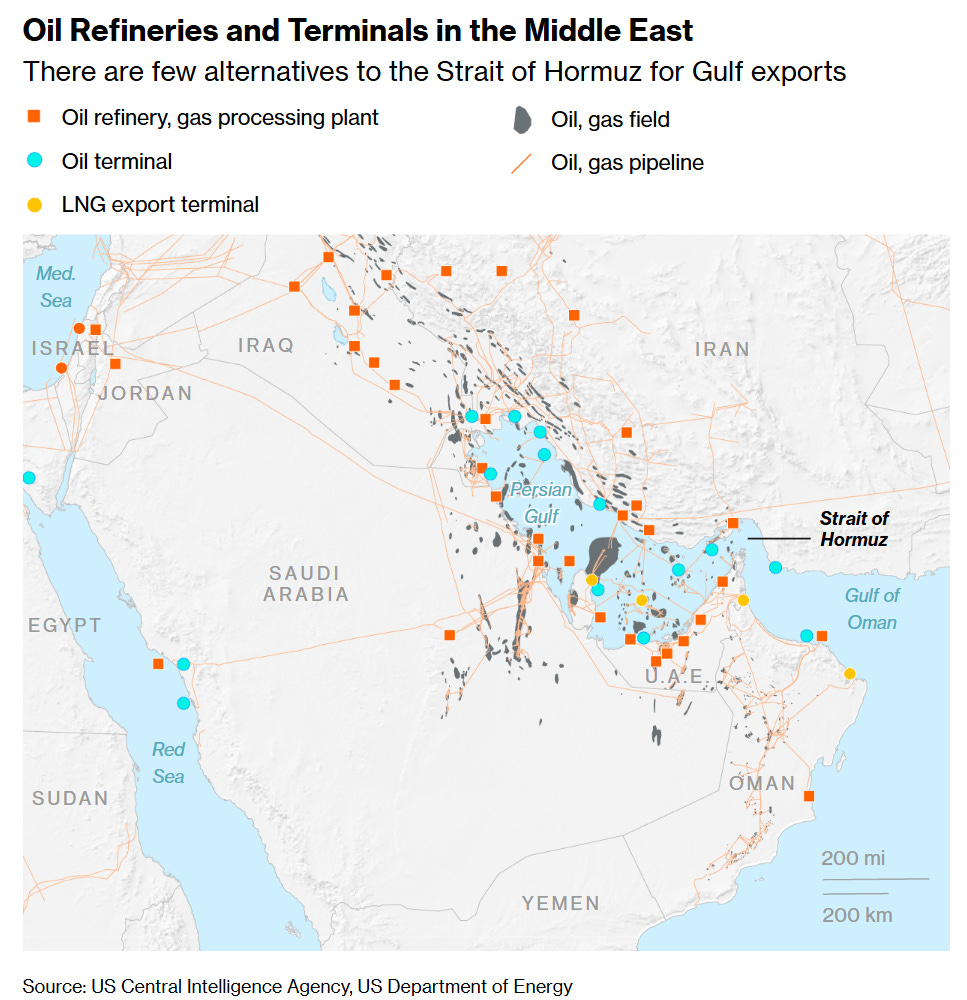
It blows my mind that no one in the US government apparently considered Iran closing the Strait of Hormuz as a consequence of this war. The Atlantic and CNN both reported that Trump and his associates never war-gamed that scenario. 20-25% of the global oil supply travels through a single strait. As we wrote in last week’s piece, One in the Hand:
In the name of cheapness efficiency, we concentrated 25% of the world’s oil through one chokepoint. That’s not a supply chain. That’s a single point of failure.
Iran hasn't stopped at closing the Strait. It has made all energy infrastructure a target. If you purchase American weapons, you are a target. Iranian attacks have severely damaged over 40 energy assets across nine countries crippling key infrastructure in Qatar, Saudi Arabia, and the Gulf, including 17% of Qatar's LNG capacity. These strikes have forced facility closures, disrupted maritime traffic, and sent global energy prices soaring. More than 40 Middle East energy assets ‘severely damaged,’ IEA chief says —CNBC
The 2008 Financial Crisis was caused by financial engineering and excessive debt; it nearly brought down the system, but it was recoverable. Iran's attacks are on physical world assets. You can't restructure a destroyed LNG terminal. It takes 3-5 years to build one from scratch. Each train is custom-made, several stories tall, and requires heavy-haul equipment just to put in place. It’s the largest LNG field in the world, and Qatar has 115,000 people who work there, and livelihoods depend on those facilities.
Australia Fuel Crunch Expands to Hundreds of Gas Stations —Bloomberg
Fuel shortages are already spreading. Australia reported 600 gas stations running out of fuel in a single week.
If I were Japan or South Korea right now, I would not feel confident in my alliance with the United States. Both countries are heavily reliant on Middle East oil. It won’t be long before their leaders have to explain to voters why holding trillions in US Treasuries is an intelligent idea while their citizens sit in fuel lines for hours.
The Strait of Hormuz and Middle East energy will never look the same as they did before February 28th, 2026.
Since the birth of the petrodollar system in 1973, energy markets and financial markets have been inseparable. Gulf countries sell oil, recycle the proceeds into US financial markets and weapons, and the system hums along. It’s worked out beautifully for America — cheap oil and record stock markets. The rest of the world had a different experience, as covered in last month's issue — Regulators, Mount Up! To make a long story short, a Middle East alliance can not happen due to taking over global oil prices, so Israel and the US continue to kneecap countries and cause division.
Financial markets have been violently volatile, surging on days Trump announces peace progress and crashing when Iran proves he was lying. Iran Hasn’t Requested Pause on Energy-Site Strikes —WSJ The Wall Street Journal exposed one such lie when the White House claimed Iran had requested a pause on energy site strikes. Iran had made no such request.
Iran doesn’t need to beat the US military; Iran just needs to beat the US Treasury market, and Iran is winning. Here is the number that matters: every time the 10-year Treasury hits 4.4%, Trump announces a ceasefire or a breakthrough in peace talks. Treasury Secretary Scott Bessent said the administration's economic success should be measured by the 10-year Treasury yield. We are at an all-time high since Liberation Day. The bond market didn't just create fear, it created the famous term TACO. Trump Always Chickens Out. The same dynamic that forced Trump to retreat on tariffs is now driving the war policy. It goes to show that high debt levels tie your hands.
The 30-year Treasury is approaching 5%. At that level, the interest expense on America's debt becomes a fiscal death spiral. It is scientifically proven that we will go bankrupt print money if the 30-year Treasury is over 5%.

The only exit is the printer. Printing money into the largest energy crisis of our lifetimes, with inflation already climbing at the fastest rate most Americans have ever seen, is a recipe for numbers that would make the 1970s look mild. Inflation has brought down nations far more powerful than we like to admit. The US is the best in the world at blowing things up; everyone knows that. But missiles and aircraft carriers cannot save the Treasury market.
Energy and financials are just the beginning. This is where shit gets real. One third of the world's fertilizers, helium for microchips, and the petrochemicals that make your Lulu leggings all pass through the Strait of Hormuz.
Helium shortage has already started impacting tech supply chains —Reuters A helium shortage is already impacting tech supply chains.
The global population of 8.3 billion people is fed thanks to humanity's extraordinary ability to produce food with fertilizers and genetically modified seeds. Remove one-third of that fertilizer supply, and you are not talking about higher grocery bills. You are talking about places that import food, having nothing to import.
It's already starting. Midwest farmers are saying plainly, if you didn't secure your fertilizer last year, you aren't getting any this year. What we call in the business a no-bid market. No amount of money fixes a shortage that doesn't exist. We are entering a period where the things that matter most — energy, food, raw materials cannot be purchased at any price.
The ceasefire of a few days ago is the most fragile ceasefire in our lifetimes. The entire planet is walking on egg shells. The Strait is still not open, and until then everything above applies. It is not a coincidence we won’t hear anything until after the market close on Friday, as the US has not slowed down in shipping personal and equipment for a ground invasion to the Middle East.
More to come on the supply chain crisis next.
What to watch: Energy prices. I am studying some coal names, as they will be needed to supplement all the LNG that has come offline. A new decade of energy is among us.
A 12-Order Cascading Analysis of a Zero-Flow Strait of Hormuz Closure
Systemic Risk: A 12-Order Cascading Analysis of a Zero-Flow Strait of Hormuz Closure — Craig Tindale
Overall, investor consensus right now includes the level of denial I have not seen in my investing career. The market crashed at the beginning of a virus that 99.9% of people survived Covid was dramatic, but apparently the greatest energy shock the world has ever seen is no big deal. That disconnect should concern anyone paying attention.
The gap between paper markets and physical reality is widening in ways that cannot be ignored. WTI crude seems reluctant to hold above $100 a barrel while physical Omani barrels are trading at $160. Paper silver contracts sit around $70, while you cannot find physical silver online for less than $80. What you are witnessing is the financial market manipulating the price of a share of oil on a screen in America versus the price of a real barrel of oil in the Middle East. Those two things are no longer the same.
The markets and media are pushing a narrative that things are not yet out of hand. I want to point out two facts that cut through that narrative:
The world’s most powerful military (according to Trump and Rubio) has not been able to open the Strait of Hormuz.
If the Strait remains closed for another two weeks, it becomes a near certainty that US stock and bond markets will get hit by the combined effect of the Financial Crisis and Covid. Simultaneously.
Earlier this month, Craig Tindale published an analysis of the cascading collapse of global supply chains that will occur if the Strait remains closed. It is long. It is a must-read:
The modern world order, having organized itself around efficiency, cost minimization, and logistical precision, has created a machinery of dependence so extreme that the interruption of one narrow corridor can propagate outward into a general crisis of civilization.
What appears at first as a maritime blockade is in fact the exposure of the entire global system as a hierarchy of brittle interdependencies.
Here is the chain as Tindale lays it out: oil and LNG fail as inputs into electricity, fertilizer, shipping, chemicals, mining, manufacturing, and state finance. From there, fuel inflation becomes fertilizer inflation. Fertilizer inflation becomes food inflation. Food inflation becomes urban instability, sovereign subsidy exhaustion, and hunger. In this sequence, food shortages are not a secondary humanitarian issue. They are among the central political outcomes because modern populations do not experience systemic breakdown through grand strategy. They experience it through unaffordable bread, intermittent power, empty pharmacies, and the collapse of public order.
The physical cascade goes deeper than food. The loss of sour crude becomes a sulfur and sulfuric acid crisis. That becomes a crisis for copper and cobalt. That becomes a transformer and grid crisis. That becomes a semiconductor crisis. That becomes a crisis for computing and data centers.
The myth that digital civilization floats above heavy industry is, in this scenario, extinguished. Compute is shown to rest on copper, transformers, stable voltage, LNG, and ships.
In this framework, hyperinflation is not cyclical. It is being used as a tool in war. When energy-importing nations are forced to acquire dollarized fuel at any price, when currencies weaken, and fertilizer costs reprice an entire harvest cycle, inflation enters every household budget and every government ledger simultaneously. Firms cannot quote. Governments cannot subsidize. Populations can no longer calculate the future. Credit markets seize. Foreign exchange reserves are draining. The boundary between economic crisis and political crisis disappears.
The closure of Hormuz, under this analysis, is the event through which the modern world recognizes that its supply chains were never only economic structures, but the hidden constitution of social peace itself.
If we get to April 15th and the Strait is still closed, the world will begin to spiral. The collapse of the following supply chains has already begun:
Fertilizer
Helium and Electronics/AI
Pharmaceuticals
Plastics
Oil/LNG
It is 2026, and the threat of starvation for food-importing nations is real. Some of the largest food importers outside China are Japan, the EU, and South Korea. That list reads almost identically to the list of the largest holders of US Treasuries. Those countries own 40% of US bonds.
You know what countries with hungry citizens don't do? Buy US stocks and bonds. In reality, America's closest allies will be selling Treasuries and liquidating US assets to raise cash to buy food at prices none of us have ever seen.
In such a world, hunger, hyperinflation, sovereign failure, technological stagnation, and geopolitical militarization are not separate crises. They are the normal operating features of a civilization that has discovered, too late, that its efficiency was built on concentrated fragility.
What to watch: US Treasuries. As nations raise cash, Treasury rates rise. The West dies in the bond market, so we will either default on our debt or print the money to make up the difference. We will never default on the debt so the big print will be forced resulting in extreme levels of inflation.
There is nothing wrong with playing defense. Stack cash. Get your watchlist dialed in. Get ready to pounce on the buying opportunity that follows. Cash is a position.
Banking, payments services disrupted after Amazon UAE data centers hit in drone strikes
Banking, payments services disrupted after Amazon UAE data centers hit in drone strikes —CNBC
What the mainstream media isn’t reporting is that the US hasn’t had more assets destroyed in a war since WWII, and we are only a little over a month in.
Iran understood the American weapons position better than most Americans did. Iran deliberately wasted its older, inaccurate, and smaller missiles early, knowing that US and Israeli interceptor stockpiles are fixed, and that replacing them requires an ass-kissing conversation with China. As the war has progressed, Iran has launched fewer missiles with greater strength and greater accuracy. They are not running out. They are just getting warmed up.

CNBC reported that Amazon had two data centers hit in the Middle East in the early weeks of the conflict.
The constraining factor on building data centers is simple: you need an electrical grid capable of powering them. The US has added barely any terawatts to its grid over the last 25 years. You cannot build out AI without massive increases in energy. China has built and added an entire US grid's worth of energy capacity in the last ten years alone. So if you are Amazon, Apple, Meta, Nvidia, or Google, where are you building your data centers? New or after being hit by Iran?
The Middle East. The only American ally with a grid capable of supporting them. 175 existing data centers with 98 more scheduled by 2029. All within range of Iranian missiles.
The Magnificent Seven stocks have driven roughly a third of the entire S&P 500's market capitalization. Up from 12.5% in 2016. One third of the American stock market is now at the mercy of data centers sitting inside a war zone.
Think about what that means. The stock market is the economy. The stock market is the primary driver of tax revenues. The retirement accounts of 100 million Americans. All within striking distance of Iranian missiles.
The consensus view repeated endlessly by mainstream media is that the Iran conflict is fundamentally about China. Maybe. But has anyone in that conversation accounted for what happens when the Mag 7 starts losing data centers and has nowhere to build new ones?
Shifting construction back to the US is not an option. There is a three-year backlog for new data center electrical connections in America. We failed to address our grid problem for a generation in the name of climate change. The world has now been divided into two groups: countries that took action on climate and countries that did not. The countries that did not (Russia, China, and Iran) now have the rest of the world begging them for raw materials and energy.
Without rapid data center construction and improvements, the US will lose the AI race to China. When the US loses the AI race to China, it will have to ask China’s permission before entering any new conflict after Iran.
What to watch: I would no longer have a majority of my wealth in the S&P 500. I have taken steps to de-risk. A market crash of this magnitude would force the Fed to inject liquidity.
Boil In Your Own Oil
“Those who began this operation should be left to work out their own oil problems — to boil in their own oil, so to speak.” — President Eisenhower, 1956
That quote was made famous when the last global reserve asset fell. I covered the Suez Crisis in depth last month in the There Can Be Only Two section — but it wasn’t even a war so much as a small conflict. Eisenhower had been the Allied Commander in charge of all of Europe in WWII and had just finished fighting a decade earlier. Unlike today, America leaders were sick of war.
So when Britain, France, and Israel invaded Egypt simultaneously in October 1956 and left Eisenhower holding the bag, his response was cold and surgical. He imposed crippling economic sanctions that effectively cut Europe off from imported energy and forced all three allies to withdraw. He didn’t feel comfortable doing it. Britain and France were American allies, after all. But he felt he had no choice. How could the US support Britain and France, he asked, if in doing so it lost the whole Arab world?
Eisenhower’s gamble ultimately failed, Egypt aligned with the Soviet Union anyway and used the same dangle and delay strategy on Washington that Iran is using on Trump today. But the template Ike created was real: sometimes the only way to recalibrate a relationship that has become strategically costly is to let it burn.
Vance reportedly knocked PM in difficult phone call for overselling chances of Iran regime change — Israel Times 3/27/26 “Before the war, Bibi really sold it to the president as being easy, as regime change being a lot likelier than it was.
A month into this war, the Western mainstream media has begun admitting on multiple fronts that Israel convinced Trump to enter this conflict — and is now looking for someone to blame as the war deteriorates. The Israeli Times reported on March 27th that Vice President Vance had a difficult phone call with Netanyahu, who reportedly sold the president on the idea that regime change was far more likely than it actually was.
Whether you agree with Trump's policies or not, the man has had outstanding political instincts for a decade. You don't engineer the greatest political comeback in American history without them. This war has felt out of character. Luke Gromen pointed to a thread by @JanitorTito_ on X that offers the first logically coherent explanation for Trump's actions that I have seen since the bombs started falling. I am building on Gromen's framework here because it's the only alternative that makes sense.


Janitor Tito’s argument begins with a structural problem. The US and Israel have a dependency that is too deeply embedded to unwind through conventional policy. The lobby is too entrenched, the Overton window too narrow, and direct confrontation politically impossible. So how do you recalibrate a relationship that cannot be openly discussed?
His answer: You accelerate it. You support knowingly destructive plans explicitly and publicly, on Israel’s behalf. You name the beneficiary openly. You make the costs undeniable and visible to the American public. You break the window from the outside because it cannot be opened from the inside.
This long arc strategic thinking does not originate with Trump, Rubio, or Vance. They are the visible surface. It originates in the permanent fixtures — intelligence, foreign policy institutions, and the private strategic circles that produce the people who rotate in and out of power. The origin point is 1973. The Yom Kippur War and the oil embargo made the structural tension between unconditional support for Israel and American energy and regional interests impossible to ignore at the strategic level. That is when serious long-term thinking about this problem began inside the CIA and the State Department. It was never committed to paper as formal policy. It was transmitted through conversation, institutional culture, and the informal networks connecting intelligence, finance, and foreign policy elites across administrations.
The Overton window was intact then. But the thinking was already decades old.
What is new is not the thinking but the political moment. For the first time, a coalition has emerged that is simultaneously nationalist enough to prioritize American interests over the relationship and populist enough to be somewhat insulated from the traditional costs of doing so. The thinking has finally found a vehicle willing to operationalize it.
Here is the dollar connection that ties everything together, and this is where Janitor Tito’s analysis hits hardest. The dollar’s reserve status rests on three pillars: military dominance, energy markets priced in dollars, and the perception of the US as a stable, rational actor. The Israeli relationship has been quietly corrosive to at least two of those pillars for decades. It generates regional instability, complicating Gulf relationships. It produces foreign policy that looks irrational to external observers. And it has accelerated adversaries' motivation to build dollar alternatives. The single greatest threat to dollar reserve status is the BRICS coalition, and its political cohesion is substantially driven by the perception of US foreign policy as captured by a specific interest rather than driven by rational national interest of the US. Countries that might otherwise be indecisive about dedollarization have been pushed toward it by the optics of American Middle East policy.
Reserve currency status is the foundational source of American power, far more important than any bilateral relationship. If the Israeli relationship has become a structural threat to that status, it becomes unnecessary regardless of every other consideration. A country that controls the global reserve currency can recover from almost anything. A country that loses it cannot. That is the entire strategy in one sentence.
Like a moth drawn to a flame, the only way to stop the moth is to let it reach the flame. Trump may be closing in on simultaneously discrediting the neocons who want America in permanent war, redefining the toxic dependency on Israel, degrading Iran’s nuclear capability, and rebuilding American energy dominance from scratch. If he pulls it off, it would be the biggest presidential win since WWII.
But Janitor Tito is honest about the risks. This is a controlled demolition attempted in a nuclear adjacent environment with multiple actors. The architects are betting that chaos produces a better equilibrium than managed decline. That bet does not always pay off. The danger is the transitional period — oil above $100, perceived US destabilization, and China capitalizing on the chaos to accelerate dedollarization before the strategy reaches resolution.
If this conclusion is even remotely correct, there will be no TACO. The neocons and Netanyahu are going to suffer a painful and public defeat. Trump has the Western media exactly where he wants them — broadcasting that this was Israel’s idea, that Trump was duped, that the war was Netanyahu’s war. Whether entirely true or not, half the country believes what MSNBC reports, and the other half believes Fox News. Either way, the narrative is being shaped.
High risk. Potentially the highest reward any American president has attempted in 80 years. The question, as Janitor Tito puts it, is whether we can ride it to a controlled outcome.
What to watch: There is a significant risk to this plan, and it could go very badly. Reduce risk, raise cash, and stockpile essential goods. We have begun doing this in our own home as food production systems come under sustained attack. This is not paranoia. This is preparation.
When Humanoid Robots Come to a Small-Town Factory
When Humanoid Robots Come to a Small-Town Factory —WSJ
A robot is doing a job in Cheraw, North Carolina that a person did a year ago. For $10 an hour. Soon $2. That’s not the future. It’s not a movie. That is happening right now.
Stepping gingerly across the metal floor, it holds its four-fingered hands at chest level until it reaches its objective: a 25-pound basket of bearing components fresh from a stamping press. The worker uncurls its claw-like fingers, daintily grips the basket by its edges and walks it over to a conveyor that will send it through an industrial washing machine. About a minute after it grabbed the first basket off a pallet, it returns to grab another. So it goes for eight hours a day, basket after basket, pallet after pallet.
A year ago, a person did this job.
The robot is called Digit, built by Agility Robotics and currently being tested by Schaeffler, a global manufacturer that makes parts for cars and airplanes. There are only 200 humanoid robots in the workforce today. McKinsey estimates 5 million by 2040. That number is laughable, and not in the way McKinsey intends. China already has 2 million industrial robots running right now, so you’re telling me that will double in 15 years and not 5 or less? I don’t think so. McKinsey will be lucky to still have clients by 2030 at this pace. Who needs consultants when the robots and AI are smarter than the consultants?
Cheraw employs about 750 people. Like many small towns across America, it has faced decades of economic disruption from poor trade policy. The locals blame NAFTA. The textile industry left. Factories closed. The timber industry struggled. Now the robots are arriving, not as a recovery, but as the future.
As this article came out, two more headlines caught my attention:
OpenAI’s Former Research Chief Aims to Automate Manufacturing With AI — WSJ
Jeff Bezos in Talks to Raise $100 Billion for AI Manufacturing Fund —WSJ Jeff Bezos is in early talks to raise $100 billion for a new fund that would buy up manufacturing companies and seek to use AI technology to accelerate their path to automation. The fund, described in investor documents as a “manufacturing transformation vehicle,” is aiming to buy companies in major industrial sectors such as chipmaking, defense and aerospace.
Bezos is raising $100 billion to automate manufacturing. OpenAI’s former research chief is targeting factories. The smartest capital in America is finally paying attention. The problem is that China didn’t wait for American capital to pay attention.
China has entire factories running 24 hours a day, 7 days a week, in the dark. No breaks. No PTO. No health insurance. No humans. While America was debating trade policy on Twitter and consulting firms were building PowerPoint decks about the future of work, China was building the future.
Iranian missiles hitting Middle East data centers aren’t just an energy story or a financial story. They are a manufacturing story. No data centers means no AI progress. No AI progress means China wins the automation race by default, while America is still trying to find a plug-in.
The road to AI and robotic manufacturing will be a roller coaster. But the things I know are:
We are currently losing to China in robotic manufacturing and AI.
If missiles keep hitting AI data centers for too long, we will lose the AI race entirely.
If neither of those is addressed sooner rather than later, China will manufacture everything for our military moving forward.
What to watch: AI is accelerating much faster than anyone is talking about. What China makes for us doesn’t seem like a big deal until it’s the airbag censor in a vehicle or a safety switch in a fighter jet. These items are small in size, but will shut down the whole production line.
Lifestyle
The Real New Year

Since birth, we have been told that New Year’s Eve is on December 31st. You get all dressed up, still riding the Christmas high, and count down to the ball dropping. You get your resolution dialed in and your midnight kiss lined up.
I am here to tell you there is a better day to celebrate new beginnings.
March 20th was the Spring Equinox —the real first day of the new year. It is the first day when daylight and darkness are equal, the inflection point where the balance tips toward light. Every ancient civilization knew this. We forgot it somewhere between the Hallmark calendar and the ball drop.
So if you abandoned your January resolution somewhere around February 3rd, you are not behind. You are right on time.
It has always been hard for me to get excited about a fresh start when there is snow on the ground, darkness by 5 pm, and the seasonal depression is sitting on your chest like a weighted blanket. It is much easier to commit when the days are getting longer, the weather is turning, and the world outside your window starts looking alive again.
Everything in life moves in cycles. Nature doesn’t start its new cycle in the dead of winter. It starts now, when the cold dark gives way to warmth and new life. There is no reason your cycle should be any different.
The resolution you gave up on is still waiting for you. Pick it back up.
Investments:
The ceasefire in Iran is cute. But let’s be honest about what just happened.
Trump is not tough enough to do what would actually be required to defeat Iran. And frankly, the world couldn’t endure that level of pain even if he were. We all know Trump deeply cares about the stock market and his ego. A baseless victory will be declared, chest pounding will occur, and America will walk away. The timeline is unclear. The outcome is not.
No matter what Americans are told, the rest of the world watched this war play out in real time. They saw the Strait of Hormuz closed for weeks. They saw energy infrastructure across nine countries destroyed. They saw Iranian missiles get more accurate as the war progressed, while America announced a new peace deal every time the 10-year Treasury hit 4.4%.
The world doesn’t grade on Truth Social posts. We lost.
And the consequences don’t disappear with a ceasefire. Energy infrastructure that took decades to build will take years to rebuild. Supply chains that snapped don’t reattach overnight. Allies that watched America stumble don’t forget what they saw. The ceasefire ends the shooting. It doesn’t undo the damage.
