Regulators, Mount Up!
March 2026
The Rover
Lincoln County, New Mexico

Regulators
We regulate any stealin' of his property
We're damn good too
But you can't be any geek off the street
You gotta be handy with the steel, if you know what I mean
Earn your keep
Regulators, mount up!
Those lyrics came from a movie based on a real story about the oldest game in American history. Someone had the money, someone wanted in, and somebody had to die for it.
Young Guns, starring Emilio Estevez, Charlie Sheen, and Kiefer Sutherland, was a band of outcasts hired by distinguished gentleman and county store owner John Tunstall to tend to his cattle in Lincoln County in the 1870s.
L.G. Murphy & Co. held a monopoly in the market, operating a store and brewery at Fort Stanton while leveraging military connections to secure contracts to supply beef and vegetables to the fort and the local reservation. Military contracts were the equivalent of moving kilos back then, the money was that good
The House — Murphy and Dolan acquired the cattle used to fill these contracts through shady means. Foreclosing on settlers who bought land on credit, leveraging the Santa Fe Ring — a corrupt network of politicians, attorneys, and land speculators who ran New Mexico Territory like a private business from the late 1860s all the way to 1912. Organized crime with a sheriff’s badge.

It’s hard to watch other people make money when you know you could do the same thing yourself. Pure capitalism. Tunstall and Chisum did the math. The problem wasn’t the idea, the problem was the competition were thugs. Gangsters don’t like it when someone invades their territory. Doesn’t matter if it’s a street corner in Chicago or Lincoln County, New Mexico, in 1878.
The breaking of that monopoly led to the Lincoln County War of 1878–1881. This is where Billy the Kid and the Regulators came in, making sure the Tunstall and Chisum side wasn’t getting cattle stolen.
President Rutherford B. Hayes called Lincoln’s Main Street the most dangerous street in America.
At the peak of the war, Billy the Kid shot two deputy sheriffs. The Regulators were trapped in Alexander McSween’s home for five days while it burned around them. McSween was killed while fleeing and lay dead in the yard. Billy the Kid escaped.
Frontier capitalism. The opportunity was real, but it could cost you everything.
Billy the Kid was 21 years old. Died a fugitive. But Tunstall and Chisum broke the monopoly. The outsiders won even after they lost.
That’s the American frontier in one story.
Today, the Lincoln County buildings still stand north of Capitan, New Mexico. The old courthouse and general store are still there today as a remembrance of one of the deadliest periods in New Mexico history.
The most interesting things I read this month:
The biggest headline of the month was the joint force attack on Iran by the US and Israel. I will tie in these article to that attack when applicable, but I will cover it more next month. There is still a lot more to play out if you ask me.
Xi Jinping calls for China renminbi to attain global reserved status
China reveals its plan to challenge the US dollar for dominance. -CNN
Trump is hand-delivering China the one thing it has spent 15 years trying to manufacture: a reason for the world to stop trusting the dollar.
China has been settling trade outside the dollar since 2009. Right after the Great Financial Crisis. You don’t need to be a rocket scientist to see why. When the world’s reserve currency nearly takes down the global economy, the countries holding it start running numbers. And that math has always pointed in the same direction.
For anyone who has followed Chinese economic development over the last 20 years, this moment has been at the back of our minds. China wasn’t just building factories. It was building an argument.
The flagship ideology journal of China’s Communist Party just published remarks from President Xi Jinping outlining plans to turn the renminbi into a global reserve currency — the role the US dollar currently plays as the go-to currency for the vast majority of foreign transactions.
Being the global reserve currency sounds like winning. And it is, until it isn’t.
Strong demand for dollars gives the US outsized influence — the ability to borrow cheaply overseas and impose sanctions on rival nations.
But here’s what comes with that privilege. You have to print money to bail out debt crises across the globe that aren’t yours. You have to defend the petrodollar with your military. You watch your middle class hollowed out and your industrial base dismantled because a strong reserve currency makes your exports expensive and your labor uncompetitive.
The United States replaced Great Britain after WWII. London was in ruins. The UK was fragile and in conflict with Egypt. All it took was the failure of the pound to hold the $2.80 level, and America stepped in and inherited all the benefits and every single burden that came with them (more on this in a minute).
China has watched this movie from start to finish. Which is exactly why their answer to the reserve currency trap is gold.
China has been importing record amounts of gold. Reported and unreported. Nobody in the West knows exactly how much they actually hold. And that’s the point.
If the renminbi is fully backed by gold, China doesn’t inherit the fiat currency problem. No endless printing. No defending energy markets with aircraft carriers. No slow erosion of your manufacturing base to keep the reserve currency machine running.
A gold-backed renminbi sidesteps the very trap that has quietly gutted American economic power over 50 years. China doesn’t want to be the next America. They want to be something the world has never seen, a reserve currency that doesn’t cost your country.
Here’s the honest reality. The renminbi currently sits at roughly 20% of global exchange. The US dollar sits at 57%. That gap doesn’t close on dreams alone.
“To get people to use the renminbi, you’ve kind of got to carve out a niche, and it’s been really difficult,” said Dinny McMahon of Trivium China. “Now the way the Party thinks about it is — we’re in a really unique moment, because people are becoming disillusioned with the dollar.”
Disillusionment is not the same as trust. To dethrone a reserve currency, the world doesn’t just need a reason to leave, it needs somewhere credible to go.
Which is why China’s long game isn’t a frontal assault on the dollar. It’s a slow build of alternative infrastructure. And nowhere is that clearer than in how they’ve handled sanctions.
From our September 2025 newsletter:
“Sanctions were imposed on Russia’s VTB Bank in February 2022, and it was removed from SWIFT. Without access, VTB should have been cut off from global finance. However, the bank found at least one workaround: it advertised that account holders could transfer up to 1 million rubles daily into accounts on Alipay, China’s giant payment platform — with funds available within one business day. Russian customers move rubles from VTB to Alipay, and once inside Alipay, those funds can flow anywhere internationally — effectively neutralizing a major Western sanction.”
China didn’t build this workaround by accident. They studied every sanction the US has ever imposed and engineered exits around each one. The dollar’s ultimate power is exclusion. Cut someone off from the system, and they’re helpless. China is systematically making that power obsolete.
And you can only weaponize the dollar so many times before the world stops building on top of it.
What to watch: Gold. Gold will continue to do well as the world shifts away from the dollar and closer to a neutral reserve asset. I remain with gold and Bitcoin as my two largest positions.
China urges banks to curb US Treasuries exposure
China urges banks to curb US Treasuries exposure, Bloomberg reports — Reuters
The end of the global monetary structure doesn't arrive loudly. It shows up in quiet headlines until the moment passes where there is no returning. This is one of those headlines.
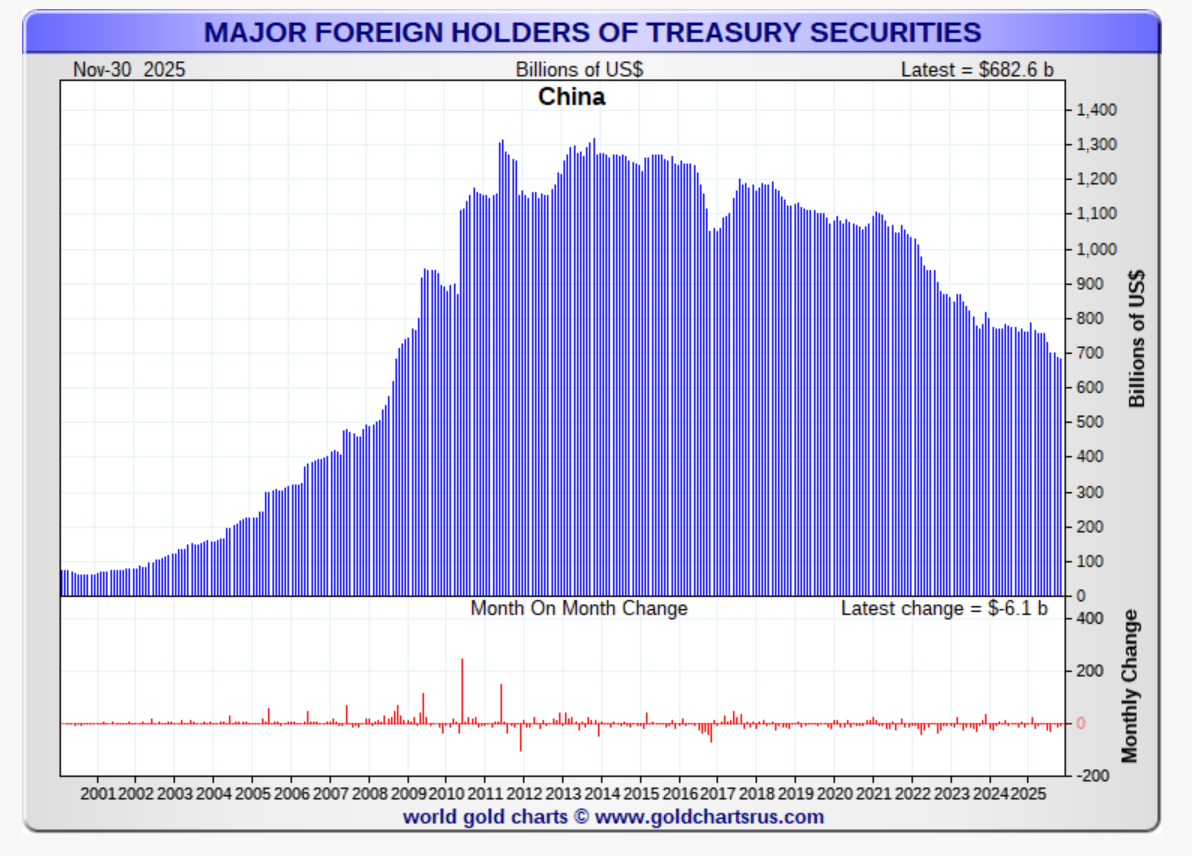
Chinese regulators have advised financial institutions to curb holdings of U.S. Treasuries due to concern over concentration risk and market volatility. Officials urged banks to limit purchases of U.S. government bonds and instructed those with high exposure to pare down positions, though the advisory does not apply to state holdings, Bloomberg reported.
China isn’t just stopping Treasury purchases. They’re telling their banks to reduce what they already hold. That’s a different move entirely.
The boring answer is diversification — managing concentration risk across Chinese banks. But the real answer runs much deeper. China has been quietly settling trade outside the dollar for years. That move alone drives dollar demand way down. And frankly, if I were them, I’d want no part in financing American deficits so the US can continue living beyond its means.
China isn’t just stepping back. It’s canceling the credit card.
The fiscal pressure this creates on the United States is the actual story here. For decades, foreign demand for Treasuries kept US borrowing costs artificially low. That benefit is quietly being withdrawn. You are not borrowing money from mom and dad anymore. It’s coming from a bank with interest.
Gold. Renminbi energy settlement. SWIFT workarounds. Every piece fits. This isn’t isolated news. It’s the same story, one chapter further.
And Trump isn’t helping.
Trump's unpredictable approach to trade and diplomacy, his attacks on the Federal Reserve and huge increases in public spending has left market participants questioning the haven status of U.S. debt.
The global monetary system as we’ve known it is over. It just hasn’t made the front page yet.
What to watch: Gold. As banks sell UST’s and buy gold, up is the only way gold can continue to move.
The Chinese Factory That Opened in the U.S. and Clobbered Its Rivals
The Chinese Factory That Opened in the U.S. and Clobbered Its Rivals —WSJ
Since the beginning of Donald Trump’s presidency, one promise was clear: invest in the US and you won’t pay tariffs. A Chinese company took him up on that offer. It’s crushing American morale.
Ohio’s governor, along with state and federal lawmakers, welcomed Fuyao when the Chinese glassmaking giant took over a closed General Motors factory a decade ago. The project, supported by Ohio taxpayers, was hailed as a step toward reviving a battered Rust Belt region. Now, many feel duped.
Competition from Fuyao Glass America is threatening 250 jobs at a rival plant that has operated since the 1950s. Vitro, which owns the longtime Crestline, Ohio, facility, spent the past year debating whether to shut down entirely. Since 2019, Vitro has closed three other auto-glass plants across Pennsylvania, Michigan, and Indiana. The company attributes its decisions largely to Chinese competition.
Are the Chinese cheating or simply outworking us? Probably a little of both.
The U.S. alleges that Fuyao and its affiliates created a pipeline to import workers, housing them in family-style hotels and transporting them directly to the facility. Some employees told law enforcement they were trafficked across the US-Mexico border. Nearly all of Fuyao’s employees had documentation showing legal work authorization — but many workers from named supplier companies didn’t show up the day of the raid, and none of the absentees had legal permission to work in the US.
The Chinese bend the rules. But they don’t break them. And more importantly, they don’t complain about what it takes to win.
As Jeff Bezos once said, “Your margin is my opportunity.” China has turned that into a national strategy. From auto glass in Ohio to copper refining, to EVs, to all critical minerals. Every industry, same playbook.
Which brings us to the real question: Is the enemy China, or American comfort?
Chinese workers are living in cheap hotels and grinding on H-1B visas. Meanwhile, the American response to tariffs is a Twitter thread written like a PhD dissertation. These two approaches to competition do not produce the same outcome.
China doesn’t win because it cheats. China wins because it doesn’t care about the things Americans refuse to give up. Comfort. Convenience. Social media posts faking happiness. The Chinese are playing a different game entirely, and now it’s being played in our backyard.
Rumors are swirling that Trump may allow Chinese EVs into the US market as long as they’re manufactured domestically. If that happens, Elon Musk’s EV monopoly is finished. Chinese EVs offer twice the quality at half the price. Tesla doesn’t win that fight.
It doesn’t matter what industry China enters. They find a way to win. Trump says he’ll welcome them with open arms, but it’s tough to welcome the champion into your house and expect to win.
What to watch: Trump and Xi were rumored to meet in April. Don’t count on it. China is not playing for Team America, and they haven’t been for decades. We all know China is helping Iran, whether they admit it or not.
Something Big is Happening
Something Big is Happening by Matt Shumer on X
In early February, CEO and cofounder of Otherside AI, Matt Shumer, posted an X article about the rapid pace of AI progress and the potential disruption it poses.
If you were paying close attention, you might have noticed a few people talking about a virus spreading overseas. But most of us weren’t paying close attention. The stock market was doing great, your kids were in school, you were going to restaurants and shaking hands and planning trips. If someone told you they were stockpiling toilet paper you would have thought they’d been spending too much time on a weird corner of the internet. Then, over the course of about three weeks, the entire world changed. Your office closed, your kids came home, and life rearranged itself into something you wouldn’t have believed if you’d described it to yourself a month earlier.
I think we’re in the “this seems overblown” phase of something much, much bigger than Covid.
I’ve spent six years building an AI startup and investing in the space. I live in this world. And I’m writing this for the people in my life who don’t... my family, my friends, the people I care about who keep asking me “so what’s the deal with AI?” and getting an answer that doesn’t do justice to what’s actually happening. I keep giving them the polite version. The cocktail-party version. Because the honest version sounds like I’ve lost my mind. And for a while, I told myself that was a good enough reason to keep what’s truly happening to myself. But the gap between what I’ve been saying and what is actually happening has gotten far too big. The people I care about deserve to hear what is coming, even if it sounds crazy.
I should be clear about something up front: even though I work in AI, I have almost no influence over what’s about to happen, and neither does the vast majority of the industry. The future is being shaped by a remarkably small number of people: a few hundred researchers at a handful of companies... OpenAI, Anthropic, Google DeepMind, and a few others. A single training run, managed by a small team over a few months, can produce an AI system that shifts the entire trajectory of the technology. Most of us who work in AI are building on top of foundations we didn’t lay. We’re watching this unfold the same as you... we just happen to be close enough to feel the ground shake first.
But it’s time now. Not in an “eventually we should talk about this” way. In a “this is happening right now and I need you to understand it” way.
I know this is real because it happened to me first
Here’s the thing nobody outside of tech quite understands yet: the reason so many people in the industry are sounding the alarm right now is because this already happened to us. We’re not making predictions. We’re telling you what already occurred in our own jobs, and warning you that you’re next.
For years, AI had been improving steadily. Big jumps here and there, but each big jump was spaced out enough that you could absorb them as they came. Then in 2025, new techniques for building these models unlocked a much faster pace of progress. And then it got even faster. And then faster again. Each new model wasn’t just better than the last... it was better by a wider margin, and the time between new model releases was shorter. I was using AI more and more, going back and forth with it less and less, watching it handle things I used to think required my expertise.
Then, on February 5th, two major AI labs released new models on the same day: GPT-5.3 Codex from OpenAI, and Opus 4.6 from Anthropic (the makers of Claude, one of the main competitors to ChatGPT). And something clicked. Not like a light switch... more like the moment you realize the water has been rising around you and is now at your chest.
I am no longer needed for the actual technical work of my job.
AI is coming for white-collar jobs. It may not be 100% of them, but it doesn’t have to be. Our system is built on leveraged debt. It only takes 7-8% unemployment, and the systemic debt will do the rest.
The only way the world fights this is with giant injections of US Dollar liquidity. Global policymakers are behind on this trend, which is why you don’t hear more about it. Everything is fine until it isn’t.
What to watch: Gold and Bitcoin. The only way to fix the no jobs situation is a universal basic income, as discussed last month. This will require massive printing. Reshoring supply chains will require massive printing. And now, along with lowering demand due to higher oil prices, low demand = lower tax receipts. Bottom line: they can’t stop printing.
There Can Be Only Two
There Can Be Only Two —Grant Williams
Grant Williams is one of the most articulate writers and presenters in the macroeconomic world right now. He’s one of those guys who makes a very complicated idea simple enough for a second grader to understand. Williams doesn’t put out much free content anymore, so when he does, it’s worth the read.
Americans live for the big moments. From a 4th-quarter drive in a Super Bowl to a bombshell TMZ video that shocks the nation in an afternoon. The attack on our global reserve asset won’t come like that. That’s the problem. It may happen over a weekend, and we won’t even feel it.
We expect currency transitions to behave like revolutions, to arrive clothed in crisis and present themselves clearly as a moment when one world ends and another begins. Instinctively, we look for a collapse large enough to feel definitive. However, even a cursory glance back through monetary history will demonstrate that history has always been entirely unmoved by our narrative preferences.
To understand how we departed from the last global reserve asset, let’s go back to the summer of 1956. Egyptian President Gamal Abdel Nasser nationalized the British and French-owned Suez Canal. The sterling had been the pinnacle of global commerce. The world’s trade, credit, and insurance were all conducted in the pound. Sound familiar?
Beneath the surface, though, after WWII, Britain was far more fragile than it wanted to let on. Sound familiar? The post-war order was more sensitive to US interests, so America did not financially support the conflict. The rift between the two allies was all the opening the Americans needed. The $2.80 exchange rate for the pound sterling, set in 1949, carried enormous significance. After Suez exposed Britain’s fragility, that level could no longer be maintained without American assistance. It was game over for the pound.
No front page headlines. No market crash. Just the quiet loss of trust in a country that had held the global reserve title for over a hundred years. The pound didn’t go to zero. It just wasn’t needed at the adult table anymore.
Global reserve assets don’t end in the news or on financial ledgers. They end in the minds of central bankers. The Suez Canal conflict didn’t kill sterling. It just made the world aware of its fragility.
Dollar dominance has been around for seventy years, and with how the world economy has developed, we have never seen a currency like it. The birth of the petrodollar system in the 1970s, $8 trillion spent in the Middle East on endless wars, and even the Great Financial Crisis have not broken this system. If anything, each crisis made the world more reliant on the dollar.
The dollar didn’t become the world’s reserve currency because it was imposed by decree or demanded through diplomacy. It became central because it offered something the post-war world desperately needed and couldn’t find elsewhere — a combination of liquidity, scale, legal framework and institutional stability that made the dollar not merely desirable, but avoidable to almost no one. In time, that usefulness hardened into habit, and habit into assumption.
Until 2022. The decision to freeze Russian assets after the start of the Ukraine war is the most important headline you’ve never heard of. This forced central banks around the world to wake up. The dollar was no longer an asset of reserve and liquidity. It was actively being used as a weapon.
For the first time since the modern reserve system had been assembled, a major central bank discovered that its reserves were not simply financial instruments subject to market fluctuations, but political assets vulnerable to external control. What had long been assumed to be a country’s ultimate insurance policy against crisis was revealed to be conditional on correct political alignment. The freezing of Russian reserves shattered that perception in a single act.
The large purchases of gold by central banks were not an attack on the dollar system. It was a forced response. Selling US Treasuries and buying gold became a requirement — insurance against the US weaponizing the dollar against anyone who stepped out of line. Vladimir Putin predicted that workaround systems would begin immediately, and a country was taking careful notes.
Buying gold and offloading Treasuries is an insurance policy, not an act of aggression.
China is not attacking the dollar. It’s building a world where the dollar is optional. From the gold imports to the net settlement in renminbi to the SWIFT workarounds, each one alone means nothing. But together, an exit door is quietly under construction.
Advances in technology, payments infrastructure, and bilateral agreements introduced something new into the system: choice. When capital has other places to go, it doesn’t need to flee to express dissatisfaction. It simply drifts away into a friendlier embrace.
All the action is in the Middle East for a reason. For the world to transition to a gold and commodity-based economy, oil is the biggest piece on the board. Since the petrodollar system began 50 years ago, Gulf countries have recycled dollar surpluses into American stock markets. We got cheap oil, they got dollars to invest, and we all got rich.
Gulf sovereign wealth funds are now allocating more capital eastward — not for political reasons, but because growth and demand have shifted in that direction. China is no longer simply a buyer of energy and commodities, but increasingly a long-term commercial and financial counterparty.
The problem is that those dollars are beginning to flow east, and for a good reason. China has posted growth the world has never seen. China invested more money in Saudi Arabia last year than in Iran, yet the headlines focus only on Iran shipping oil to China. China is now the largest financier of green energy projects in the Kingdom.
It’s this burgeoning alliance between China and the Gulf States, built upon shared commercial interests, a natural energy supply and demand dynamic, and an increasingly shared desire for autonomy away from the weaponization of the US dollar, that represents the real shift.
Seventy years after Suez, the US faces a similar weak position, where China waits to secure its dream of a China-based global monetary system.
If we are waiting for the moment to take action, that moment has passed. The question now is whether we wake up before the exit door is fully constructed. We have the fiduciary responsibility that comes with being the global reserve asset. We already got away with being reckless once. It’s time to grow up and act like it.
No financial system lasts forever. The system may not change. But the world does.
What to watch: Gold. Central banks will have to import more as insurance against the dollar, and trade is settled outside of the dollar system.
America Imported a Record Amount Last Year Despite Seismic Trade Policy Changes
America Imported a Record Amount Last Year Despite Seismic Trade Policy Changes -WSJ
Record imports. Record trade deficit. After everything, the tariff talk, the reshoring promises, the critical minerals push. The numbers don't lie.
The nation’s trade deficit—the gap between imports and exports in both goods and services—was $901.5 billion last year, slightly smaller than the $903.5 billion deficit recorded in 2024, the Commerce Department said Thursday. The small change shows America’s role as a heavy net importer remains intact, at least thus far, despite seismic policy shifts during the year.
Overall, imports last year were $4.334 trillion, up about 5% from the prior record of $4.136 trillion in 2024. Exports were $3.432 trillion, up about 6% year over year.
Companies never trusted the tariffs. You don’t front-load imports unless you believe the tariffs will be gone before your company gets hit. Nothing about that is a supply chain adjustment, it’s a bet on inconsistent politics.
Manufacturing is not a light switch. It takes decades. Raw materials, labor force, and infrastructure take time. None of these exist in a four-year cycle of jumping back and forth between two extremist sides. Americans aren’t built to suffer short-term pain for long-term gain. It’s been one year since Trump took office, and people argue over who is to blame for any failure. Failures can date back to multiple presidential administrations.
This is the same story. China built its manufacturing base over 30 years of deliberate, painful, consistent policy. America can't commit to a tariff for 30 months without the Supreme Court intervening or X melting down. China isn't beating us with cheap labor anymore. They're beating us with patience.
What to watch: We will need to rely on South Korea and Japan in the early stages of any reshoring effort. I am long international equities as discussed last month.
U.S. Arms Sale to Taiwan in Limbo Amid Pressure Campaign From China
U.S. Arms Sale to Taiwan in Limbo Amid Pressure Campaign From China —WSJ
The arms sale to Taiwan is in limbo. Not because of Taiwan. Because of us.
A major U.S. arms sales package for Taiwan is in limbo following pressure from Chinese leader Xi Jinping and concerns among some in the Trump administration that greenlighting the weapons deal would derail President Trump’s coming visit to Beijing, according to U.S. officials.
Beijing was already angered over the $11.1 billion in arms sales for Taiwan that the U.S. unveiled in December. U.S. officials had been discussing approving additional sales when Xi pressed Trump about the issue during a February 4th phone call.
America has spent 70 years as the guarantor of global security. The one country you could count on to show up. That reputation is the product. The moment allies question it, the entire architecture begins to crack.
We are negotiating from weakness. We need Chinese critical minerals to build the weapons required to defend Taiwan from China. Read that sentence again. That’s not a foreign policy problem. That’s a supply chain problem that became a national security crisis while nobody was paying attention. The Pentagon has been sounding the alarm for years. We just didn’t listen until the bill came due.
This is the same theme running through every issue this month. Can’t reshore factories. Can’t commit to tariffs. Can’t wean off cheap imports. And now can’t arm an ally without permission from their enemy. China didn’t manufacture this weakness. We did.
Trump's desire for a visit to Beijing outweighs the completed Taiwan arms deal, which isn’t shocking. It’s just the most visible symptom of how deep the dependency runs.
Every Gulf country is pulling out of trillions of dollars of investments in the US because the security guarantees that have been upheld for decades are falling apart. The Middle East will not invest in the US so as not to have the peace it was promised.
Lifestyle
AI is changing the game in nearly every field. We’ve touched on AI taking over white collar jobs multiple times in this newsletter, but last month I found a new use for it nobody is talking about.
Decoding your genome for health risks.
If you’ve ever used 23andMe to decode your ancestry, you can download your raw genome file and have your AI of choice scan it for health risks. Last month we talked about personalized health plans, it doesn’t get more personalized than your own DNA. And it’s free.
My biggest risks based on my genetics:
Heart disease
Type II diabetes
Macular degeneration
Two came as no surprise. Heart disease is the most common killer in America, and my dad’s side is riddled with Type II diabetes. But knowing now means I can start combating both decades before they become a problem.
The macular degeneration came out of left field. I’ve never been big on sunglasses, I believe they interfere with circadian rhythm and reduce your body’s natural resistance to sunburn. But that changes now. Especially in winter when the sun reflects off snow, or any time I’m on the water.
This is another step toward healthcare built around individual needs rather than population averages.
My protocol coming out of this: Omega 3s for heart health, more fish, vegetables, and rice during the week, and a cleaner overall diet. The Type II diabetes markers are manageable — Vitamin D3 and magnesium, both of which I was already taking. Less alcohol is just good advice for anything health-related.
Your DNA has been sitting in that 23andMe file. Might be worth a look.
My Investments:
2026 isn’t slowing down. It was a wild year before the war in Iran started, but that will be the main theme in markets moving forward. I don’t believe it will be over any time soon. US leadership seems to have added a week to the timeline every day that passed, and now it might be September?
Iran isn’t some weak oceanfront country, they are dug in with munitions and supplies to last a long time. Wars are always more complicated than they appear. Second, third, and even fourth-tier impacts are very unpredictable.
Commodities will continue to be the story. We are witnessing a supply-side oil shock greater than COVID. Gulf states are locking down supply, refineries are shutting down, and the Straight of Hormuz is closed.
Iran knows the fragile state the US is in, and if oil hits $200, it leaves the US with some tough choices: save the bond market from default or print ungodly amounts of money to keep $200 oil and insane inflation.
Cash- $10K
My cash position increases a little, and then I have to buy something for the house, or the annual insurance payment comes due again.
Having a lot of cash was easier when I didn’t have a house.
I get my bonus next week, and taxes are still coming around.
I have also begun tracking what I spend every month. When I was just traveling around building wind farms and didn’t have any bills, I didn’t worry about it. Now that has changed. If you can’t spend less than you make, it’s game over.
I am not spending more than I make, but I need to know if there is any waste available to cut, and you can’t manage something you don’t track.
Employer 401k
I went into great depth with this last month, but no change this month. I don’t change the allocation in my 401 (k) very often, maybe once a year.
My stance is still that the US will need our Asian allies to reestablish any supply chains in the US.
I am bullish on international equities. We have seen volatility since the Iran situation, and that will not go away until the war is over.
Bitcoin
No change in my position, and I still have not sold any Bitcoin. Bitcoin is still down about 50% from the highs.
I am keeping a close eye on Bitcoin, as it has outperformed gold since the Iran war began. Bitcoin has traded like a tech stock, but if Bitcoin rises amid WWIII, that could be the moment we have been waiting for.
Either way, the US is going to have to print a lot of money to keep fighting Iran. It’s costing the US $1 billion per day.
Bitcoin is volatile, but the underlying reason I own it is still there. The US will never stop printing money, and that will spread further on the global stage as countries are dragged into the war.
Gold
No change in my position. I am honestly surprised at the poor performance of gold during the Iran situation.
I am looking to add another oz of gold on a price swing down, which we may be coming soon.
Again, countries will print stupid amounts of money for this war, which will help gold. And if Iran can win, I think gold or a gold-backed yuan isn’t too far from becoming a global reserve asset.
All good for gold to rip much higher.
PBF Energy PBF 0.00%↑
If oil is going to hit $200 and oil refineries are shutting down all over the world, I am not upset to own one of the largest petroleum refineries in the US.
The stock has gained a lot of ground in the last week with the war, but is pulling back today. It could still go much higher, as jet fuel and heating oil are also spiking like crazy.
The all-time high for this stock is $62, but if oil hits $200+, I expect it to be broken. Not bad when I got in for about $7/share.
If the US is going to ship the Venezuelan dark, nasty sour oil around the world, the refinery PBF has in Louisiana will be needed to make that happen.
I will be holding this stock until the Iran situation changes, and then potentially be looking to sell. The high hit during this oil crisis is likely to be the high for years to come.
Sirius XM SIRI 0.00%↑
In a chaotic world, it’s nice to own some stocks that have nothing to do with geopolitics. Sirius is one of those stocks.
No matter how many bombs are dropped, trade routes closed, or rumors swirling, XM radio will just keep doing its thing. No involvement in the violence.
This stock seems to have bottomed and will hopefully start making new highs. Sirius advertising dollars are up as it focuses on subscriber and free cash flow growth.
It’s still incredibly cheap, so I hold faith the market will catch up here at some point.
Sirius issued senior notes to refinance some of its 2026-2027 debt.
Alibaba BABA 0.00%↑
No change in the position.
David Tepper sold off his shares of Alibaba, while Cathie Wood loaded up on it.
The company is still performing well, but the stock has struggled after the Pentagon labeled Alibaba an aid to the Chinese military.
Michael Burry said Alibaba needs to be reevaluated along with the other companies on the Hong Kong Exchange. The businesses are doing well, but the stock is not following.
Barron’s also released an article saying that Alibaba has bottomed.
I am not holding my breath until I see the stock actually move.
Nam Tai Properties $NTPIF
Some good news from the Chinese real estate stock.
Nam Tai Property Inc. reported unaudited financial results for the second quarter ended June 30, 2025, on February 11, 2026, showing a sharp rebound in performance. Revenue surged 139.7% year-on-year to $14.2 million, with gross profit up 44.6% and net income from operations swinging to a $0.9 million profit from a $3.6 million loss a year earlier.
The company also booked consolidated net income of $13.7 million in the quarter, compared with a $7.0 million loss in Q2 2024, lifting basic and diluted earnings per share to $0.23 from a $0.12 loss. Its balance sheet as of June 30, 2025, showed total assets of $458.7 million, increased cash and reduced restricted cash versus a year earlier, alongside a higher long-term debt load and a new current portion of amounts due to shareholders, highlighting both strengthened liquidity and ongoing leverage in funding its development pipeline.
Also, the audit is over! The long-awaited audit is now done. Nam Tai engaged MRI Moores Rowland LLP as its independent auditor on March 28, 2025, to audit financial statements covering 2021 through 2024.
Relisting update: The completed audit is the single biggest prerequisite, so they're closer than they've been in years. But the outstanding material weaknesses in internal controls and the lingering IsZo Capital dispute are real obstacles. Realistically, a relisting application is possible in late 2026 at the earliest, assuming internal controls are remediated, and no new governance fires break out. It's a catalyst worth watching, but don't expect a formal announcement soon.
This is more news than we have received in years. 2026 could be a big year for Nam Tai. It makes sense why the stock has been hitting new highs.
Sprott Physical Uranium Trust $SRUUF
No change in the position. Uranium broke above 100.
There is still a shortage of Uranium compared to the demand needed to build out the energy supply around it. This seems to be years out. You also need a lot of critical minerals to extract energy from Uranium, which the US just does not have.
I have held uranium for some time now, and it’s one of those things everyone says is going to “GO NUCLEAR,” but it seems to never really move that much.
I could be wrong, as hard assets gain value in the future. Especially if the world continues to move away from the dollar system.
GameStop GME 0.00%↑
No change in the position. I have contemplated buying more, thinking Ryan Cohen will pull the trigger on an acquisition, which would make GameStop an “instant Berkshire,” per Michael Burry.
After all the anticipation last month of a HUGE acquisition, we are still waiting.
Ryan Cohen did come out and attack “risk-free corporate insiders.”
Cohen wrote on X that American capitalism is rotting from the head down. He called business bosses hollow men of the boardroom who value appearances above accountability.
They are masters of PowerPoint, Cohen wrote. If the stock rises, the Insider gets a huge bonus. Those who cause market collapses are sacked with a tens-million-dollar golden parachute.’
Cohen said current compensation arrangements separate power from culpability. He said bosses gamble with shareholder cash without risking their own money and use experts to avoid blame if schemes fail.
GameStop is apparently considering an acquisition that might change investor opinion.
How do you not trust your money with that guy?
House
The house has been defeating lately. As I travel a lot for work, when I get home, I’m just throwing money and projects on projects.
The closet I shared the video about last month is coming along. The base cupboards are in, and I am working on framing around them. Currently dealing with freezing rain, so cutting wood outside is not very enjoyable.
The furnace is having issues again. The house is warm, but it’s still throwing codes.
Flowers and trees were ordered for spring planting. I spoke with Claude a lot about what plants and trees to plant for wind blocks, birds, and pollinators. Claude really can help with anything. Furnace issues, plants that grow best in your soil conditions, or even estimates of what it will cost to finish your garage based on the dimensions.
The garage's finishing is also being planned.
Bottom line: If you think you have a lot of time and money, buy a house that needs work, and that will change.
Better times are coming, though. Days are getting longer, and Spring is almost here. It’s been a long winter.
That is it for this month.
Thanks for being a part of this!
Casey Donaldson


