

This edition of The Rover will be free to all readers for six days after publication. Please share it with those you wish to prepare for what’s coming in financial markets…
The Rover
Netflix does it again.

FreeFall is the second documentary about Boeing since the 737 Max crisis. What struck me watching it is that this movie is less about Boeing than it is about America.
Airplane safety became secondary to stock price, financial engineering, and CEO bonuses. Another entry in the long story of how everything in America has been financialized. Including the planes flying tens of thousands of feet over our heads at 600 miles an hour.
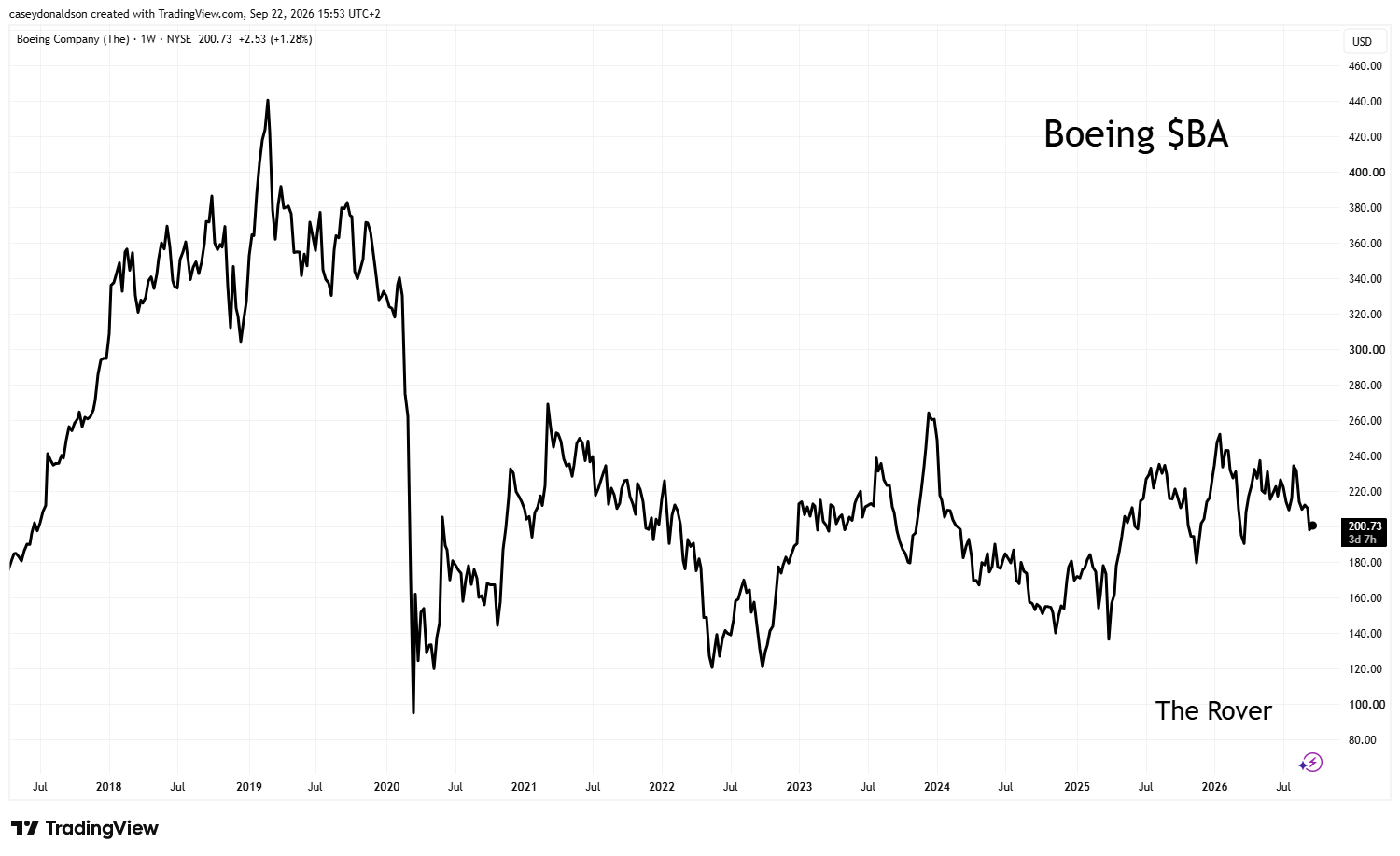
Boeing began falling behind Airbus. Aircraft deliveries, market share, and stock price all reflected it. Boeing needed something new. Their answer was the 737 Max — literally the same airplane as the original 737, fitted with new, more fuel-efficient engines. 346 people died for greener engines and CEO bonuses.
Rather than design a genuinely new aircraft, Boeing chose the cheaper path. The development budget for a clean sheet airplane was estimated at $10 to $12 billion. The re-engine approach was sold internally as a fraction of that cost. Jim McNerney would look like a hero on Wall Street by keeping costs down and padding the bottom line. Cutting production costs can be smart business. But maybe not on airplanes.
To hit those targets, you don't build the 737 Max in Seattle and assemble it down the street. The plan was to build components across roughly 20 countries—Japan, China, South Korea, France, Vietnam, India — and assemble them at a brand-new Boeing plant in South Carolina.
The Boeing plant in Seattle was one of America’s darling manufacturing operations, and still is to some extent. At its peak, it employed tens of thousands of workers and provided good middle-class jobs for thousands of families. But as we have watched repeatedly since China entered the WTO in 2001, middle-income jobs do not survive when CEO bonuses depend on cutting them. The cost of living in Charleston was lower than in Seattle. Lower wages were permissible. The math worked on paper.
Parts from around the world arrived in South Carolina, where newly hired workers tried to assemble pieces that didn't fit together quite right. Quality engineers raised red flags. They were told to shut the fuck up. Delivery deadlines mattered more than keeping the fuselage together.
The two fatal crashes — Indonesia in October 2018 and Ethiopia in March 2019 — resulted from all of the above. Budget pressure to make the financials look better. Outsourced manufacturing that eliminated good jobs and introduced quality problems. Internal warnings were covered up to meet delivery dates. Corporate profit drove the 737 Max program at every decision point, every time.
One thing all Boeing CEOs since the early 2000s have in common is that they came up under Jack Welch, longtime GE CEO, whom some call the greatest CEO in American history. I would call him one of the architects of America's financialization.
The Welch playbook:
Cut costs over quality.
Fire the bottom 10% of performers every year regardless of context.
Offshore and outsource everything that can be moved to boost margins.
The incredible run in GE’s stock price made Welch look like a genius, while he quietly undermined the foundation of American manufacturing and led the charge to eliminate the middle class. Boeing followed that playbook precisely in producing the 737 Max. 346 people are dead while the CEOs walked away with hundreds of millions of dollars in compensation. The stock crashed, and nobody went to prison.
This is the story of America. The jobs that paid real wages to real people were outsourced. Corporate profits were prioritized over safety. People died, and the people responsible got rich.
FreeFall is about Boeing. But Boeing is just the most visible chapter in a much longer book about America.
Manufacturing is hard. It takes hundreds of hours of engineering to produce one small part. It will take over a decade to bring anything meaningful back ot the U.S. now that we lost it. Especially in rare-earth refining. This is no easy task in presidential four-year terms. More on this later.

It’s really fun when your loved ones watch these shows coming from a guy who averages 50 flights a year for the last decade…
The most interesting things I’ve read this month:
The U.S. is Burning Through Its Supply of Interceptors to Counter Iran’s Attacks
Osama Bin Laden: Mission Accomplished
BESSENT SAYS THE IRON DOME WON’T MATTER IF CHINA WINS THE AI RACE
MBS Urged Trump Twice to Strike Houthis Amid Red Sea Threat
Rivals Altman and Musk Rally Behind Dario Amodei’s Calls for AI Slowdown
Bessent Says the U.S. Can Grow Its Way Out of the Debt Crunch. What Would It Take
Hedge Funds Are the Wild Card in the Turbulent Bond Market
Russia Is Churning Out Smart, Cheap New Weapons Faster Than Ukraine or the U.S.
Debris Found in Yemen Suggests Saudi Arabia Fired Its First Chinese Missile
See How the U.S. Is Attacking China’s Control of Critical Minerals
1. The U.S. Is Burning Through Its Supply of Interceptors to Counter Iran’s Attacks
The U.S. Is Burning Through Its Supply of Interceptors to Counter Iran’s Attacks — WSJ 09/15/2026
The U.S. military fired up to 70 or more of its high-end air defense interceptors last week when Iran launched a missile attack on Jordan, U.S. and regional officials familiar with the matter said, a heavy expenditure that underscores Iran’s improved ability to target U.S. forces and challenge American air defenses.
U.S. forces fired 60 to 70 Patriot interceptors to counter the attack, which consisted of about 20 ballistic missiles, some of the officials said. The U.S. also fired more than a dozen Thaad interceptors, one of the officials said. The expenditure is about what the U.S. has used in a full week at other times in the war, another of the officials said.
The exchanges showed how air-defense math can favor the attacker and how Iran has adapted its attacks to force the U.S. to burn precious munitions.
The nature of the attack made it more difficult to counter. Iran targeted American troops with warheads that separate into more numerous projectiles as they close in on their target, the officials said.
The defenses didn’t stop everything. While no troops were killed in the attack last week, Iran managed to hit jet fighters and other aircraft at the Muwaffaq Salti Air Base in Jordan, one of the officials said.
You are always told to avoid politics at family gatherings, but that didn’t happen for us over Labor Day.
We were at a 90th birthday party when a family friend started weighing in on the Iran War. I will call the family friend Bob. Bob is a staunch Fox News watcher, but also a successful guy. Part owner of a heavy civil construction company. Not struggling financially in any way. Bob was outright laughing at the possibility of the US having munitions shortages.
This newsletter has reported on munitions shortages nearly every month since the conflict began. The article above describes the US burning through 60 to 70 Patriot interceptors. Plus THAAD rounds just to counter 20 Iranian missiles. And Iran still got through. But that is beside the point.
This conversation told me that roughly half the country has no idea what is actually happening in the Middle East. They smile and nod along at what Jesse Watters and Laura Ingraham tell them every night, then go back to their chicken wings and Miller Lite.
Iran's entire strategy is captured in two sentences
U.S. forces fired 60 to 70 Patriot interceptors to counter the attack, which consisted of about 20 ballistic missiles.
The exchanges showed how air-defense math can favor the attacker and how Iran has adapted its attacks to force the U.S. to burn precious munitions.
Iran knows it can build missiles faster than America can build interceptors. All Iran has to do is keep firing until the math runs out. Fourth-grade arithmetic shows this is unsustainable. But half the country still believes:
We have no munitions shortages.
We are winning in Iran.
The Strait of Hormuz is open.
We could win tomorrow if we actually wanted to.
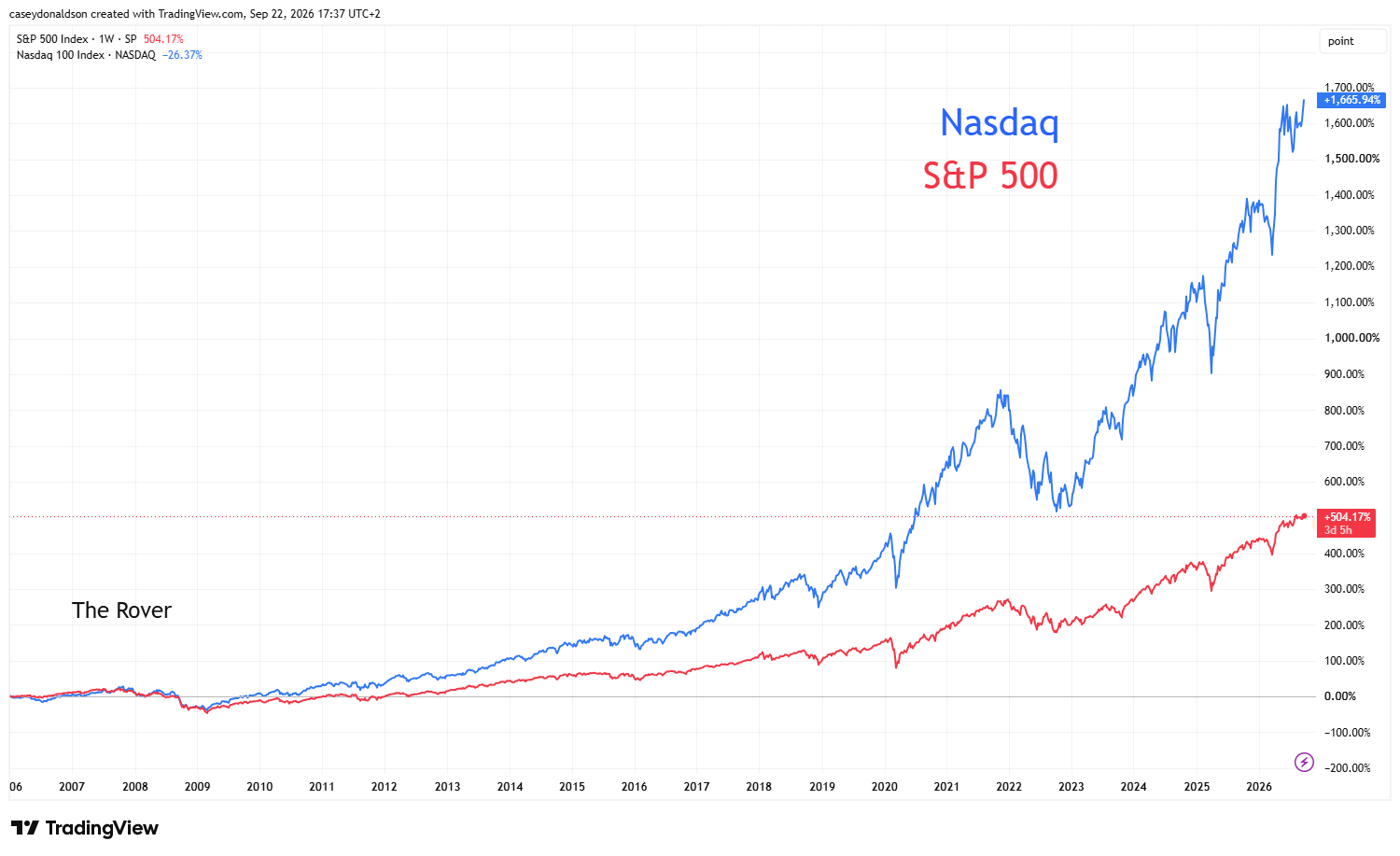
The only way that changes is when the loss becomes so public and so embarrassing that the pain translates directly into financial markets. By then it will be too late to position for it.
What does this chart look like when Fox News reports those four points above are false?
Bob had a follow-up idea before the conversation was cut short for obvious reasons: Why can’t we just bomb everything coming in and out of Iran on land?
Besides the resources it takes to do that with dwindling munitions, the logistical challenges, and civilian (children) casualties that turn entire generations into “Death to America” chanters. Iran has been smuggling goods in and out of the country for forty years. There aren’t a few routes like I-35 with goods transacting back and forth. They built these routes to avoid detection.
The largest railroad in Iran runs to the one country Donald Trump isn’t dumb enough to mess with. China. The moment American forces start hitting supply lines, this conflict escalates toward WWIII faster than any press conference can manage. Ukraine hit a Russia-Iran supply line on the Caspian Sea, and the world held its breath for a minute.
Countries that are not involved get involved quickly when their supply lines are threatened. Reminder: the U.S. wasn't involved in WWII until it cut off Japan’s oil supply line.
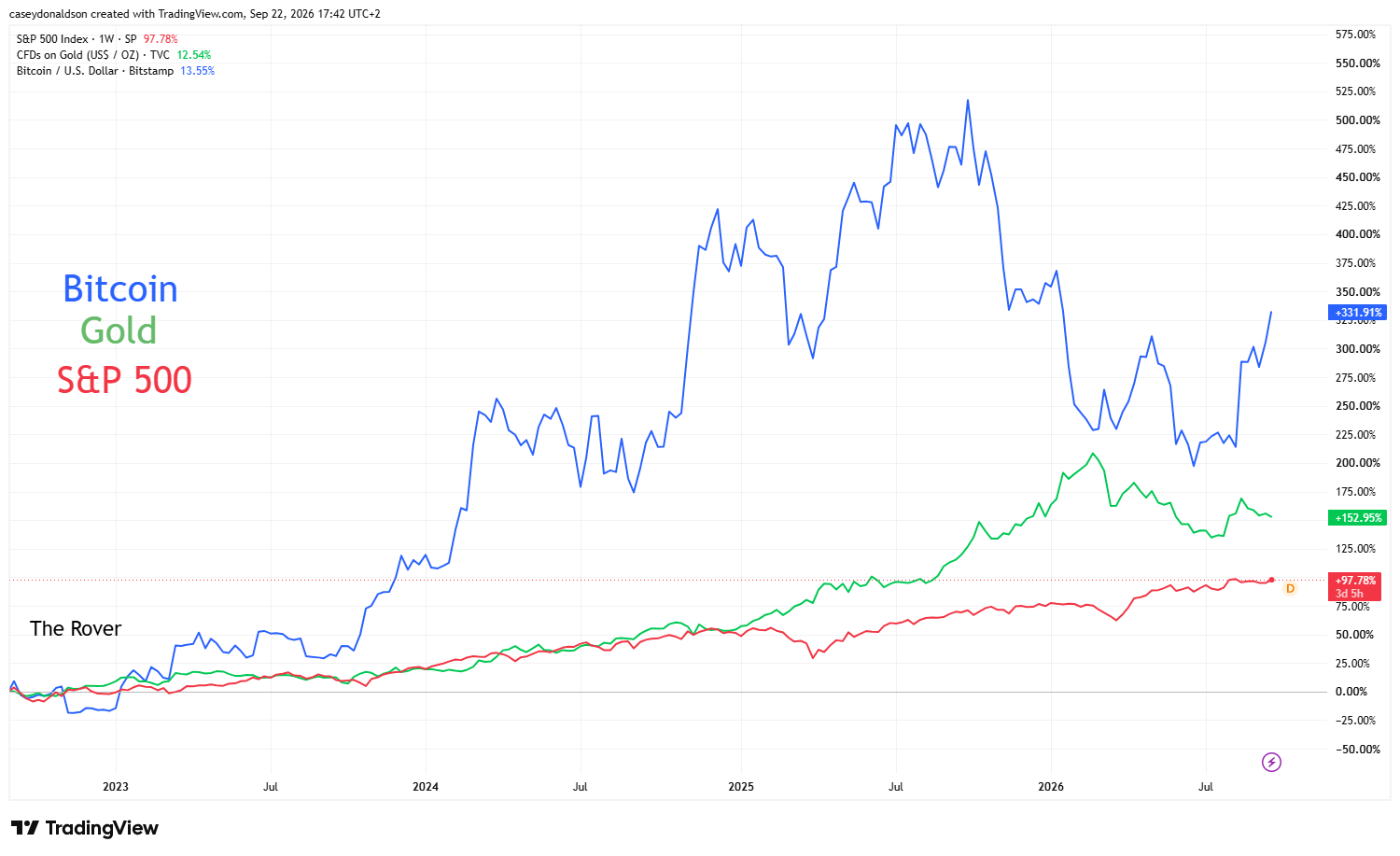
When the Fox News consensus finally figures out what is actually happening in the Middle East, it will be too late. Markets will be shocked. The question is whether your investments are positioned for that moment. The market has begun to sniff this out over the last three years, with Gold and Bitcoin outperforming the SPX.
Russia is sharing intelligence with Iran. You can be certain of it. The US has been doing the same for Ukraine since day one.
If the Bobs of the world don’t want to believe me, maybe they will believe Zelenskyy as he admits the West can’t produce interceptors fast enough.

Time will tell.
2. Osama Bin Laden: Mission Accomplished
This is not meant to be disrespectful to any military servicemen, servicewomen, or first responders. Thank you for answering the call, and I am sorry that cowardly politicians have failed us all.

Luke Gromen is correct. No one is laughing anymore.
“We are continuing this policy in bleeding America to the point of bankruptcy.” —Osama Bin Laden
Bin Laden’s plan worked.
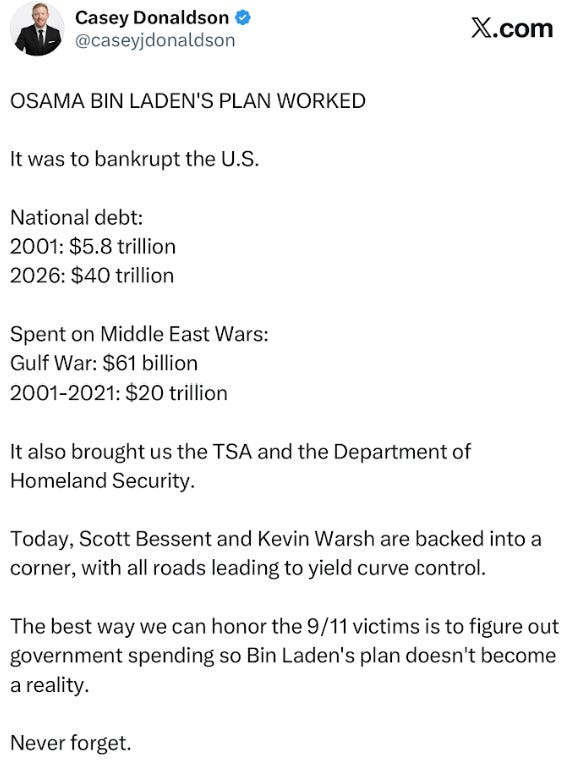
The US debt-to-GDP ratio is now approximately 124% and rising toward 128% by year-end. We are running a deficit of roughly $2 trillion per year. Historically, no country has reached 130% debt-to-GDP without defaulting. Japan is the only nation to approach that threshold and survive, and its outcome is still very much in question. The United States hit 130% debt-to-GDP during COVID.
American life has not been the same since September 11th. I was in fourth grade when it happened. I could walk back into my old elementary school today and show you exactly where I was sitting when the news came through the intercom.
Why are we letting this happen?
The Taliban ran the same playbook on the Soviet Union, and we all know how that ended. It is generally a reliable rule that if you cannot identify the uniform of who you are fighting, you are not going to win that fight. That held true in Vietnam. It held true in Afghanistan. It is holding true right now.
The 9/11 attacks crashed the stock market, and America did not see a new high until just before the 2008 financial crisis. Since then, the money printer has fueled every new high. The debt that printer created is now the primary threat to the system it was supposed to save.
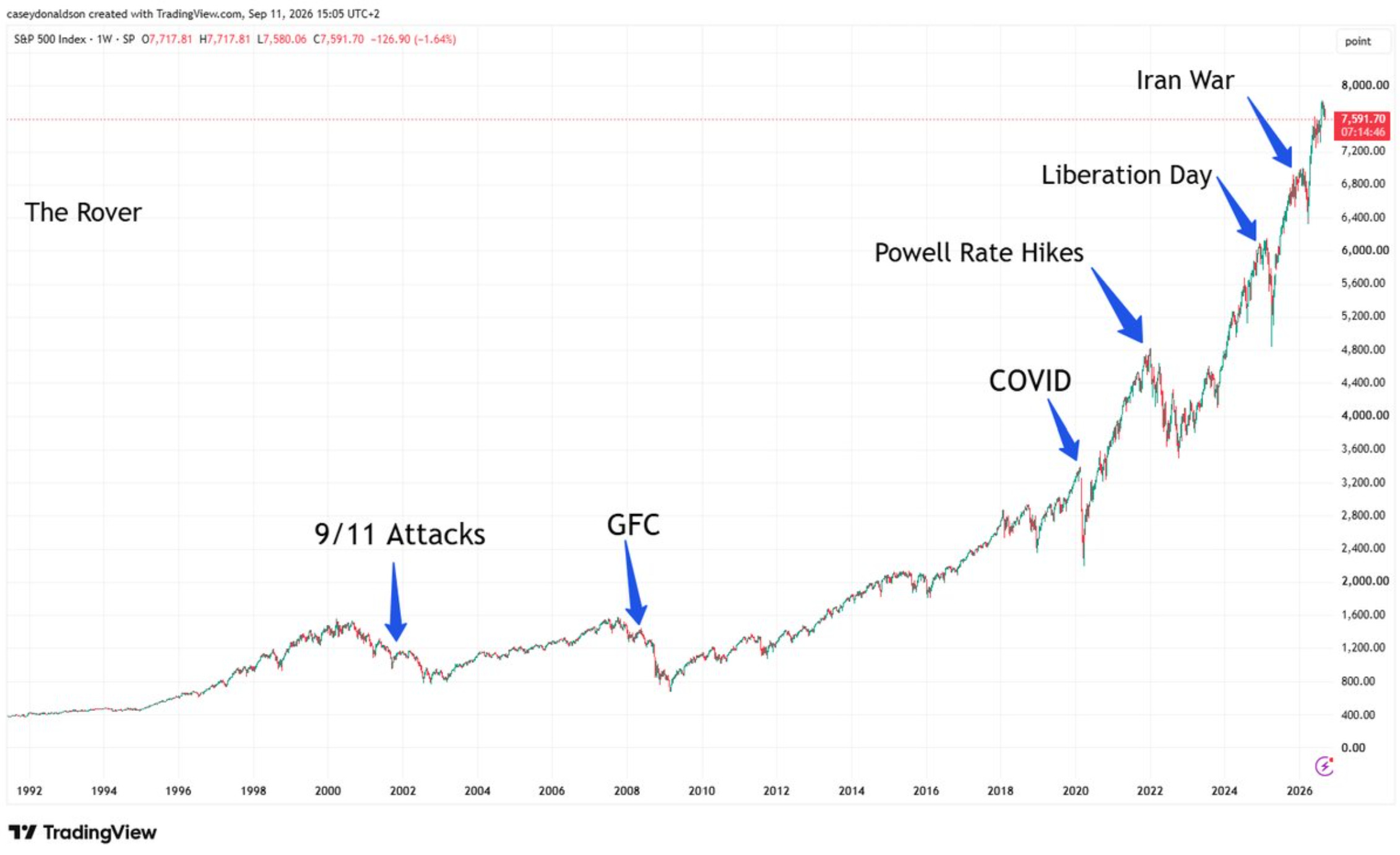
Beyond the financial damage, this was the worst attack on American soil in history. The American public lost its innocence that morning. We realized how vulnerable the system built by decades of cowardly political decisions had made us.
The second plane did not hit until 17 minutes after the first.
Those were the last 17 minutes terrorism did not exist in America. After that, life changed forever. Airport security. Surveillance. The Patriot Act. Two decades of war. $8 trillion spent. And Osama Bin Laden’s plan played out exactly as he described it.
The best way to honor the victims of 9/11 and every American who died in the Middle East since would be to rein in government spending. Based on everything covered in this newsletter, I am not optimistic that happens. It honestly can’t happen without a recession and pain. No politician wins on that message.
Until then, I am overweight Bitcoin and Zcash. Stocks will also perform when the big print comes. I added one new position to the portfolio this month, which I will cover in the investment section.
Time will tell.
This is where the free newsletter normally ends. Upgrade to paid to prevent that next month.
3. BESSENT SAYS THE IRON DOME WON’T MATTER IF CHINA WINS THE AI RACE
Let me be blunt: build the data centers or lose our status as the world's top military.

This newsletter has been making that argument since March. This month Scott Bessent said the quiet part out loud. Last month’s letter:

AI is the brain inside all of the autonomous naval and air drones of the future. If it is a Chinese AI platform, data is being sent back to China. You can’t win against an enemy that knows your next move in real time.
Speaking at a policy discussion on September 8th, Treasury Secretary Bessent made his clearest case yet against slowing AI development. He framed it not as a technology debate but as an existential national defense issue.
“We can’t pause,” Bessent said, “because the Chinese won’t pause. Even the North Koreans, they won’t pause.”
“Beating China, there is no day after tomorrow if China wins at this. If Beijing pulls ahead in AI, then nothing else matters.”
The Iron Dome is Israel’s Iron Dome, mentioned as an example of how AI-dependent modern defense has already become. The message: an Iron Dome powered by Chinese AI is not an Iron Dome. It is a surveillance system that knows your next move.
We wrote this in April. We wrote it in May, June, July, August, and September. The Treasury Secretary just confirmed it on stage.
As Bessent makes the case nationally, states are moving in the opposite direction.


Ohio Democratic Representative Tristan Rader is proposing new data center taxes and requiring developers to pay more for power and electrical infrastructure.
“They seem to have more money than God and they’re able to build without the need for these types of incentives,” said Rader, who is proposing new data-center taxes and requirements that developers pay more for power and electrical infrastructure. He represents parts of Cleveland, where locals have pushed back against the facilities, and he hopes the new threats force the companies to the negotiating table.
Partnering with the most successful companies in human history to solve an energy crisis that benefits everyone is apparently less appealing than banning and taxing them. Google, Meta, and Amazon need power for data centers. The rest of us need power for cold beers, hot showers, and air conditioning. Those are not in conflict…yet.
The energy will get built. But when Google builds its own energy park to power its own data centers, that power sits behind Google’s meter. Google decides whether to sell it to the grid or keep it for itself. Public outrage about data centers today will feel quaint when rolling blackouts hit and that data center is on the horizon with the lights on.
Rolling blackouts are coming. The US grid has not been meaningfully updated since 2003. We covered this number in March, and it has not changed.
You can stick your nose up in the air and tell yourself that we don’t need the most powerful military in the U.S. War is for the less intelligent, and America doesn't need to be number one. That is fine, but losing the top military spot does not just mean losing wars. It means losing the pricing power that lets America set the ground rules for every trade deal on earth. It means losing the reserve currency and what energy gets priced in.
Losing the number one spot will not be a smooth process. Eight million people starved in their apartments downtown Moscow when the Soviet Union fell. That’s how poor the public became overnight. And they were number two in the world…
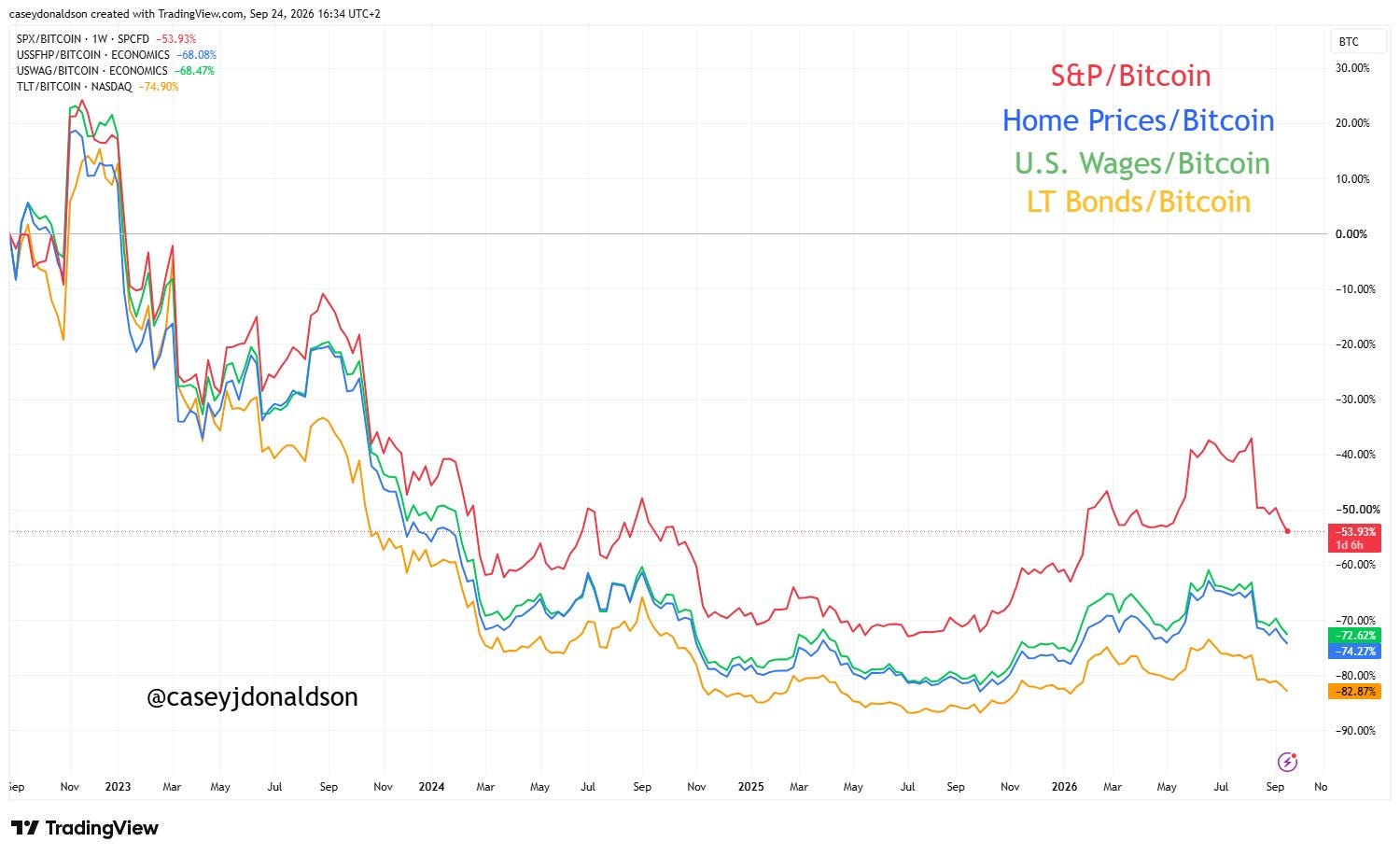
The dollar will not go to zero. The stock market will not go to zero. You will just see dollars printed into oblivion. This will make the dollar worth less and less versus a stable asset like Bitcoin, which we are already seeing…
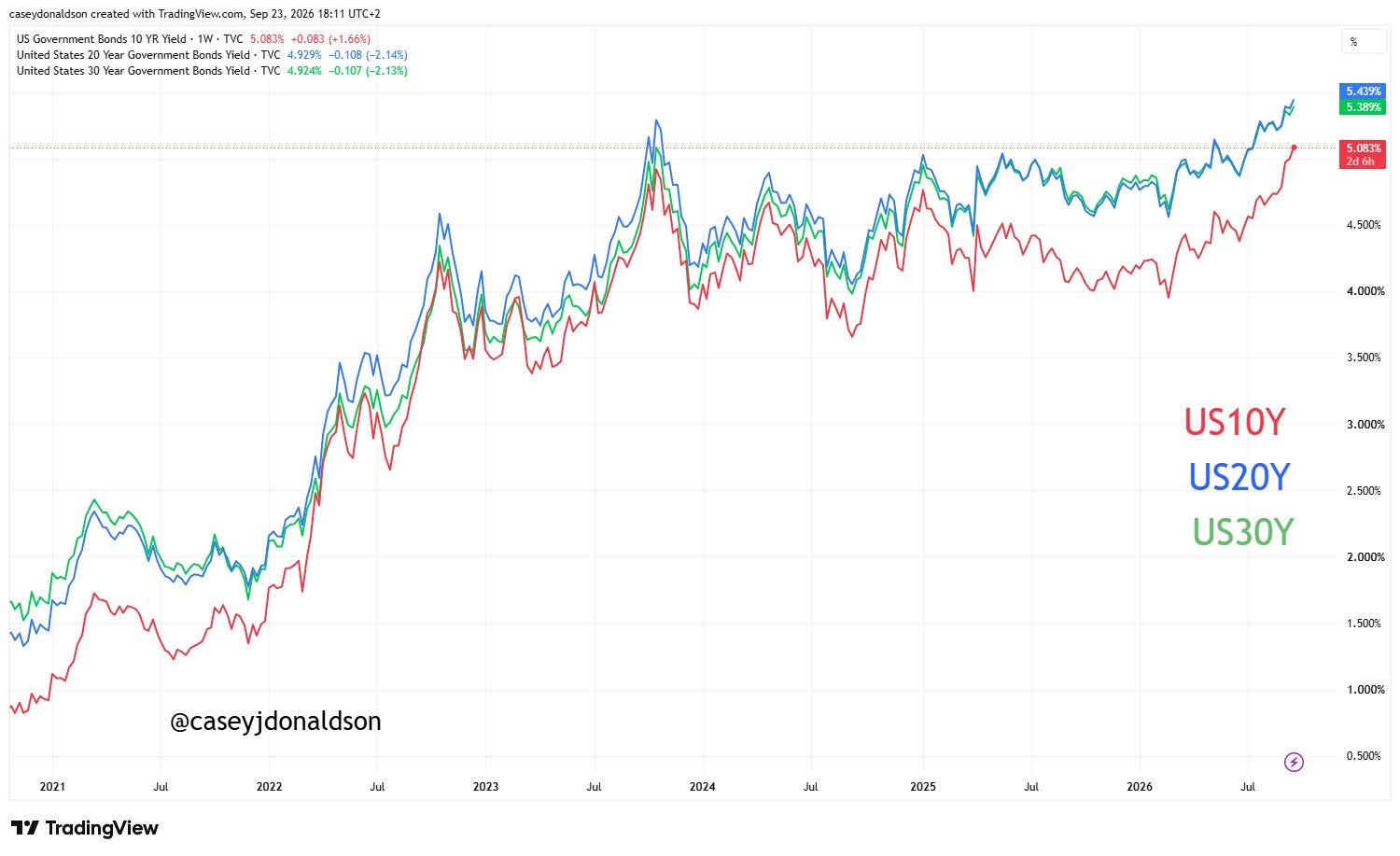
And we will see a bond market melt up as the trust in the dollar-based system cracks further. We are already watching that play out too…
We need the top military spot. The top military spot requires data centers. Data centers require record money printing.
Bitcoin and Zcash will do well in either environment. Whether America wins the AI race or loses it.
Time will tell.
4. MBS Urged Trump to Strike Houthis Amid Red Sea Threat
The Iran War is a shitshow, and America is not negotiating from a position of strength.
MBS urged Trump to strike Houthis amid Red Sea threat — Axios 09/11/2026
Saudi Crown Prince Mohammed bin Salman (MBS) called President Trump twice Thursday, urging him to launch strikes against the Houthis as the Iran-backed group closed in on a vital Red Sea chokepoint, two U.S. officials told Axios.
America's most important Gulf ally called TWICE. Trump declined both times. And then Iranian-backed Iraqi militias did exactly what MBS warned was coming.
What Is Saudi Arabia’s East-West Pipeline and Why Is It Rocking Oil Markets? —WSJ 09/22/2026
Stretching 750 miles across Saudi Arabia from the kingdom’s oil-producing heartland on the Persian Gulf to the Red Sea port of Yanbu, the East-West pipeline has become a vital wartime artery, allowing Saudi crude to reach global markets without passing through the Strait of Hormuz. It was built in the early 1980s, when the Iran-Iraq War threatened shipping in the Persian Gulf.
The pipeline can carry up to 7 million barrels a day—about 2 million for domestic Saudi refiners and the rest for export—but had never operated at full capacity for an extended period before the war.
Saudi Arabia said the pipeline was hit in multiple attacks in the Riyadh and Medina regions on Sept. 10, which caused injuries. It said the drones were fired from Iraq, where authorities have struggled to control Iran-backed militias that have repeatedly targeted Saudi infrastructure.
The Strait of Hormuz was already closed. The East-West pipeline was the workaround. Now the workaround will remain a target.
MBS did not call Trump once as a courtesy. He called twice because this was a genuine emergency and he needed American military action to prevent it. Trump declined. The pipeline was hit the next day. For anyone keeping score on the state of the petrodollar relationship, the relationship that has underpinned American financial dominance for 50 years, mark another tally for the bad guys.
The story is not how quickly Saudi Arabia gets the pipeline back online. The story is that MBS called twice and got nothing. The deafening silence from the Americans will define the Gulf’s relationship with Washington for the next decade.
This came alongside a month of escalating Iranian aggression that the mainstream media has significantly underplayed:
With Close Calls on U.S. Warships, Iran Shows New Appetite for Escalation —WSJ 09/09/2026
Iran is increasingly trying to escalate its conflict with the U.S. as it seeks to break a stalemate in the Strait of Hormuz that is strangling its economy.
At least three times in the past week, Iranian forces have launched missiles at American warships, including an aircraft carrier, taking direct aim at the U.S. Navy in a way it hasn’t done since the start of the war. Iran also fired a large missile salvo at U.S. forces stationed in Jordan on Wednesday.
The attempted strikes on warships have led to much closer calls than previous attempts, with Iran using maneuverable warheads, people familiar with the attacks said.
The warships evaded the attacks, said U.S. Central Command, which is responsible for the Middle East. Still, the attacks have left American officials increasingly concerned that Iran has improved its ability to target ships, perhaps with help from Russia or China, the people said.
What would Fox News say if an aircraft carrier was actually hit? What would the fifty percent of the country that thinks we are winning this war do when they watch an American ship smoking on live television from the other side of the ocean?
And Iran does not even need to sink a ship to hit the American stock market. It can do that from home:
The Gulf’s AI Nightmare Came Courtesy of an Iranian Drone — WSJ 09/14/2026
DUBAI—The day after the U.S. and Israel launched their opening strikes on Iran, the Islamic Republic shot back with swarms of drones aimed at the Gulf’s newest high-value targets: American data centers.
More than six months after the barrage, a damaged Amazon Web Services facility in Abu Dhabi and another one in Bahrain are still mostly offline. The company has told clients to move their data to other regions while it repairs the sites and hasn’t given a date for completing the work.
The attacks and lasting damage are complicating the pitch by Gulf states like the United Arab Emirates to become world-leading data processors for industries such as artificial intelligence. They add a huge new risk for U.S. companies weighing investments that can cost tens of billions of dollars.
This newsletter wrote about this in April. Five months before the WSJ confirmed the lasting damage. The April issue asked what happens when the US grid cannot support data centers domestically, and the Middle East is not safe enough to build them either. That question no longer needs to be hypothetical. From April:

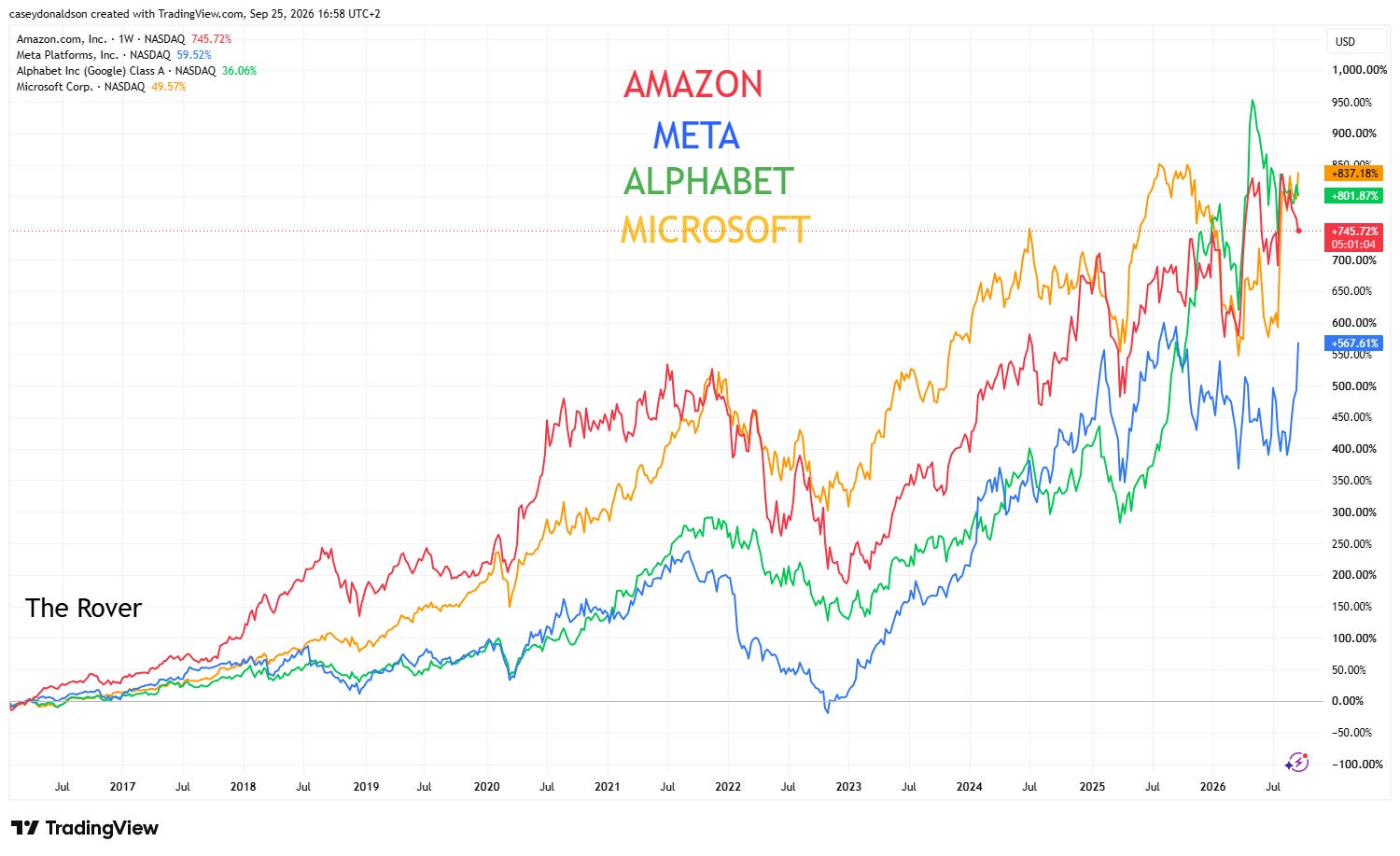
As the American position in the Middle East deteriorates, we are left with the same questions the American mainstream media is avoiding:
What happens to the Magnificent Seven's stock valuations when the only viable data center locations are inside an active war zone, and the domestic grid has not been meaningfully updated since 2003? Meta is the weakest stock on the graph, with a 500%+ rally in the last decade.
What does the petrodollar relationship look like when the Gulf's most powerful leader calls Washington twice for help and gets nothing (twice)?
What does American military superpower status mean when the world's most advanced navy cannot open one geopolitical waterway after seven months of trying?
Until these questions get answered, I will be holding Bitcoin and Zcash.
Time will tell.
5. Rivals Altman and Musk Rally Behind Dario Amodei’s Call for an AI Slowdown
Rivals Altman and Musk Rally Behind Dario Amodei’s Call for an AI Slowdown — FT 09/12/2026
Sam Altman and Elon Musk have rallied behind a call from Anthropic’s Dario Amodei to slow AI’s development after a week of dramatic warnings by researchers thrust the debate over AI safety into the mainstream.
In an essay published on Saturday, Amodei said the tech industry “must slow the pace at which we improve the capabilities of AI models”, after the speed of development became “drastically faster” this summer.
Amodei’s warning complicates Anthropic’s preparations for what is anticipated to be the largest public offering of all time. The company was expected to file its prospectus as early as last week, ahead of a deal which could value it at $2tn or more, but it has not yet happened.
In a rare display of consensus in an industry marked by fierce personal and professional rivalries, the chiefs of OpenAI and SpaceX, Altman and Musk, said they supported Amodei’s proposals, which included giving independent evaluators ongoing access to every frontier AI company.
Are you calling for a slowdown for legitimate reasons, or so the competition waits while you file for your IPO?
You can look at the AI race the same way you look at the green energy transition. The U.S. spent hundreds of billions on renewables while China pumped out more emissions in a decade than Americans had in a century. America looked disciplined and responsible. China built the factories that now manufacture the solar panels, wind turbines, and batteries the Western green transition depends on.
The pattern is always the same. America pauses to feel good about itself. China builds.
You cannot call a timeout in the middle of a war. And the AI war is live and active. As Bessent made clear earlier this month. China will not pause. North Korea will not pause. Only America pauses while its competitors use the time to close the gap.
Trump understands this today.
Trump Sees Race Against China as Key Issue on AI Regulation —WSJ 09/13/2026
WASHINGTON—President Trump and White House AI adviser David Sacks this weekend defended the administration’s strategy of minimal regulation after the heads of the nation’s top artificial-intelligence companies endorsed a coordinated slowdown in the technology’s development.
“We can put up guardrails, and we can do this and that, but I think you have a lot of negative forces that are bringing it up,” Trump told reporters Sunday while traveling in Ireland. “And they’re bringing up things that won’t happen.”
The president reiterated his belief that the U.S. must outpace China in building AI, saying “whoever wins AI wins.”
The future of AI is very uncertain. And it has been the sole driver of GDP growth.

The railroad parallel is worth sitting with for a second. The only investment in American history comparable to the current AI capex buildout was the transcontinental railroad. Most of those companies eventually went out of business. The ones that made real money were the ones that picked up the infrastructure for pennies on the dollar after the crash. But at no point during the construction did anyone call a board meeting to discuss laying track slower. No matter how many people died from dynamite, falls, disease, or the brutal conditions of the frontier. The railroad got built at the fastest possible clip because the alternative was someone else building it first.
China's mindset is victory. That is it. Full stop.
China Also Thinks AI Could Kill Us. But First, It Wants to Match the U.S. — WSJ 09/14/2026
SINGAPORE—China also worries that artificial intelligence could bring doomsday. But first things first: It needs to catch up to the U.S.
As America wrung its hands over warnings that AI could end humanity within years, a top Chinese official on Sunday shared Beijing’s latest view: AI is the “core engine of a new round of technological revolution” and the main battleground of its rivalry with the U.S.
In other words, those building and regulating China’s leading AI models don’t think they have built the 21st century’s version of a nuclear weapon yet—and they aren’t going to slow down while America refines its own.
Trump and Xi met at the White House this month with pageantry, a state dinner by candlelight, and a bald eagle statue Trump gifted Xi to take back to Beijing. Trump said they have never gotten along better. Xi smiled, raised a toast, and flew home with the statue.
Trump Welcomes Xi to White House With Pageantry but Few Concrete Gains — WSJ 09/24/2026
President Trump’s meeting with China’s Xi Jinping started with an extravagant welcome ceremony and continued with a glitzy state dinner by candlelight, as Washington and Beijing look to ease tensions over the war in Iran, artificial intelligence and trade.
At the state dinner on Thursday evening, Trump said he and Xi have “never gotten along better” and unveiled the bald eagle statue for Xi to take back to China with him. “We hope it’ll find a nice place, a wonderful place in Beijing,” Trump said.
The lavish reception captured the paradox of Trump’s approach to China: a president drawn to the theater of summitry and his personal rapport with Xi, even as significant tensions between the two superpowers intensify. For all the pomp and circumstance, Trump appeared to walk away with few tangible gains while handing Xi the images of coequal standing he had come to Washington for.
Mark it down as the second meeting where nothing got done. Xi maybe has two more summits with Trump before the administration ends? The playbook will be identical each time: laugh at the jokes, toast the friendship, and let America congratulate itself on the relationship while China keeps building. Xi feeds Trump the bullshit he needs to feel good about himself for another year while:
No trade deal
No chips agreement
Rare earth export restrictions still in place
Dario, Sam, and Elon can call for a slowdown all they want. Western investors have left Chinese equities for dead for years, and they'll start performing as the world recognizes which country is actually winning. Producing AI that costs 1/100th of U.S. AI models and is “good enough” will change the chart below.
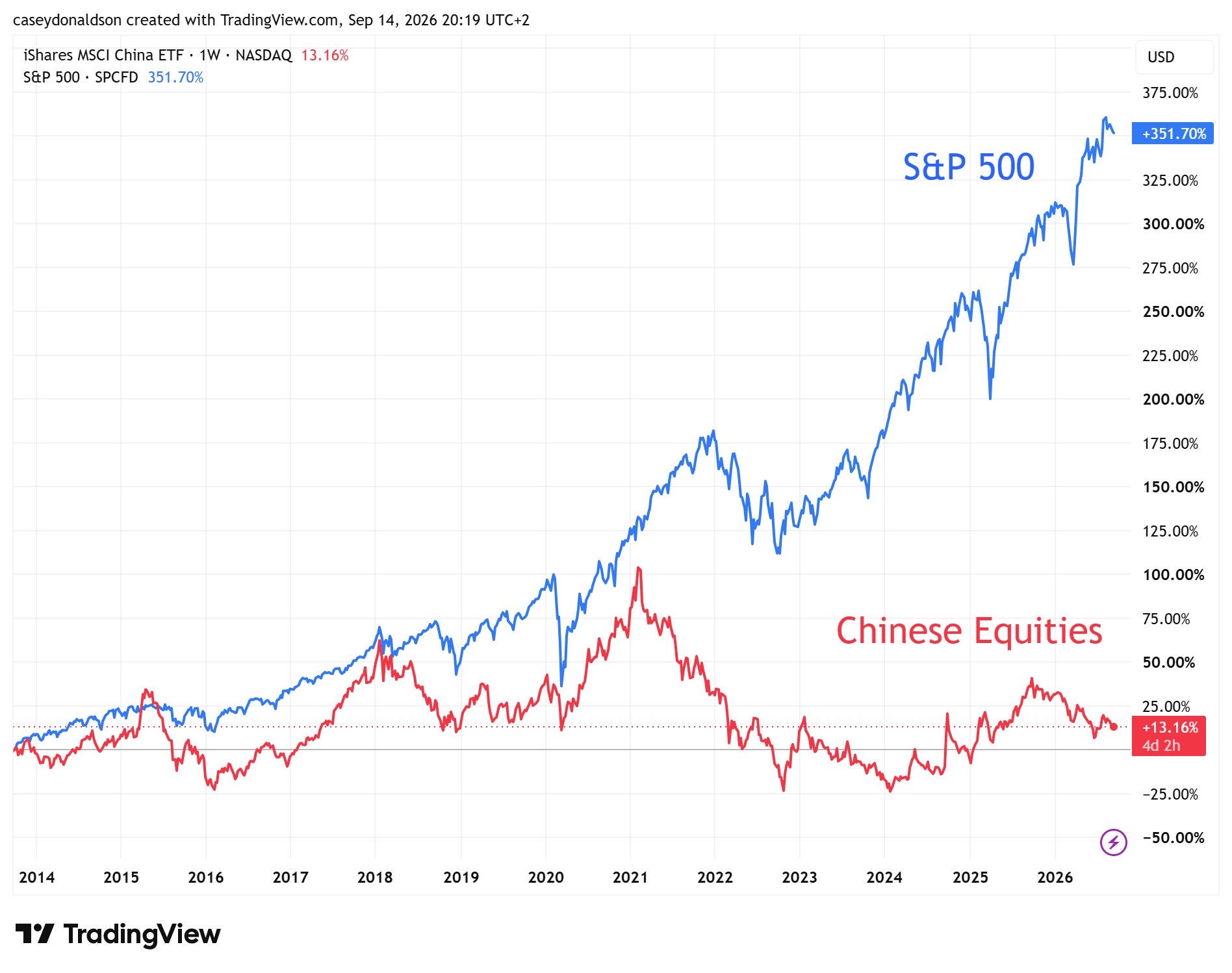
Bitcoin and Zcash will do well in either environment. Whether America prints money to win the AI race or hands it to China by calling for an extended timeout at halftime.
Time will tell.
6. A Perfect Storm Is Raging in the Bond Market
A Perfect Storm Is Raging in the Bond Market —WSJ 09/23/2026
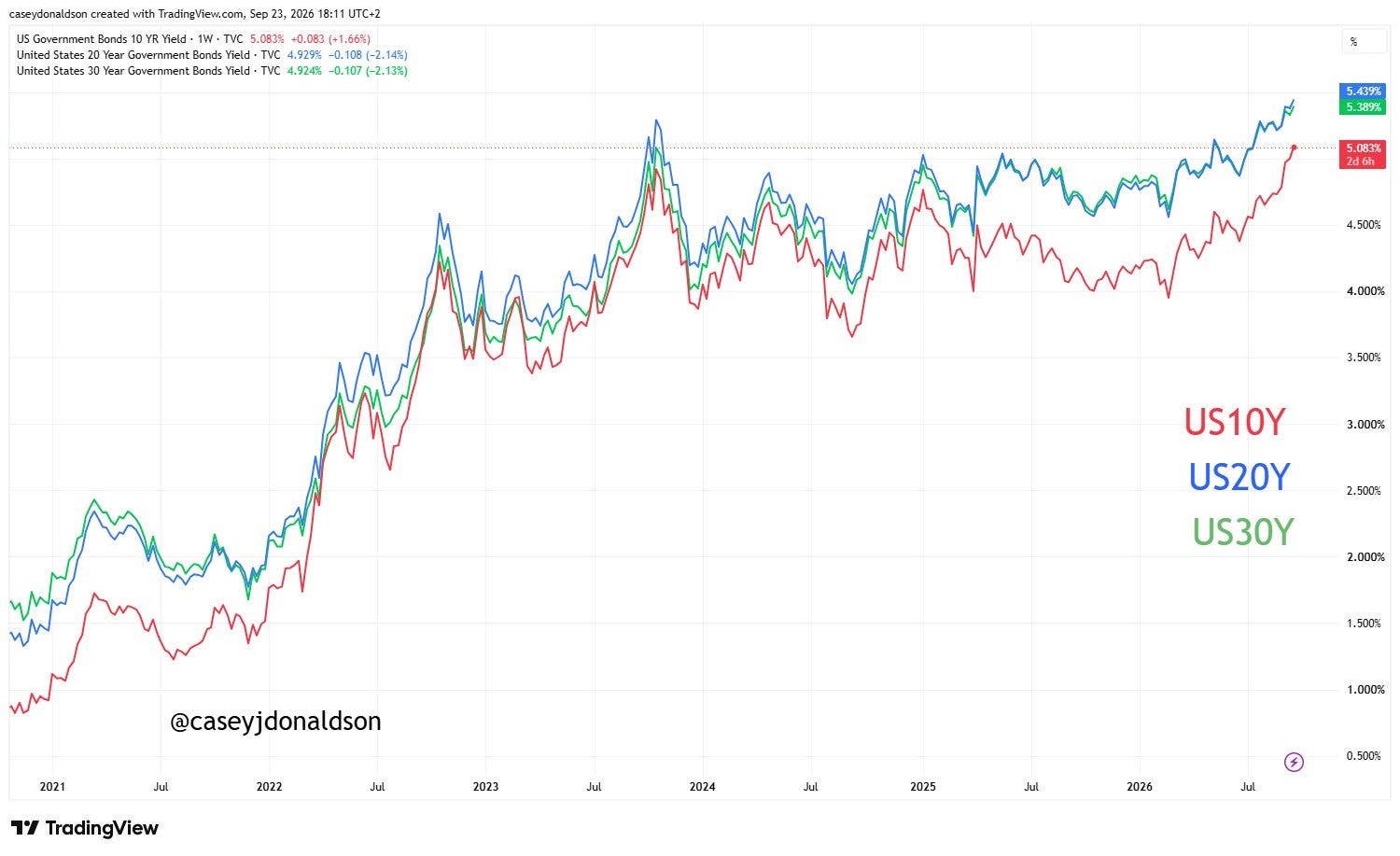
The Fed hiked rates by 0.25 basis points last month. Rates fell for a cup of coffee, then surged to new multi-decade highs. Get used to it. This will happen one more time.
Government bond yields, which rise when bond prices fall, have been climbing for months, and their rise is already rippling throughout the economy, impacting everything from mortgage and credit card rates to private-equity firms’ willingness to make debt-fueled acquisitions. With the midterms fast approaching, Treasury Secretary Scott Bessent has sought to tamp yields down with a buyback program that appears to have done little to change the market’s momentum.
At the same time, the uptick in yields still doesn’t seem like it has done enough to broadly slow the economy. That has only caused yields to rise further, as investors bet that the Fed will have to raise rates even higher than previously anticipated to have any real success in bringing down inflation.
My take: Interest rates will sustain levels we haven’t seen in our lifetimes.
We are witnessing a new era of bond rates being ushered in for a few reasons:
The world is done funding U.S. deficits. Rates will have to rise high enough to attract U.S. citizens and provide an adequate return for tying up capital in a weaponized currency.
The steady long-term central bank holders of Treasuries are being replaced by Cayman Islands hedge funds that will sell at the first whiff of volatility. That is not a stable buyer base for $40 trillion in debt (more on this in a minute).
AI companies will accept 8% rates to finance the AI buildout, pushing all rates higher. Investors will buy AI companies’ bonds for the higher return, leaving fewer buyers in other debt categories.
It’s easy to forget the long-term average interest rate is around 7%. We spent decades below average. Get ready for reversion to the mean.
This will not be smooth. It will be volatile as Trump talks about cutting rates to 1%, and Bessent discusses inflating the debt away.
Bessent Says the U.S. Can Grow Its Way Out of the Debt Crunch. What Would It Take? —WSJ 09/13/2026
“With 3% growth, we grow our way out of this,” Bessent said at Southern Methodist University last week, arguing that the economy was headed there before the Iran war disrupted energy flows. “We’ll get to the other side of this Iran conflict, and the underlying economy is very, very strong, and I think reaccelerating.”
I am purposefully setting aside the Iran war's impact on yields as a temporary factor. The larger issue is structural. The world doesn't want US Treasuries at these debt levels, regardless of what happens in the Strait of Hormuz. The Iran war is accelerating a problem that existed before the first bomb dropped.
With debt at $40 trillion and growing by $2 trillion per year, Bessent and Warsh have no good options. Cut the deficit and GDP takes a hit, causing a recession. Hike rates and you slow growth while raising an interest expense that is already unaffordable. Cut rates, and you pour gasoline on inflation that is structurally built into the system.
Here is the comparison that should stop you cold. Warsh is being asked to run the Volcker playbook with debt-to-GDP at 125%. Volcker ran it with debt-to-GDP at 30%. That is not the same playbook. That is not even the same sport. What that math actually means is that inflation has to run significantly hotter before rates can be hiked hard enough to crush it. The system cannot survive the Volcker treatment at current debt levels without the global financial system breaking first.
Inflation runs. Then the hike. Then the pain. We are in inning one.
Nobody holds enough hard assets for when this arrives. I'm playing it with Bitcoin, gold, Zcash, and silver.
Time will tell.
7. Hedge Funds Are the Wild Card in the Turbulent Bond Market
Hedge Funds Are the Wild Card in the Turbulent Bond Market —WSJ 09/14/2026
Anxiety about the Iran war, inflation and mushrooming public debt have driven the recent selloff in Treasury bonds. There is another factor that could add volatility into the mix: hedge funds, a growing force in this market.
For decades, governments could rely on predictable buy-and-hold investors to snap up their sovereign debt. Now, pensions and other long-run investors are pulling back in search of higher returns elsewhere, leaving a void filled by hedge funds and other faster-twitch traders.
Hedge funds held about $2 trillion of Treasurys at the start of this year, more than double their holdings five years earlier, according to the Treasury Department’s Office of Financial Research, which said hedge funds controlled a record 7% of the market.
You should get used to hearing about Cayman Islands hedge funds.

Why does a hedge fund need to be based in the Cayman Islands if it follows the rules? That question answers itself.
Hedge funds now control a record 7% of the Treasury market, or $2 trillion. That's more than double their holdings from five years ago, and they're growing at a pace never seen before. This matters because hedge funds are not buy-and-hold investors. They are return-maximizing traders who will sell at the first sign of volatility, the first whiff of a better opportunity, or the first margin call that requires liquidation. They do not hold Treasuries because they believe in America. They hold them because the trade is working. When it stops working, they will exit faster than any central bank ever could.
The US Treasury market has been the slowest-moving, most stable, most predictable large market in the history of global finance. It had to be. You cannot be the world’s financial backstop if the value of your bonds is jumping around like a meme stock. Every global institution that prices risk, every mortgage that gets written, every corporate bond that gets issued references the Treasury market as the foundation. Stability was the entire product.
That product is changing. Patient, long-term holders are being replaced by day traders in global finance. Funds with no national allegiance, no political cost for selling, and every incentive to move the moment conditions shift.
The Treasury market has never been here before. A $40 trillion market increasingly dependent on investors who can exit in minutes, amid geopolitical chaos, with a Fed that has no good options and a government running a $2 trillion annual deficit with no plan to stop.
The volatility that has historically been unthinkable in Treasuries is now possible. It is being engineered into the structure of who holds the debt. We are now more concerned with selling debt than with who the buyer is, to engineer the most stable global financial system.
When the first real panic hits: a failed auction, a geopolitical shock, a hedge fund forced to unwind. The exit door will be exactly as small as it always is. And the buyers who used to absorb that selling without flinching will not be there anymore.
The slow-moving market is about to become something nobody has a playbook for. Bitcoin and Zcash are how I am positioned for what comes next.
Time will tell.
8. Russia Is Churning Out Smart, Cheap New Weapons Faster Than Ukraine or the U.S.
Russia Is Churning Out Smart, Cheap New Weapons Faster Than Ukraine or the U.S. —WSJ 09/13/2026
Just as Ukraine was learning how to parry Russia’s drone attacks, Moscow has moved the goal posts with a new generation of innovative jet-powered weapons.
New Geran drones and Banderol cruise missiles are lethal reminders that Russia still has the resources and supply chains to field fresh threats, this time packed with advanced electronics that allow them to find targets accurately and evade interception. Crucially, the leap forward was enabled in large part by components sourced from China, in violation of international sanctions, say Ukraine and others, based in part on wreckage from the few shot down so far.
China has said it regulates exports of technologies that could be used in war.
The U.S. and its allies in the North Atlantic Treaty Organization, meanwhile, are struggling to increase production of vital arms such as Patriot interceptors. Western governments are also grappling with how to accelerate turning innovations into mass-produced equipment.
Russia and China love to invoke the rules-based international order at UN meetings right up until the rules apply to them. It’s more of a swipe at the U.S. UN-based rules order than anything, but the Chinese components inside Russian drones are another reminder of how seriously Beijing takes those rules.
But here we are again, provided with another example of Russia outproducing Ukraine and all of NATO in an active war.
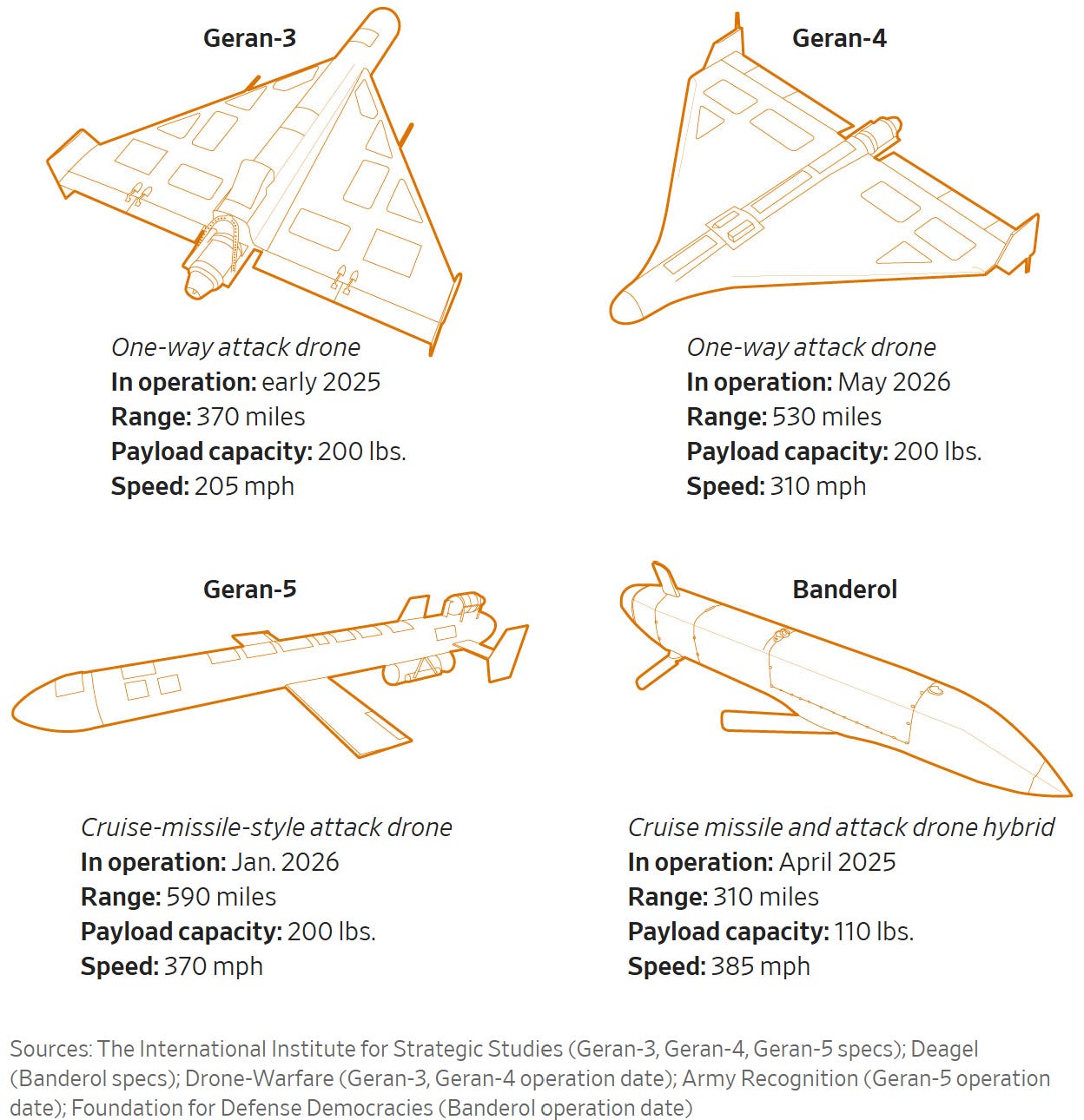
Russian drones have gotten 200+ mph faster during this war, as the U.S. is using Patriot missiles and fighter jets to shoot the drones down. The Geran-5 flies at up to 373 miles per hour. Fast enough to evade interceptor drones entirely and stress every air defense system the West has deployed. And the US is using $5 million Patriot interceptors to shoot down $100,000 drones because that is the only defensive tool available.
Run those numbers, and you will run out of missiles.
Most of the Chinese components inside these weapons are commercially available — dual-use parts made for civilian applications that Russian engineers have weaponized with remarkable efficiency. The Geran-5 runs on a Chinese TELEFLY turbojet engine. Its navigation system uses commercial satellite technology. Its communications electronics use 3G and 4G modems. None of it is restricted.
Patriot missile orders may not be filled until 2030. China ships Geran-5 components the same day. As many as you can buy.
The supply chain asymmetry in this war is not sustainable for the Western side. And we do not even know all the cards Russia and China are holding. While American defense contractors quote delivery dates four years out, Iran, China, and Russia are slow rolling out better and better drones. They test them in combat, modify them for lethality, and mass-produce them while the West can’t figure out a procurement issue from 8 months ago. Supply chains win wars.
Time will tell.
9. Debris Found in Yemen Suggests Saudi Arabia Fired Its First Chinese Missile
Debris Found in Yemen Suggests Saudi Arabia Fired Its First Chinese Missile —WSJ 09/16/2026
DUBAI—Debris discovered in Yemen indicates that Saudi Arabia has fired a Chinese-made ballistic missile in combat for the first time, Yemeni officials and weapons experts said, in a move likely aimed at signaling to the kingdom’s Houthi rivals that it has other weapons in its arsenal.
The use of the Dongfeng 15, if confirmed, would mark the first time Saudi Arabia has used a ballistic missile in its yearslong war with Houthi militants in Yemen. It would also shed new light on China’s sale of missiles to the Middle East, which Beijing has long denied.
“The Saudis are showing a card that they previously haven’t shown to try to balance the strategic equation,” said Sascha Bruchmann, a research fellow at the International Institute for Strategic Studies, a London-based think tank.
China’s Foreign Ministry and Saudi Arabia’s government didn’t immediately respond to requests for comment.
How convenient. In the same month Trump declined two phone calls from MBS asking for protection against the Houthis, a Chinese ballistic missile turns up in Yemen with Saudi Arabia's fingerprints on it.
These findings pull back the curtain on China denying arms sales to the Middle East, amid multiple U.S. campaigns to shut that down. The U.S. sells arms to every bad guy in the world, but it’s good business to be the only ones allowed to do so.
Saudi Arabia's use of Chinese missiles also points to a far more serious munitions supply-chain problem. When you cannot get replacement missiles for three to four years, you use whatever supply you can actually access.
Watching both countries actions is wiser than listening to what they say. Both these countries portray they are just strict business acquaintances, but there seems to be more than meets the eye:
Saudi Arabia opened its second ever sovereign wealth fund in China, rather than anywhere else in the world.
Saudi Arabia sells more oil to China than Iran. And Saudi Arabia imports more goods from China than anywhere else.
Now Saudi Arabia is using Chinese weapons.
Putting these puzzle pieces together calls for a much closer relationship than the WSJ suggests. Saudi Arabia is the bedrock of the petrodollar system. The entire architecture of dollar dominance in global energy markets beginning in the 1970s rests on the assumption that Riyadh and Washington are aligned.
Multiple pieces of evidence this month — the declined phone calls and the Chinese missiles — suggest that alignment is cracking in ways that markets have not yet fully priced in.
When it does register, it will not be gentle. Cracks in the US-Saudi relationship are not a geopolitical story. They are a dollar story. And a dollar story at this scale is an everything story.
Chinese stocks, Bitcoin, and Zcash will benefit most when the market catches up to what is already happening on the ground.
Time will tell.
10. See How the U.S. Is Attacking China’s Control of Critical Minerals
See How the U.S. Is Attacking China’s Control of Critical Minerals — WSJ 09/27/2026
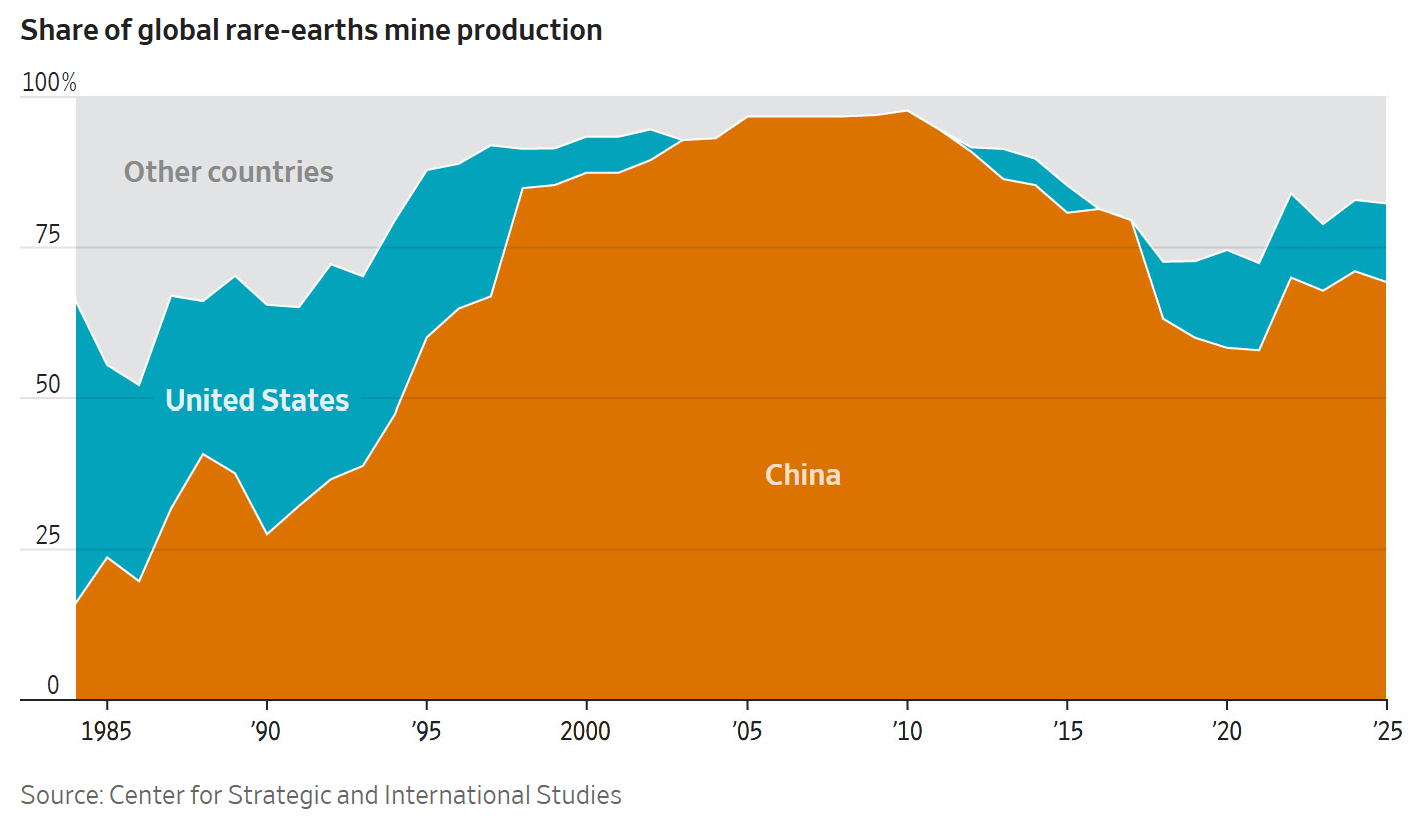
The Trump administration is engaged in a multibillion-dollar, governmentwide effort to loosen Beijing’s chokehold on critical minerals. It is slowly starting to work.
The effort to develop a China-free supply chain moved into high gear after April 2025, when China put export controls on key rare-earth elements. It has spanned the departments of Defense, Energy, State, Commerce and Interior, as well as new offices and two government banks, coordinated by the White House National Security Council.
Before the mid-1990s, the U.S. was a global leader in rare-earths production. “It took us 30 to 35 years to lose industrial capacity,” said Tomasz Nadrowski, author of “Mineral War: China’s Quest for Weapons of Mineral Destruction.”
And it will be at least a decadelong effort to escape China’s chokehold, experts say.
But is it enough?
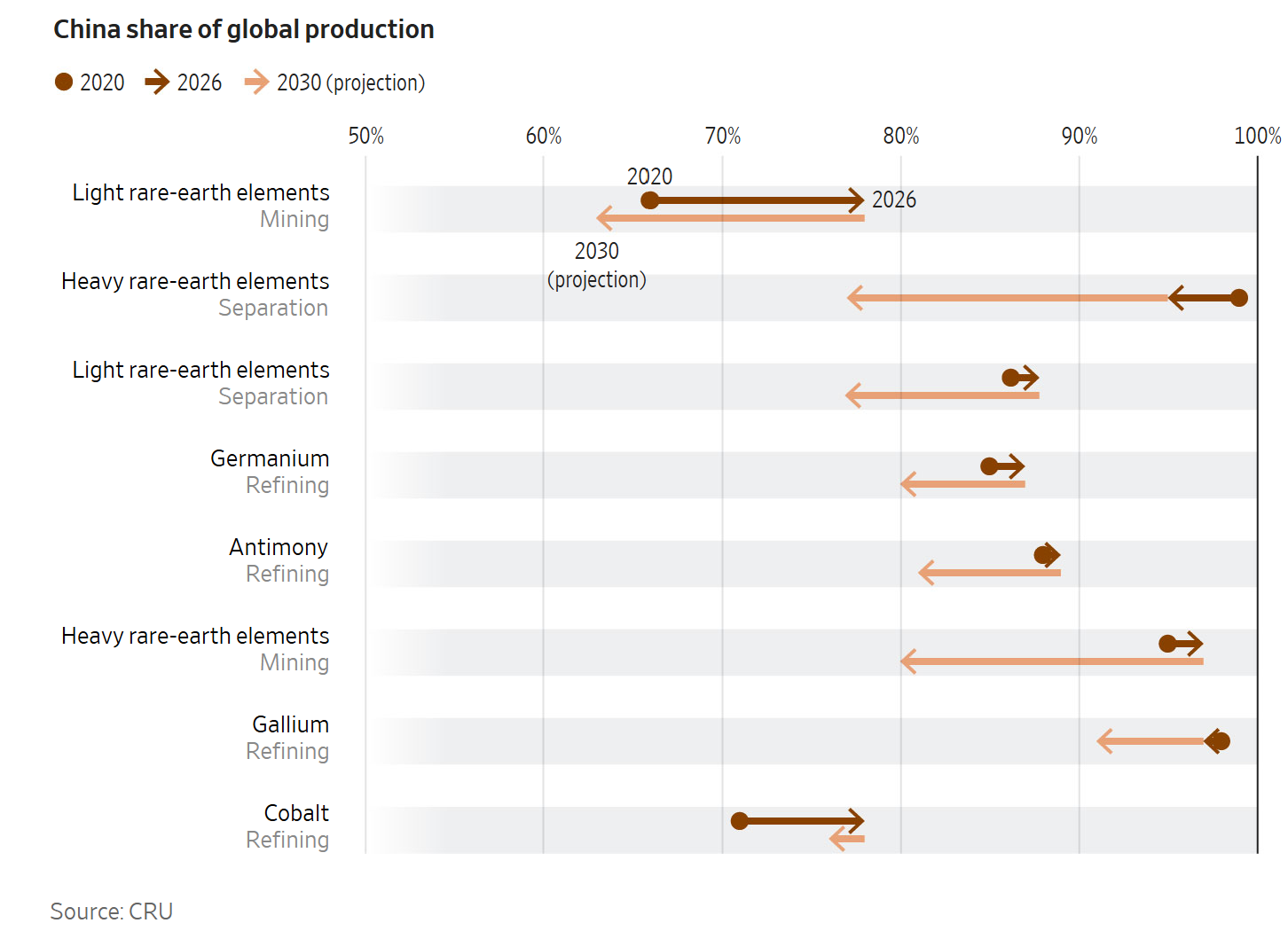
By 2030, China will still control over 80% of heavy rare earth refining. The West will still depend on China for 91% of its heavy rare earth needs, according to IEA data. The Trump administration has completed more than 180 critical minerals projects since taking office and is spending tens of billions of dollars. And the best-case outcome by 2030 is a 10 to 15% increase in domestic production.
That is what tens of billions of dollars and the full focus of a presidential administration buys you. A 10 to 15% improvement. Against an 80% Chinese market share.
And that outcome requires whoever wins the presidency in 2028 to be fully committed to continuing the effort. AOC won't allow the environmental impact of heavy rare earth mining. That is a political reality that anyone paying attention already knows. The heavy rare earths are the ones that actually matter:
The light metals that withstand high heat in weapons manufacturing and fighter jets.
The materials inside every electric vehicle motor.
The elements behind medical and surgical lasers.
The minerals enabling fiber-optic data transmission.
These are not optional inputs. These are the physical foundation of modern military power, modern medicine, and modern communications. And in 2030, 91% of the Western world's supply runs through China, regardless of everything the Trump administration is doing right now.
Before the mid-1990s, America led rare earth production. It was ours to lose. We handed it away over four decades of cowardly political decisions and green energy policy that made domestic mining politically toxic while China built the most comprehensive critical minerals infrastructure in history.
Bottom line: We will be lucky to see a meaningful domestic supply chain for heavy rare earths by 2035. It will take far more than tens of billions of dollars. It will require a sustained national commitment across multiple presidential administrations. The kind of commitment America has not demonstrated since Dwight D. Eisenhower's Interstate Highway System in 1956.
“By 2030, we will still be in trouble,” said Neha Mukherjee, research manager at Benchmark Minerals. “It’s just that, if all these projects in the pipeline are able to come online, we will be in less trouble than we are right now.”
In less trouble than we are right now. Slightly less reliant on China. That is the official best-case scenario from one of the leading analysts in the field. The U.S. can’t fight any major wars while this holds true.
Plan accordingly.
Time will tell.
The Rover Portfolio:
New stock purchase: PDD Holdings Inc. PDD 0.00%↑
I am still an equity investor at heart. Gold, Bitcoin, silver, and Z cash are my insurance, but finding equities is the real wealth compounder. I added PDD Holdings; the international face is Temu, but its e-commerce business in China is Pinduoduo.
PDD trades at 8.8 times trailing earnings with a return on equity above 25%. Better gross margins than Amazon. Better operating margins than Amazon. Real free cash flow. Not the kind Amazon is currently burning through on its AI buildout. Amazon trades at 21 to 22 times earnings with negative free cash flow right now. PDD is the better business by almost every fundamental measure, and it trades at less than half the multiple.
The reason is China. The market is pricing in regulatory unpredictability, US-China tension, and the real possibility that the political relationship between Washington and Beijing worsens before it improves. Add in genuine margin compression from a subsidy war between PDD, JD, and Alibaba, all cutting prices to win market share. Plus legal exposure from Shein’s IP infringement claims against Temu, and you have a stock that looks cheap for reasons that are partially legitimate.
Here is why I still bought it.
PDD runs an asset-light model. No owned warehouses. No delivery fleet. Unlike JD, which owns its entire logistics operation, PDD has built a platform that scales without the capital intensity that kills returns. When the subsidy war cools, and subsidy wars always cool when everyone runs out of patience for burning money, the underlying business quality will be more visible than it is right now.
The China discount is overdone. The margin story is unresolved. Both things are true simultaneously.
This is not a trade. This is a multi-year, hold-through-volatility bet on a genuinely superior business model being temporarily mispriced because of the country it operates in. I have been wrong on Chinese equities before, and I could be wrong here. But the gap between what this business is worth and what the market is paying for it is too wide to ignore.
Buys:
PDD under $75
Bitcoin under $75k
Gold under $4k
Silver under $60
Holds:
Zcash
Your specific Bitcoin, Zcash, gold, and silver allocation should depend on what you feel most comfortable with. I base it on age. I will group it by age:
20s: 100% Bitcoin and Zcash
30s: 80% Bitcoin and Zcash, 20% gold and silver
40s: 60% Bitcoin and Zcash, 40% gold and silver
50s: 40% Bitcoin and Zcash, 60% gold and silver
60s: 20% Bitcoin and Zcash, 80% gold and silver
Above 70: 100% gold and silver
These are just examples. Do whatever allows you to sleep at night.
My breakdown:
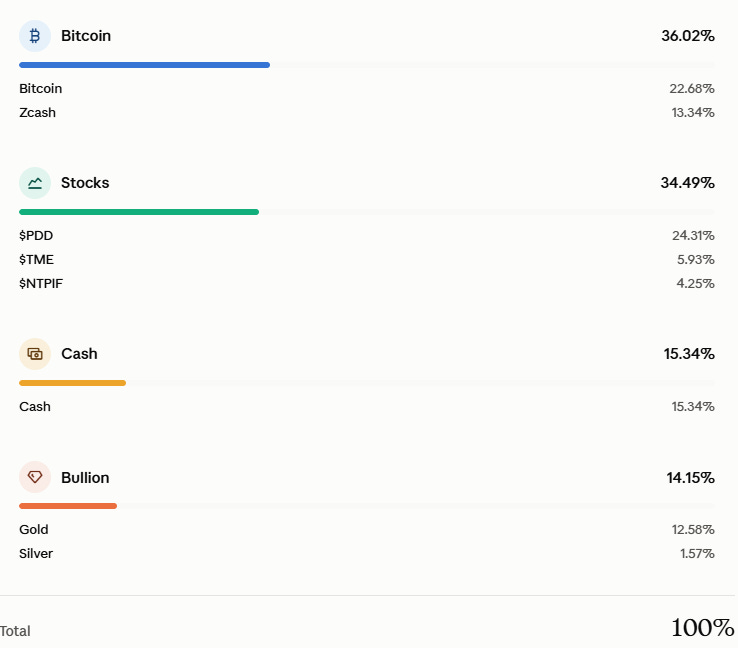
That is all for this month.
Fall is here. Enjoy the last days of the warm weather. Now that it's October, you can get out the fall decorations and watch Halloween movies.
I hope you have a great Halloween.
Thanks for reading and have a great weekend!
Casey Donaldson
Disclosure
The investment positions, opinions, and analysis contained in The Rover are for informational and entertainment purposes only and do not constitute financial advice, investment recommendations, or an offer to buy or sell any security. I am not a licensed financial advisor, broker, or investment professional.
All investments carry risk, including the potential loss of principal. Past performance is not indicative of future results. The positions I hold and discuss in this newsletter — including but not limited to Bitcoin, gold, Tencent Music Entertainment, Nam Tai Properties, PDD Holdings Inc., and any other securities mentioned — reflect my personal investment decisions and are not recommendations for others to follow.
The Rover may discuss speculative investments, emerging markets, cryptocurrency, and other high-risk assets. These are not suitable for all investors. Before making any investment decision, you should conduct your own research, consult with a licensed financial professional, and consider your own financial situation, risk tolerance, and investment objectives.
The information in this newsletter is believed to be accurate at the time of writing but may become outdated. Markets move fast. The world moves faster. Neither The Rover nor its author assumes any liability for decisions made based on the content of this publication.
Invest at your own risk. Think for yourself.