

The Rover

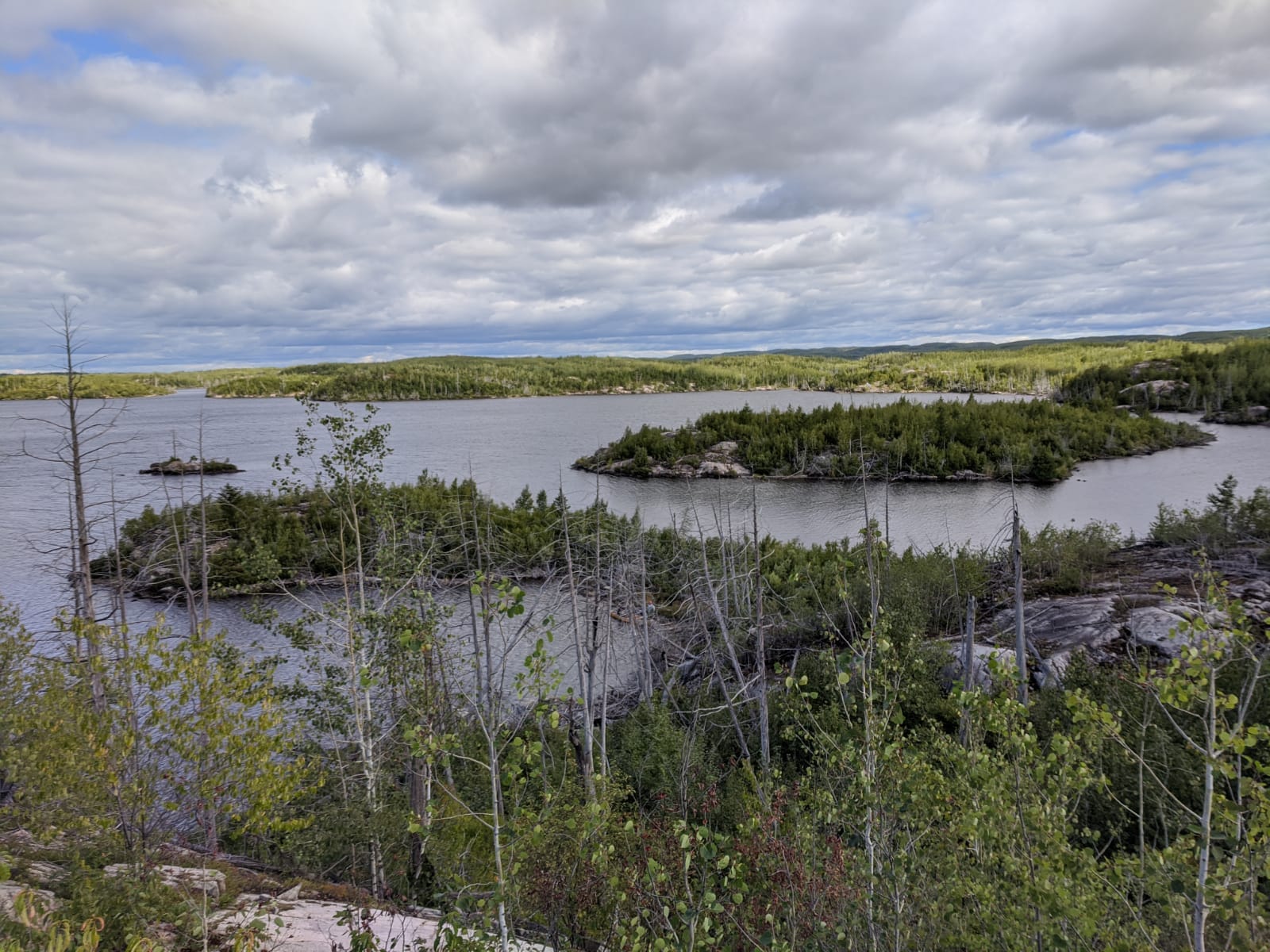
The Boundary Waters Canoe Area (BWCA) is one of the most pristine wilderness areas in North America. Over a million acres of untouched lakes, forests, and waterways on the Minnesota-Canada border that have been protected for decades. It is genuinely beautiful. I say this as someone who lives in the Duluth, Minnesota area, has spent weeks camping there, and understands what that land means to the people who love it. And we may have to mine it anyway.
Beneath the Boundary Waters sits one of the largest undeveloped deposits of critical minerals in the United States. Copper, nickel, cobalt — the exact materials required to build the batteries, the weapons systems, the electric grid, and the AI infrastructure that determine whether America remains a sovereign nation capable of defending itself or becomes permanently dependent on China for the inputs that run the modern world.
This is not a debate about whether you love nature. I love nature. This is a pros vs cons decision that nobody in Washington has the courage to put plainly. So I will.
Option one — you protect the Boundary Waters at 100%. Every acre untouched. And you permanently hand China the leverage that comes with supplying the critical minerals America refuses to dig out of its own ground. That leverage looks like what we have covered all year in this letter. Taiwan arms deals held hostage. Data centers dependent on Chinese copper. Weapons systems that cannot be built without Chinese rare earths. A way of life that gets altered not by a war but by a supply chain.
Option two — you allow carefully regulated mining in a defined area of the Boundary Waters. You accept that some wilderness is the price of sovereignty. You begin the decade long process of building a domestic critical minerals supply chain that does not require a phone call to Beijing every time America needs to defend itself or build something.
There is no third option. There is no version of this where America gets 100% protected wilderness and 100% critical mineral independence simultaneously. YOU CAN’T HAVE BOTH. That is not a political position; it’s opportunity cost.
The people who will fight hardest against mining the Boundary Waters are the same people who have zero clue that China is our supply chain and that it pollutes more than the rest of the world combined. The connection between a pristine lake in Minnesota and a weapons system that can’t be built is not obvious until it is. By then, the decision has already been made for you.
Writing the future of America ourselves will always be better than the version that relies on China for everything. And if that means sacrificing 1% of nature areas, it’s what we have to do. Would we even notice? Making the hard choice isn’t for everyone.
I am not a hater of nature. I am a realist about what it costs to ignore what is underneath it. China put out more greenhouse emissions in seven years than the U.S. did in a century to become a global power.
Your comfortable lifestyle will not stay the same with China as our supply chain. Is protecting nature worth that to you?
The most interesting things I read this month:
Iran Launches Surprise Missile Attack on U.S. Forces
China Erases Real Estate Gains From the Last 20 Years.
Frequent Oil Draws From U.S. Strategic Reserve Push Old System to Breaking Point.
Japan finance minister urges giant pension fund to invest more at home.
China’s Xi Touts Open-Source AI and Takes a Swipe at U.S. Dominance.
The Massive Supply Deals Feeding the AI Frenzy Are No Sure Thing.
China Successfully Tests Sea-Based Rocket Booster Recovery System
Russia Passes Crypto Law to Legalize Trading
Fed Holds Rates Steady but Three Officials Vote for Increase
Canadian Wildfires Create Hazardous Air in Midwest and Northeast
1. Iran Launches Surprise Missile Attack on U.S. Forces
Iran Launches Surprise Missile Attack on U.S. Forces —WSJ 07/28/2026
Iran launched a surprise ballistic-missile attack on American forces in Jordan, a U.S. official said, a violent escalation that piles new pressure on President Trump to renew the war in earnest.
The missiles were all successfully intercepted, the U.S. military said. But the assault raised the prospect that American forces would have to respond, just as negotiations to reopen the Strait of Hormuz and eventually jump-start broader peace talks were picking up speed.
The assault marked a shift for Iran, which until now had generally fired on U.S. forces in retaliation for American airstrikes on its own territory. With the unprompted missile attack, Iran showed it is willing to take the fight to the U.S. on its own terms in an attempt to force Trump’s hand.
Shortly after the Iranian strikes on Jordan, the American military said U.S. and Saudi jet fighters had launched strikes in Iraq on Tuesday against Iran-backed groups that the Islamic Revolutionary Guard Corps previously directed to attack American troops and Saudi energy infrastructure. Those attacks against U.S. forces weren’t successful, U.S. Central Command said.
I attempted to ignore the Iran War this month because it’s a rollercoaster ride filled with drama, lies, and market manipulation. But it’s just the gift that keeps on giving.
Iran launched its first attack against American forces that was not a retaliation this last week. Not a response to a strike. An unprovoked offensive move against American forces by a country that has been only retaliating in this war for five months.
The war is changing.
For months the pattern was consistent — America strikes, Iran retaliates, both sides announce ceasefire progress, Trump declares victory and that a deal is almost done. It was a predictable cycle that both sides understood and managed. That cycle is over. Iran moving from retaliation to initiation is a strategic shift that signals Iran believes the balance of pressure has tilted in its favor. The evidence suggests Iran is right.
The geography of the war is expanding, and that is the development that should concern everyone most. Saudi Arabia is now involved. Iraq is now involved. Yemen (the Houthis) restarted being involved. Ukraine sent a drone attack to hit an Iran-Russia trade route — pulling the European war and the Middle Eastern war into direct contact for the first time. The walls between the world’s active conflicts are getting thinner.
Hegseth and Trump continue to deny that munition stockpiles are a problem while WWIII is not a hyperbole at this point. It is a direction.
Iran does not need to win a single battle. Iran just needs America to keep losing ground on every other front while the Strait stays closed and the interceptors run low.
And then this landed two days before Iran’s unprovoked attack.
Trump Pauses Iran Strikes as Officials Weigh Dwindling Air Defense Stocks —WSJ 06/26/2026
President Trump has put off a major escalation of his military campaign against Iran amid efforts to revive diplomacy to open the Strait of Hormuz and a debate over the impact of declining munitions stocks, according to U.S. officials familiar with the matter.
But the operation was delayed so diplomacy could proceed and as officials discussed the effect a major attack could have on the U.S.’s shrinking stocks of Patriot and other air defense interceptors. The president could still order an attack, officials said, noting that the situation remains fluid.
The White House has been informed of the declining inventories of air defense interceptors by Gen. Dan Caine, the chairman of the Joint Chiefs of Staff, officials added.
The Wall Street Journal published a story reporting that Trump had paused strikes on Iran as officials weighed dwindling air-defense stockpiles — the same stockpiles that Hegseth and Trump publicly deny are a problem. Two days after that story ran, Iran launched its unprovoked attack by a military that, per Trump, had already been destroyed.
The Chairman of the Joint Chiefs of Staff personally briefed the White House on declining interceptor inventories. The same stockpiles Iran has been methodically depleting since February by deliberately firing older, less accurate missiles first to drain American air defenses before deploying their best weapons.
Iran didn’t need a source inside the Pentagon. They engineered the shortage themselves and have been watching it develop in real time on the battlefield. The WSJ story didn’t tell Iran anything Iran didn’t already know. It told the American public what we have been saying for months.
Trump paused the escalation. Iran read the pause as confirmation. The unprovoked attack followed.
Every denial from the Pentagon that turns out to be true becomes more damaging in the future. Every act of Iranian strength makes Trump’s words less credible. The White House is losing an information war against an adversary that doesn’t need social media — it just needs to allow Trump to be himself and blow up at his advisors for negative news. If your boss blames you for accurate information, the accurate information stops flowing. Right on time, as news of Trump blowing up at his advisors surfaced yesterday:

The question is whether Washington is changing with the war — or whether it is still reading from a script that Iran has no missiles and/or military remaining.
Only time will tell.
2. China Erases Real Estate Gains From the Last 20 Years

China just erased 20 years of real estate gains. Cities that were held up as ridicule to overbuilding — the ghost cities, the empty apartments, the developments nobody moved into — have seen property values collapse back to levels not seen since the early 2000s. The Western financial media covered it as a cautionary tale about communist central planning failures and speculative excess.

Do the ghost cities really haunt the economy? Hell no. But they do have an oversupply problem. But what does oversupply do? Makes things very cheap.
How much richer would the average American be if you could buy a home today at 2004 prices? Think about what that actually means. A generation of Americans who could afford a down payment in their twenties. Young couples who could start families without doing a five-year financial plan first. People who could take career risks, start businesses, and build wealth because their housing costs left room for something else. Instead, we have turned the place where people lay their heads at night into the hottest speculative asset in the country — and then wondered why birth rates are falling, why young people are angry, and why the American Dream feels like a movie from a different era.
China treats housing as a place to live. They don’t treat it as a speculative asset. America's treatment of housing as a speculative asset for the last 30 years has consequences, making it more expensive, more financialized, and more out of reach for the people who need it most. We avoided China’s supply correction by never allowing the correction to happen—through zoning laws and every policy mechanism available to protect Boomers’ asset values at the expense of younger generations.
Housing is the single biggest factor standing between most Americans and financial freedom. Not student debt. Not car payments. Not coffees and avocado toast. The mortgage, or the rent paid to someone else’s mortgage, consumes the income that would otherwise build wealth, fund retirement, and give people the margin to do what they love.
What if we looked at a house the way we look at a refrigerator? A useful thing you need. A cost of living. Not a stock. Not a speculative bet. Not the primary vehicle through which the middle class builds net worth because every other option has been made too complicated, too risky, or too expensive to access.
China’s real estate collapse was an accident that came as a blessing. But buried inside that accidental experiment is what happens when you stop treating shelter as an investment. The answer is uncomfortable for everyone who doesn’t already own a house.
Only time will tell.
3. Frequent Oil Draws From U.S. Strategic Reserve Push Old System to Breaking Point
Frequent Oil Draws From U.S. Strategic Reserve Push Old System to Breaking Point —WSJ 07/13/2026
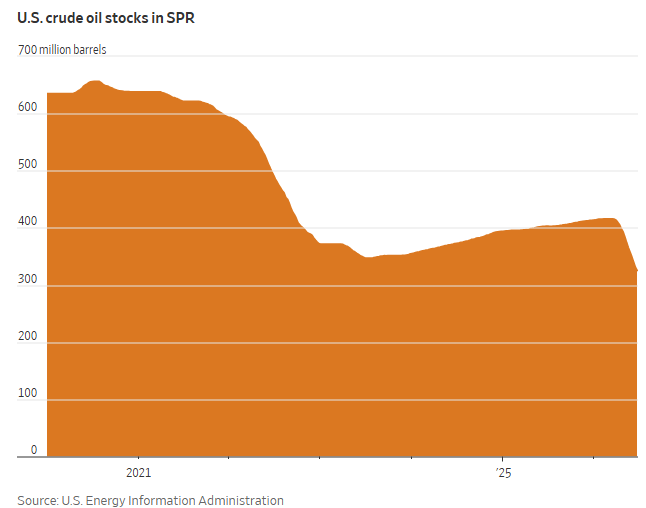
The U.S. is tapping in to its national stocks of crude with abandon. The withdrawals are taking a toll on the strategic reserve system.
Just in the past four years, the Biden and Trump administrations have ordered the largest releases from the Strategic Petroleum Reserve while seeking to tamp down soaring oil prices—a total of 352 million barrels, or nearly half the capacity of the stocks.
Now, frequent drawdowns, wear-and-tear and a lack of investments are straining the reserve, according to experts. The 60 Gulf Coast salt caverns that make up the stocks can’t be drawn from or refilled at the rate at which they were designed, federal researchers found. Equipment failures have bedeviled the reserve’s managers. At one point, a well broke and caused the loss of hundreds of thousands of barrels of crude.
The upshot: President Trump or a future administration might not be able to rely on the massive oil buffer like others have in the past—even as the prolonged U.S.-Iran war all but ensures continued volatility in energy markets.
The Strategic Petroleum Reserve was built for emergencies. Instead, it has been used as a political tool to keep gas prices down before elections and to mask the consequences of an energy policy that has left America more exposed than at any point in the last 50 years. Now the system built to save us in a real emergency is breaking down — and a real emergency is exactly what we are in.
352 million barrels drawn in four years. Nearly half the total capacity. Not because of a war that cut off supply overnight. Not because of a hurricane that wiped out Gulf Coast refining capacity. Because both parties needed gas prices lower before November. The SPR was treated like a checking account instead of a fire extinguisher — and now the fire extinguisher has a crack in it.
The system is nearly 50 years old and has never been tested at this pace. The 60 salt caverns along the Gulf Coast were designed with specific draw rates and refill rates that have been consistently exceeded. Equipment that has never been pushed this hard is now failing in ways nobody fully understands. A well broke, and hundreds of thousands of barrels were lost. A headline that never got the attention it deserved.
Nobody in Washington wants to game out this situation publicly. The Iran war continues. The Strait of Hormuz is closed. We are getting to hurricane season on the Gulf Coast. Trump reaches for the SPR — the tool every administration has relied on to buy time in an energy crisis, but the system cannot deliver at the rate the moment requires. Equipment fails. Draw capacity is limited. The buffer that was supposed to prevent panic at the pump cannot perform.
Americans are not ready to pull into a gas station that has no gas. That is not hyperbole. That is the logical endpoint of a 50-year-old system drained to keep prices politically manageable, operating beyond its designed limits, in the middle of the largest energy shock in modern history. The panic that follows empty pumps is not a supply chain story; it is a public order story.
We have been using the emergency buffer to avoid short-term pain. The long-term cost of that decision is a system that may not be there when we actually need it.
Only time will tell.
4. Japan finance minister urges giant pension fund to invest more at home
Japan finance minister urges giant pension fund to invest more at home —FT 07/9/2026
Japanese stocks surged almost 2 per cent and the yen rose from a multi-decade low after the country’s finance minister called on domestic pension funds and the public to shift more assets into domestic markets.
Traders in Tokyo described Satsuki Katayama’s comments on Friday as a form of “stealth intervention” in currency and bond markets.
Katayama said in a press conference that encouraging Japanese pension funds and households “to invest more in Japanese financial assets” was a policy measure that the administration wanted to pursue. She explicitly included the Government Pension Investment Fund (GPIF), which manages a global portfolio of roughly $1.8 trillion.
“The GPIF is the largest investor. When they start to move it influences smaller asset managers to follow suit,” she said. But she cautioned: “I think this kind of verbal announcement will be very shortlived if it is not followed through with actual asset allocation changes.”
Japanese borrowing costs have surged to their highest levels in 30 years as plans for aggressive government spending threaten to put further strain on the country’s high levels of debt.
Japan is the single largest foreign holder of United States Treasury bonds. Not China. Not Saudi Arabia. Japan. For decades Japanese institutions — led by the Government Pension Investment Fund (GPIF), the largest pension fund on the planet managing $1.8 trillion in global assets — have recycled Japanese savings into American debt, keeping Treasury yields suppressed and giving the United States the ability to borrow more than it could ever afford on its own merits.
Japan’s Finance Minister just told that fund to bring the money home.
Traders in Tokyo called it stealth intervention. That framing says it all. When a finance minister encouraging domestic investment reads as market intervention, it means the market has been so dependent on Japanese capital flowing outward — into American Treasuries specifically — that even the suggestion of redirection moves currencies and bond markets immediately. The GPIF does not need to sell a single Treasury bond for this to matter. The signal alone is enough. When the largest investor in the world starts moving, smaller asset managers follow. That is the cascade Katayama herself encouraged and acknowledged.
This is not a hostile act. That is exactly what makes it more dangerous than if it were. Japan is not selling Treasuries to punish America. Japan is not making a geopolitical statement. Japan is doing what every rational country watching this year unfold has been quietly forced to do — protecting its own currency, its own citizens, and its own financial system in a world where the American security guarantee has been revealed as conditional, and the dollar has been weaponized often enough that holding it in unlimited quantities is no longer obviously wise. When the world holds $21 trillion of your assets, you have very little power when they want to sell.
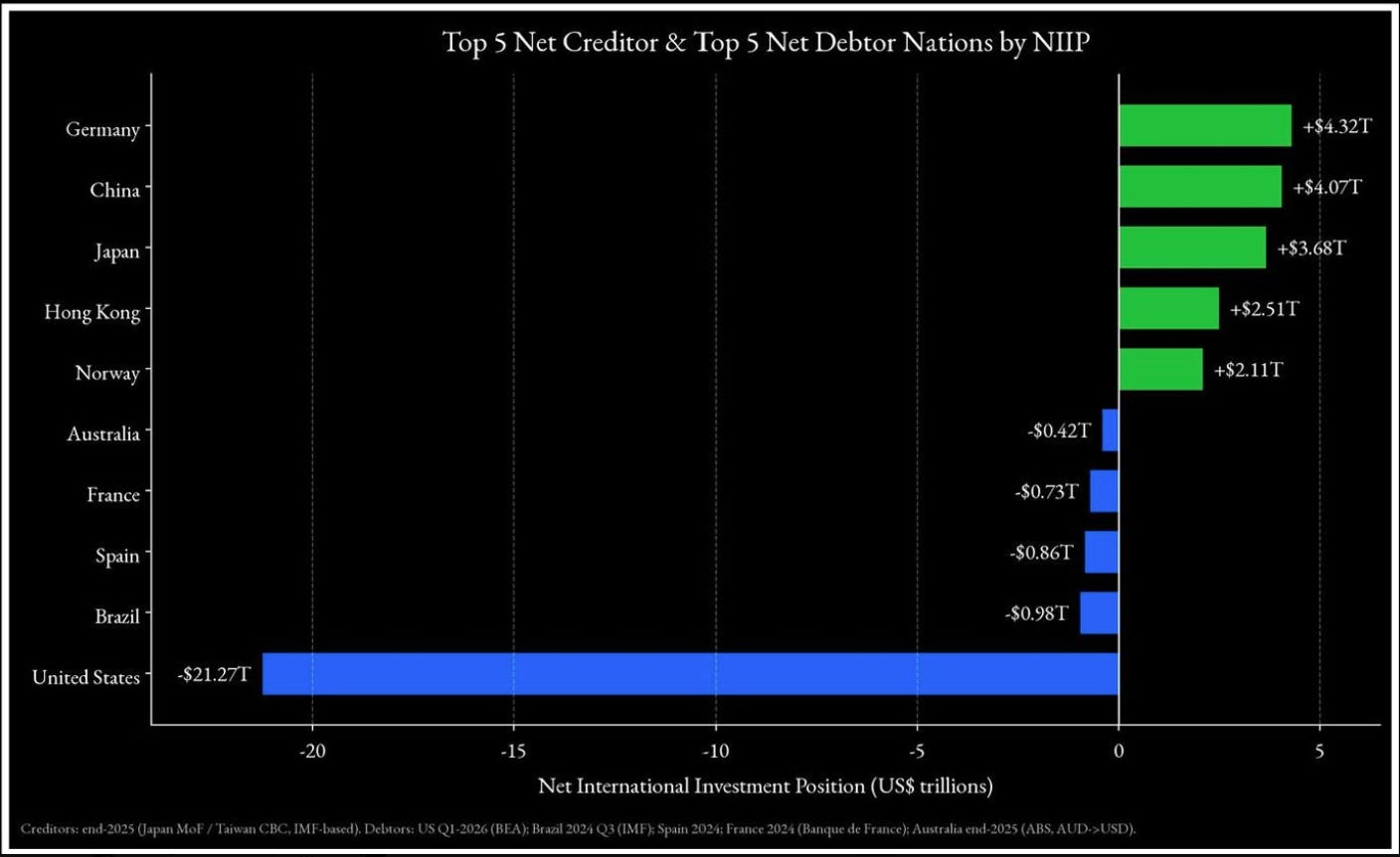
Japan watched the Iran war cut off the energy supply its entire economy depends on. It watched American sailors enforce a blockade while Trump secretly paid Iran to break it (covered last month, Made in China). It watched its fuel lines grow, and its Treasury holdings lose purchasing power simultaneously. Japanese borrowing costs are now at their highest levels in 30 years. At some point, the Finance Minister has to answer to Japanese pensioners — not American bond markets.
The math on the other end of this is brutal.
The United States carries $39.5 trillion in debt at levels it already cannot afford to service. Every basis point that Treasury yields rise adds billions to the annual interest expense. Every large foreign holder that redirects capital home rather than into Treasuries puts upward pressure on those yields. Japan is the largest. If Japan is bringing money home, others are already doing it quietly or preparing to. The Gulf states are redirecting east. China has been reducing exposure for a decade. And now the most loyal buyer America has ever had is getting different instructions from its own government.
USTs are not dead overnight. But the buyer base that made American borrowing costs artificially cheap for 40 years is shrinking in real time — at the exact moment America needs to borrow more than ever to fund a war, service existing debt, rebuild its industrial base, and finance an AI buildout larger than anything in history. The Treasury market does not have a dramatic collapse moment. It has a slow grinding realization that the world’s most important debt market no longer has enough buyers at prices America can afford.
The price of everything hasn’t doubled; your dollars are just worth half as much.
Only time will tell.
5. Open-Source AI and Takes a Swipe at U.S. Dominance
Open-Source AI and Takes a Swipe at U.S. Dominance —WSJ 07/17/2026
Chinese leader Xi Jinping endorsed the building of open-source artificial-intelligence models, touting an approach that has helped the country catch up with the U.S. in global influence.
Speaking here Friday at an AI conference, Xi cast China as a champion of openness and equality, implicitly criticizing U.S. moves to protect its lead in AI semiconductors and models.
“We should oppose overstretching the concept of national security in the field of AI or placing one country’s security over that of others,” Xi said, without naming the U.S.
His speech comes as the U.S. and China are jockeying for leadership of global AI, with the U.S. generally acknowledged on both sides to hold a small lead. Each country hopes that its AI models will become standard around the globe. And each hopes to gain a national security advantage with new technology such as Anthropic’s Mythos model, which can automatically detect cybersecurity flaws.
The Trump administration recently intervened to temporarily block access to Mythos, citing national security concerns.
Hours before Xi’s speech, Beijing-based Moonshot AI offered the latest breakthrough from China, an open-weight model called Kimi K3 that has surprised many in Silicon Valley with its advanced capabilities.
The U.S. and China have taken different approaches in the AI models that underlie chatbots such as Claude and ChatGPT. In Silicon Valley, OpenAI, Anthropic and other technology giants are building largely proprietary models using Nvidia’s cutting-edge semiconductors.
Chinese companies such as DeepSeek, Moonshot and Zhipu AI have been playing catch-up and have published many open-source models, which people are generally free to use and adapt.

Chinese Kimi-K3 comes in #1 in the frontend code arena, surpassing the best American model, Claude Fable 5.
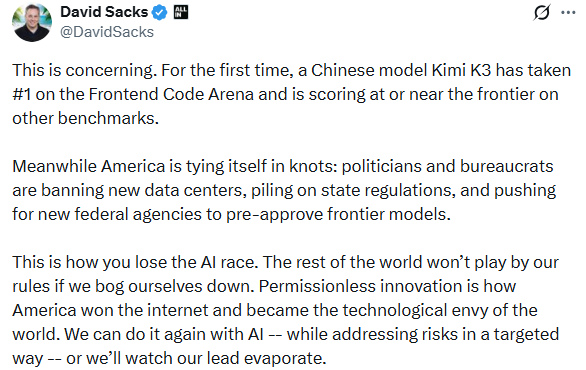
For a generation, Americans were told not to worry about China. They only make cheap goods. They copy everything. They can never truly innovate. The gap is too large. The institutions are too different. The culture of intellectual freedom that produces breakthrough technology simply does not exist in an authoritarian state.
That narrative is over.
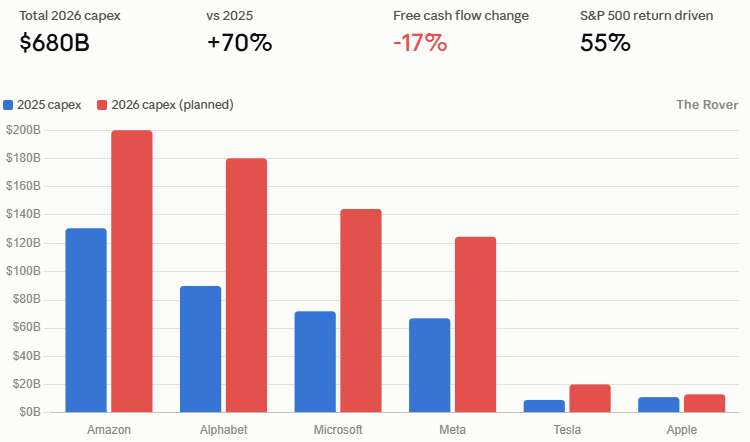
The American strategy has been to spend $680 billion in AI capex from the Magnificent Seven alone in 2026. Proprietary models built on Nvidia’s most advanced chips. Export controls to keep those chips out of Chinese hands. The logic is sound — if you control the best hardware and build the best models on it, you win.
China’s strategy has been to let America do the expensive work and then route around it. Open source models that anyone can use, adapt, and improve. DeepSeek shocked Silicon Valley by producing a model that competed with America’s best at a fraction of the cost — built on chips China was not supposed to have access to. Kimi K3 just did it again. Every time America assumes the export controls are working, a Chinese model arrives that suggests otherwise.
This is the oldest Chinese competitive playbook applied to the most important technology race in history. Watch America spend the money. Absorb the intellectual property through every channel available. Build on top of what America pioneered. Compete at lower cost with higher efficiency. It worked in manufacturing. It worked in solar. It worked in electric vehicles. The mindset that it cannot work in AI because AI is different is the same mindset that said China could never build a world-class car or a world-class battery.
The only meaningful economic growth the United States has produced in years has come from AI. The stock market is priced to perfection on AI returns that have not yet materialized. The Magnificent Seven are burning through cash reserves to win a race that is turning out to be much closer than the $680 billion price tag was supposed to allow. If China wins the AI race, or even fights to a draw, the economic and market consequences for America will be a story for the history books.
And here is the detail that should end the debate about how serious this is. American AI executives, the people building these systems, the people who see the internal scorecard every single day, are terrified. Not concerned. Not cautious. Terrified. When the people closest to the technology are scared, the people furthest from it should be paying very close attention.
Top American AI Execs Sound Alarm on Chinese Models —WSJ 7/20/2026
OpenAI and Anthropic executives are sounding the alarm about the rise of cheap AI, particularly powerful new models produced in China, suggesting they will lead to a “dystopian” AI future and present unacceptable security risks without regulation.
Some analysts who study the AI industry say the two companies, which are preparing for public listings in the next year, just want to eliminate the competition.
The emergence of highly capable, open autonomous AI systems—including Moonshot AI’s Kimi K3 model and Alibaba’s Qwen 3.8 Max, which were released in recent days and viewed favorably by investors and users—has turned the AI race on its head once again. Kimi K3 also was competitive with U.S. models on some benchmarks.
I would blame security risks too if I were scared of losing.
Anthropic just pledged $40 million to politicians to pass legislation in their favor. That is embarrassing. The most advanced AI company in America — the company building the model the US government is relying on for national security applications is spending $40 million on lobbying because it cannot beat Chinese competition on merit alone. You have to be pretty desperate to have politicians do your fighting for you.
When you start asking for government protection, it’s already over.

We have spent hundreds of billions of dollars to maybe hold a small lead over a country that has never needed to match us dollar for dollar to eventually win. That should terrify everyone.
Only time will tell.
6. The Massive Supply Deals Feeding the AI Frenzy Are No Sure Thing
The Massive Supply Deals Feeding the AI Frenzy Are No Sure Thing —WSJ 07/20/2026
Contracts worth billions of dollars have become the commercial glue holding the AI boom together. But investors shouldn’t rely on them sticking if the boom fades.
Contracts to supply computing power for artificial-intelligence calculations have become such a fixture of the craze that whole industries have begun reorganizing around them. AI suppliers say these arrangements give them unprecedented visibility into their future revenue, allowing them to wow investors with promises of bumper sales and profits ahead.
The computer-memory business may be the most extreme example. Memory suppliers and their customers have sought out longer-dated deals in recent months.

We have seen this movie before. The assets were different. The financing structures were different. The buzzwords were different. But the underlying logic was identical — and it ended the same way it always ends when an entire financial system organizes itself around the assumption that valuations only go up.
In 2008 it was mortgages. Banks bundled them, rated them, sold them, and used the proceeds to make more loans to fund more bundles to sell to more investors. Every layer of the system was priced on the assumption that housing values would keep rising. When they stopped rising, the entire structure unwound simultaneously because every piece was connected to every other piece through the same flawed assumption.
In 2026, it is AI contracts.
Companies are signing billion-dollar computing contracts based on projected AI revenues that have not yet materialized. Those contracts are being used as collateral to raise financing. That financing is being used to build more infrastructure. That infrastructure is being valued based on the contracts. The contracts are being signed based on valuations that assume the infrastructure will generate returns. Every layer of the AI financing ecosystem is priced on the assumption that AI adoption and revenues will keep accelerating forever.
What happens when that stops?
The answer is 2008. Except worse. In 2008, the US entered the crisis with manageable debt levels and a full toolkit — interest rate cuts, quantitative easing, bank bailouts, fiscal stimulus. The Fed had room to move. The Treasury had room to spend. The system had shock absorbers.
Today the US enters this potential crisis with $39.5 trillion in debt, interest rates at twenty-year highs, a Treasury market that cannot find enough buyers, a Federal Reserve that is simultaneously being pressured to cut rates and facing an inflation environment that argues for hiking them, and a geopolitical backdrop that is draining every financial and military resource available. The shock absorbers are gone. The toolkit is empty. And the crisis being built in AI financing is larger than the mortgage market that nearly took down the global financial system in 2008.
OpenAI is the most exposed of all of them. The company is valued at levels that assume it wins the AI race, monetizes that win at scale, and generates the kind of returns that justify a valuation built on hope and momentum rather than earnings. It has burned through capital at a pace that makes the dotcom era look disciplined. It is preparing for a public listing into a market already questioning whether AI capex will ever generate the returns being promised. And it is doing all of this while, as mentioned above, Chinese open-source models are matching its performance at a fraction of the cost.
OpenAI is too big to fail in the same way Lehman Brothers was too big to fail. Right up until it wasn’t.
We are risking trillions of dollars, the stability of the global financial system, and a potential crisis with fewer tools to solve it than we have ever had— only to potentially end up with the second-best AI on the planet.
Just in as I was writing this letter:
Nvidia in Talks With OpenAI to Guarantee $250 Billion Financing for Data Center — WSJ 07/26/2026
Every week we are seeing a new deal worth hundreds of billions of dollars in financing. The math does not add up.
We are staring 2008 2.0 right in the face, and no one is talking about it.
Only time will tell.
7. China Successfully Tests Sea-Based Rocket Booster Recovery System
China Successfully Tests Sea-Based Rocket Booster Recovery System — Reuters 07/9/2026
China on Friday successfully tested an experimental rocket retrieval system using a net attached to a sea platform, state media reported, in the hope of breaking U.S. dominance in reusable rockets.

If everything covered above wasn’t enough — China is in the space race too.
The country that built its early economic foundation on cheap manual labor, that the Western world dismissed for decades as incapable of genuine innovation, is now competing with the United States across every frontier that defines superpower status in the 21st century. Reusable rockets are the latest. It will not be the last.
China’s space program has accelerated at the same pace as everything else it has decided to prioritize. Methodical. Patient. Deliberate. Funded by a government that does not need to justify its budget to quarterly earnings calls or a Congress that cannot agree on anything. While America’s space ambitions have cycled through administrations, budgets, and political priorities, China has kept building. The same way it kept building factories. The same way it kept building solar panels. The same way it kept building electric vehicles until it owned the market.
The pattern is the same again. America innovates. China studies. America commercializes. China subsidizes. America debates. China builds. By the time the Western media notices China is competing, China is already winning. Do you get it yet?
The generation that grew up watching America put a man on the moon assumed space was America’s domain permanently. That assumption belongs in the same pile as the assumption that China only makes cheap goods, that Iranian missiles couldn’t threaten aircraft carriers, and that the SPR would always be there when we needed it.
If the stories in this letter have a single throughline, it is this — the world America built after World War II is being contested on every front simultaneously by a country that started with nothing and has spent 40 years preparing for exactly this moment.
The space race is just another visible frontier. The others are already further along than most Americans realize. The stock market has not yet realized this. From last month:
When the game isn’t going the way you want, you have two choices. You can play better. Or you can change the rules.
Nasdaq just changed the rules.
To accommodate the anticipated IPOs of SpaceX, Anthropic, and OpenAI, Nasdaq has quietly loosened its listing requirements. The official reason is modernization. The real reason is desperation. The AI bubble needs new fuel, and the world’s most valuable private companies need an exit for their early investors. Nasdaq just handed them one.
Let’s be clear about who benefits from this and who doesn’t.
Who Benefits? Early investors
Did the Nasdaq change the rules so Elon could cash out before China catches him? Seems like that to me.
Only time will tell.
8. Russia Passes Crypto Law to Legalize Trading Under Tight Central Bank Oversight
Russia Passes Crypto Law to Legalize Trading Under Tight Central Bank Oversight —The Moscow Times 07/22/2026
Russia has passed a long-awaited law establishing a legal framework for cryptocurrency trading, allowing Russians to buy and sell major digital assets through Central Bank-regulated intermediaries while maintaining a ban on using cryptocurrencies for domestic payments.
The legislation, adopted after years of debate, is part of the Kremlin’s broader effort to formalize the cryptocurrency market while preserving tight state oversight. Authorities have increasingly turned to cryptocurrencies to facilitate cross-border trade as Western sanctions have restricted access to the global financial system, but they have also sought to limit unregulated domestic use.
Russia passed comprehensive cryptocurrency legislation this month. While the United States Congress continues to debate the Clarity Act — unable to pass basic digital asset regulation despite years of trying — Russia codified its own framework and moved on.
This is worth pausing on. The country under the most severe Western financial sanctions in modern history, the country that watched its central bank reserves frozen overnight in 2022, the country that has spent three years building financial infrastructure specifically designed to operate outside the dollar system — that country just passed crypto laws. Not because Russia loves technology. Because Russia understands what Bitcoin actually is.
Bitcoin is a neutral reserve asset. Digital gold. A settlement mechanism that operates without borders, without intermediaries, and without the permission of any government or central bank. No country can sanction it. No banker can print more of it. The 21 million coin limit is not a feature — it is the entire point. It is the mathematical guarantee that no Scott Bessent, no Federal Reserve, and no political crisis can inflate it away.
We have watched this thesis build all year in this newsletter. Iran accepting Bitcoin for tanker transit tolls. Gulf billionaires needing to move capital during active missile strikes. China building gold exchanges worldwide as a settlement alternative to the dollar. Every story has pointed toward the same conclusion — the world is searching for neutral financial infrastructure that cannot be weaponized by Washington. Bitcoin is the purest expression of that search.
Russia passing crypto legislation is not a story about Russia embracing crypto. It is a story about a country that learned the hardest possible lesson about what it means to hold reserves in someone else’s currency — and is now building the architecture to never be in that position again.
The United States cannot pass the Clarity Act. Russia passed its own version and moved on. The country being sanctioned is building the financial future faster than the country doing the sanctioning.
And then this landed right before this letter went out.
There have been growing conversations about returning to Hamiltonian economics — a framework built around a neutral reserve asset as the foundation of trade and commerce. Which makes the following statement from the Treasury Secretary particularly curious.
Treasury Secretary Invokes Bitcoin Creator Satoshi Nakamoto in Plea for Clarity Act —Yahoo Finance 07/30/2026
“I believe Satoshi once said it best: ‘If youon’t believe me or don’t get it, I don’t have time to try to convince you, sorry.’” — Scott Bessent, Treasury Secretary of the United States
The man managing the world’s reserve currency just quoted the anonymous creator of Bitcoin in a public plea for crypto legislation. That is a signal worth paying attention to.
Could Bessent be leaning toward US trade being net settled in Bitcoin? It is not as far-fetched as it sounds. The US could let China have the gold and compete with an entirely different neutral asset — one America currently leads the world in holding and building infrastructure around. China owns the gold exchanges. America owns the Bitcoin network. That is not a bad hand if you choose to play it; that is the best hand America has currently.
What makes this harder to dismiss is the timing. Bessent quotes Satoshi. Russia passes crypto law. The Clarity Act still sits in Congressional limbo. Donald Trump cannot brag about being the crypto president of the world while Russia beats him to the legislation.
The country being sanctioned is building the financial future. The Treasury Secretary is quoting its founder. And Washington still cannot pass a bill.
That is a warning — and possibly an opportunity.
Only time will tell.
9. Fed Holds Rates Steady but Three Officials Vote for Increase
Fed Holds Rates Steady but Three Officials Vote for Increase —WSJ 07/29/2026
WASHINGTON—Federal Reserve officials held interest rates steady Wednesday over the objections of three bank presidents who wanted an increase, underscoring how pressure is building inside the central bank to act on inflation that has run above its target for five years.
The Federal Reserve held rates steady. That is not the news.
The news is that the Fed is completely boxed in and everyone in the world, including our enemies, knows it. Raise rates, and you crash a stock market already pricing perfection, detonate a Treasury market that cannot afford higher borrowing costs, and tip a war economy into recession. Lower rates into the largest supply shock in modern history and you pour gasoline on an inflation fire that is already burning through every supply chain covered in this letter. There is no door number three.
Let’s put the US fiscal position in terms anyone can understand. Imagine an individual earning $50,000 a year carrying $400,000 in debt with zero dollars in savings. That person does not have good options to make additional investments in the future. They cannot borrow their way to prosperity. They cannot spend their way to stability. Every decision they make is constrained by a hole so deep that even the right choices only slow the descent. That is the position the United States is in. And Bessent and Warsh — two genuinely intelligent men are being asked to outsmart a math problem that does not have a clever solution.
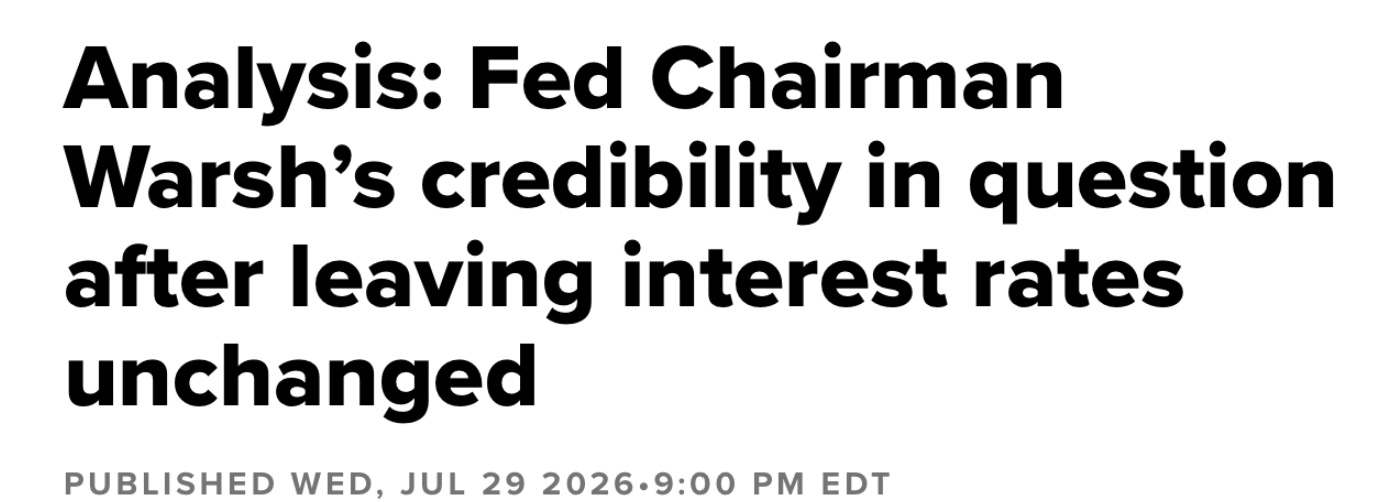
Kevin Warsh walked into the most impossible job in American finance in May. His first meeting as Fed Chair and his credibility is already being questioned. That is not a reflection of Warsh’s capabilities — it is a reflection of the position he inherited. The Fed’s new communication framework, designed to stop over-telegraphing future moves and give the committee more flexibility, is now making a different problem more visible. Business leaders cannot make decisions without some visibility into the rate environment. Would you sign a ten-year commercial lease without knowing whether rates were going up or down, let alone a thirty-year mortgage? Would you buy a home? Would you break ground on a new factory?
The businesses that were supposed to reshore American manufacturing, rebuild the industrial base, and win the AI race need capital at a cost they can plan around. The Fed’s new silence gives them nothing to plan around. The cure for over-communication may be creating its own form of paralysis — not in the Fed, but in every boardroom and every mortgage application that depends on some reasonable expectation of what money will cost six months from now. The groundwork of future economic growth is paralyzed.
The Fed is not the villain of this story. The Fed is the last institution standing between a manageable crisis and an unmanageable one — with no good tools, no political cover, a new chairman under immediate scrutiny, and a world that is simultaneously demanding lower rates and generating the conditions that make lower rates dangerous.
This is one job I would not want. Not for any amount of money.
Only time will tell.
10. Canadian Wildfires Create Hazardous Air in Midwest and Northeast
Canadian Wildfires Create Hazardous Air in Midwest and Northeast —WSJ 07/16/2026

Winds swept the smoke from the north, where the Canadian government reported more than 100 uncontrolled wildfires. Swaths of the Northeast and Midwest were under National Weather Service air quality alerts as unhealthy levels of particulates were carried into the region. Multiple alerts were extended into Friday as the smoke crawled southeast.
The smoke from Canadian wildfires is blowing into the United States again. Skies turning orange. Air quality alerts across the Midwest and Northeast. The kind of images that generate enormous amounts of climate change coverage and renewed calls for green energy investment.
Here is the number nobody puts next to those images. A single large Canadian wildfire generates more CO2 emissions than the US produces in a 3-5 year period. According to the Canadian Climate Institute, Canada has spent $500 billion on the transition to green energy and for what? One fire every few years to make that spending worthless. The mathematical reality of wildfire emissions versus industrial emissions is so uncomfortable that it rarely appears in the same article as the policy prescriptions being funded to address climate change.
Hundreds of billions of dollars have been committed to the green energy transition. Wind farms, solar panels, EV subsidies, grid upgrades, carbon credits, and the entire apparatus of climate policy that has reshaped energy markets, manufacturing decisions, and geopolitical relationships over the last two decades. And one bad fire season in Canada undoes years of that progress in a matter of weeks.
This is not an argument against clean air or a healthy environment. It is an argument about priorities, honesty, and the strategic consequences of the choices America made while convinced it was saving the planet.
Russia and China watched the green energy transition unfold and made a different calculation. Russia kept pumping oil and gas and became Europe’s energy supplier of choice until the Ukraine war forced a reckoning that Europe is still recovering from. China ignored the climate fad long enough to build the factories that now make the solar panels, the wind turbine components, and the EV batteries that the Western green transition depends on. China did not skip industrialization to protect the environment. It industrialized at maximum speed — coal plants, steel mills, chemical factories — and then positioned itself as the manufacturer of the green economy it never fully committed to living in.
The countries that took climate change most seriously are now dependent on the countries that took it least seriously for the materials required to address it. America dismantled its industrial base in part to reduce emissions. China built the replacement industrial base with no such constraints. The green transition did not reduce global emissions. It offshored them — and handed China the leverage that comes with manufacturing everything the transition requires.
One wildfire. More emissions than a country produces in a year. Hundreds of billions spent. And the solar panels cleaning it up were made in a Chinese factory powered by coal.
The green energy transition will come with consumers buying reliable and smart energy over time. Solar panels are getting cheap enough where they will pay for themselves. We don’t need to print hundreds of billions of dollars, breaking Western nations, to force it while we are already broke.
It’s not whether you agree with climate change or not; it’s just the math, and the math has never added up. The smoke just makes it visible.
Only time will tell.
