

Manganese…you hungry?
Not magnesium. Manganese.
A few months ago we discussed mining in the Boundary Waters and how Americans will have to accept some uncomfortable realities if they want their standard of living to stay the same. This month it got personal.
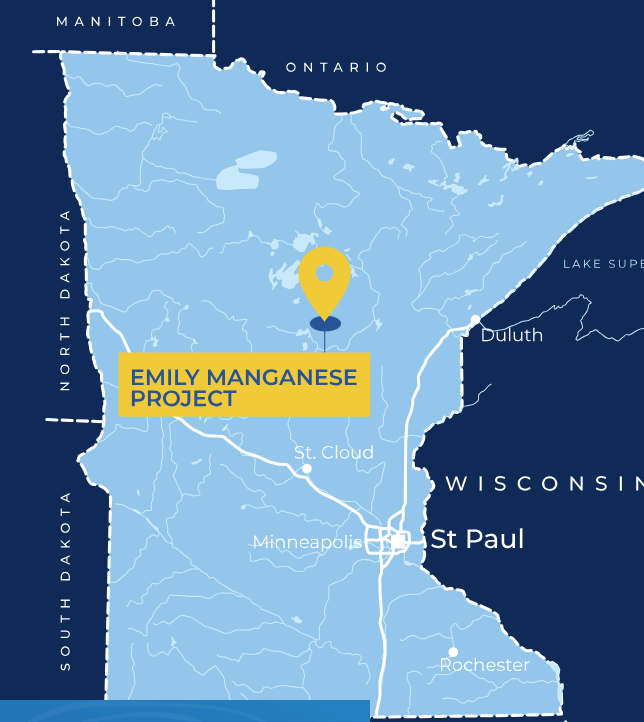
My parents own a cabin in Emily, Minnesota. A proposed manganese mine two miles from downtown Emily is currently being fought over between county residents and a company called Electric Metals. I grew up around these lakes. I understand why people are worried. I also understand what is at stake if we keep saying no to everything.
Residents of northern Minnesota lake community voice skepticism about mining manganese — MPR News 07/23/2026
The Emily deposit is on the northern end of the Cuyuna Range, which was mined for iron ore until the early 1980s. U.S. Steel developed plans to dig an open pit to mine the iron ore and manganese in and around Emily in the 1950s but declined to pursue it.
This deposit has been known about for 70 years. Nobody has touched it.
Crow Wing Power, a Brainerd-based electric cooperative, purchased some of the land and mineral rights in the manganese deposit in 2008. A subsidiary spent more than $20 million on a failed technique to shoot water under high pressure into the earth to break up the manganese and then pump it to the surface.
North Star Manganese has been exploring the site since 2020, drilling holes hundreds of feet below the surface and mapping the mineral deposit. The company would use a more traditional method of blasting the underground rock with explosives.
A company has been working on this single mine since 2008. Nearly 20 years. $20 million spent to produce nothing. That is before a single permit has been filed. Before a single shovel has broken ground. Before a single ton of manganese has come out of the earth.
If the company does apply for a mining permit, it would take years to go through the environmental review and permitting process, said Joe Henderson, director of the lands and minerals division of the Minnesota Department of Natural Resources.
Years. On top of the nearly two decades already spent. On a deposit that has been identified since the 1950s. For a mineral that is a critical component of the lithium-ion batteries used in electric vehicles, buses, and power tools. The exact batteries America keeps saying it wants to build domestically, but relies on China for.
The company believes there’s enough material at the Emily site to mine about 1,000 tons a day for more than 20 years. The manganese ore would be transported to a plant outside of Minnesota to be processed into battery chemicals.
1,000 tons a day for 20 years sitting underneath a Minnesota lake town. And we cannot get a permit to move.
Meanwhile, China looked at its critical mineral deposits and did not convene a community meeting. It did not spend 20 years drilling test holes. It did not wait for an environmental review that takes longer than some careers. China identified the resource, expedited the process, built the infrastructure, and now supplies the majority of the world’s processed critical minerals while America debates whether a mine two miles from a small town is too close to downtown.
Manganese is an important component of lithium-ion batteries used in electric vehicles, buses, and power tools. But the prospect of an underground mine less than 2 miles from downtown Emily has many local residents worried.
I understand the worry. These are my parents’ neighbors. They are good people who love their lakes and their community and don't want to see it change. That sentiment is completely human and completely reasonable.
It is also the sentiment that is losing America the critical minerals race in slow motion.
The American media talks about energy independence and domestic battery supply chains like they are policy goals that can be achieved by the end of a presidential administration. I would encourage you to think again. It takes heavy equipment, mining expertise, refining capacity, and years of permitting just to get these metals out of the ground and into a usable form. The gap between the talk and the reality is measured in decades, not press releases.
Are Americans willing to do what it takes to separate ourselves from China? The answer, from a small town in northern Minnesota, appears to be no.
The Rover connects the dots between history, macro, and your money before the mainstream media does. Please consider becoming a paid subscriber.
The most interesting things I’ve read this month:
The Gap Between the Rich and the Very, Very Rich Is Getting Wider
The ‘Colossal Headache’ of Building a Made-in-America Monopoly Game
Treasury Will Auto-Enroll 60 Million Children in Trump Accounts
The U.S. Military Exits Iraq, Leaving Behind a Nation in Peril
Xi’s Superpower Ambitions Fuel a Dangerous Debt Spiral in China
Trump strikes deal with Putin to supply Russian diesel to U.S. and global markets
Trump Official Tries to Kill Report on Perfectly Timed Oil Trades
Houthi Strike Hits Building at Saudi Aramco Headquarters
China’s Growth Machines
Trump Will Burn It Down
1. The Gap Between the Rich and the Very, Very Rich Is Getting Wider
The Gap Between the Rich and the Very, Very Rich Is Getting Wider — WSJ 09/29/2026
The ultrawealthy aren’t just pulling away from average Americans. Buoyed by a stock-market boom that has added trillions of dollars to their net worth, the extremely rich are even pulling away from other rich Americans.
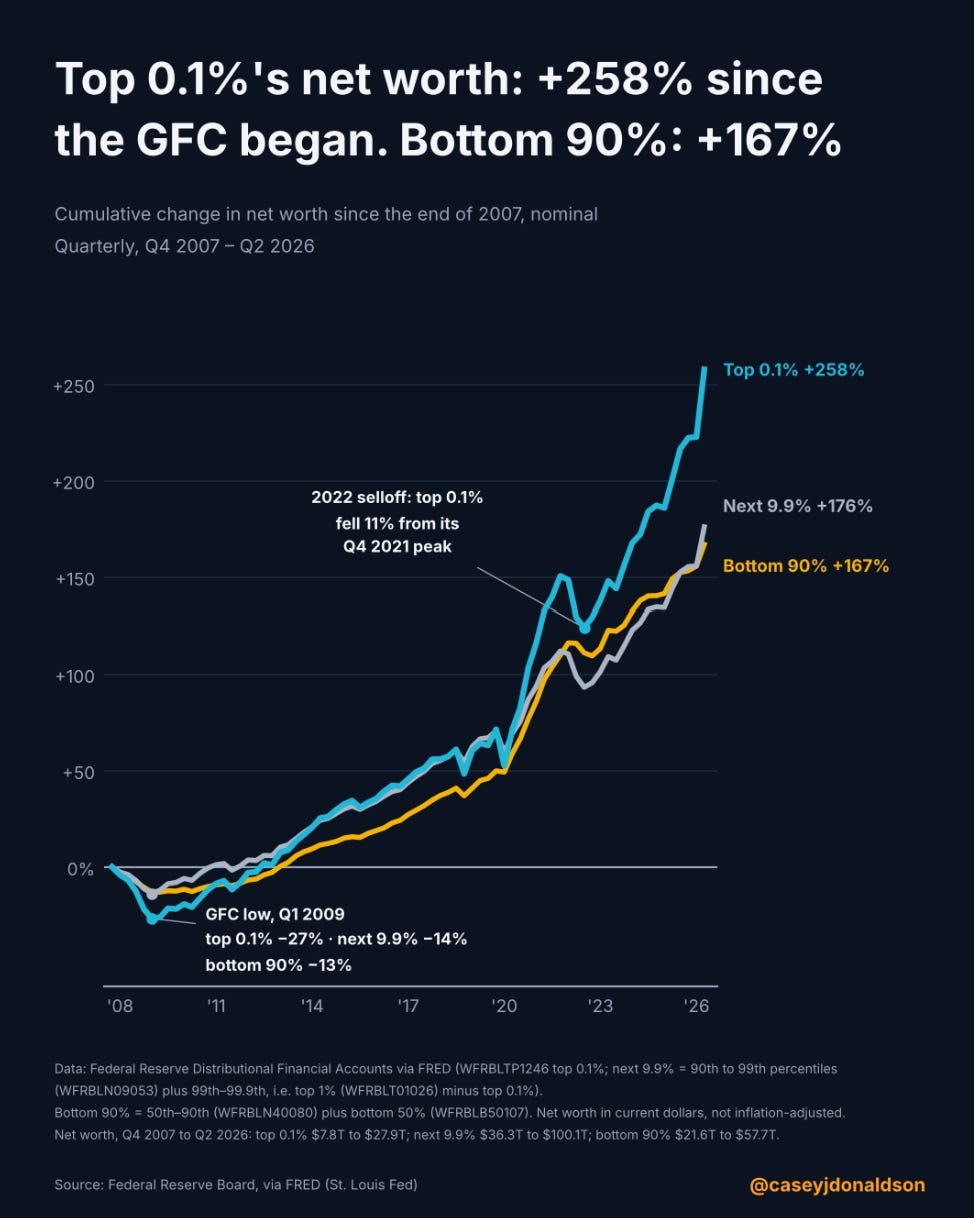
The top 0.1% wealthiest Americans have seen their total wealth more than double since the end of 2019, according to new data from the Federal Reserve. The year the pandemic started was when the ultrawealthy began to pull away from other rich groups, according to a Wall Street Journal analysis of Fed data.
In dollar terms, the very richest Americans have gained a total of $14.5 trillion in wealth over that period, with most of that—about $10 trillion—coming from gains in stocks and mutual funds, according to the Fed data, which runs through the end of June.
The 0.1% now control about $28 trillion, or about 15% of the nation’s total wealth, which amounts to nearly $186 trillion. The average wealth for a household in this group is more than $200 million.
As of 2022, the minimum for the top 0.1% was $45.8 million, according to the most detailed data available from the Fed. With wealth among the group up by roughly 50% since then, that threshold is much higher now.
This is not a Democrat or Republican story. This is a money printer story.
The record money printing that began after the 2008 financial crisis and then doubled down during COVID has had one consistent unintended consequence. Printed money eventually finds its way into asset prices. Asset holders watch their wealth explode as everyone else watches prices rise.
People love to blame the opposite political party for the rich getting richer and the destruction of the middle class. The reality is that money printing has been enthusiastically bipartisan since the GFC. Both parties spent too much. Both parties printed. Both parties watched the K-shaped economy get wider and wider and called it a recovery. Both parties bail out the rich and make the lower wealth classes pay. Socialism for the rich and capitalism for the poor.
When you manipulate interest rates and the money supply for 15 years, even the smartest economists cannot predict all the consequences. Here is what we actually got:
Housing market: The housing market is frozen. Artificially low rates for decades locked millions of homeowners into 2.9% mortgages they will never voluntarily trade for a 7.5% mortgage. The market that was supposed to provide middle-class wealth-building became a trap that benefits only those who already own or refinanced.
Stock market: The stock market concentration is at levels never seen before. All new money is funneled into seven names while the rest of the market went sideways or down.

The Economy: The K keeps widening. Those without assets are left with nothing. We have an overabundance of millionaires and an underpopulation of people who can afford to buy a house. Cue the political unrest.

Look at France right now. Over 550,000 people took to the streets on October 17th and 18th. Looting and fires. Over 1,800 arrests. The protests started over the cost of living and spread into full-scale riots across the country. The French 10-year bond yield hit 5%, a 24-year high not seen since 2002, as markets priced in the cost of political instability on top of an already unaffordable deficit. The cost of peace revealed itself immediately in the bond market.
France is a preview of what every Western economy can look like if nothing changes.
Every Western economy that has followed the same money printing playbook is building the same pressure underneath the surface. The K-shaped economy does not resolve peacefully. It resolves through policy that deliberately brings manufacturing wages back to the middle class, or through the kind of unrest that makes governing impossible and bond markets panic.
The solution: bring manufacturing jobs that were sent to China back home. Tariffs will do the heavy lifting, but there will be some short-term pain. That pain will be worth it because it will provide wages people can live on.
Nobody said a word as corporations sent jobs overseas to boost stock prices and CEO bonuses. Now everyone is a tariff expert because fixing the damage is uncomfortable. Maybe stock prices need to fall. The top 0.1% have had a very good run on the backs of the middle class. Some discomfort seems appropriate.
Two choices. Tariffs and reshoring with short-term pain and a path to a wider middle class. Or the K keeps widening, the rich keep getting richer, and we find out how France ends.
We are past the point where doing nothing is an option.
Time will tell.
2. The ‘Colossal Headache’ of Building a Made-in-America Monopoly Game
The ‘Colossal Headache’ of Building a Made-in-America Monopoly Game — WSJ 09/29/2026
Jonathan Silva and his team at WS Game Company set a challenge for themselves last year: Produce a bespoke Monopoly game that was 100% made in America.
The company set out to produce its first U.S.-made game after President Trump imposed high tariffs on Chinese imports. The goal was to have it ready in February, ahead of the 250th anniversary of the Declaration of Independence.
“It was a colossal headache. I hope I don’t have to go through it again,” said Silva, who at one point considered canceling the whole project. “It was not profitable for our company in any shape or form.”
What Silva and his team discovered was that options for manufacturing a game in the U.S. are extremely limited and costs can be prohibitively high. A like-for-like game made in China would have been better quality, cost less and come to market faster. Still, the company persevered—although it ended up just shy of 100% American-made.
Trump administration tariffs have led many companies to rethink their manufacturing footprint. WS Game’s experience highlights the challenges of quickly shifting production to the U.S. after decades of working with Chinese partners. The company initially thought it could make a game for about 20% more than the cost in China, after factoring in shipping, said Adam Hocherman, WS Game’s director of new business development. Instead, the premium was around 100%.
And the dice? They still come from China. The game company couldn’t find anyone in the U.S. to make 5,000 pairs.
In China, WS Game tells factories what it wants, and asks them to make the idea a reality. The U.S. process was reversed. “We figured out what the factories’ capabilities were, then backed into the design,” said Silva.
No one could do the job from start to finish, as is the case in China, where factories are often more sophisticated and often vertically integrated. The team looked at different game formats and cast about for manufacturers that could supply individual components before settling on a hybrid approach that relied on one main manufacturer and several smaller suppliers.
Jonathan Silva challenged himself last year. Produce a Monopoly game that was 100% made in America. It seemed like a reasonable goal for a company celebrating the country’s 250th birthday…it nearly broke him.
Silva’s company, WS Game Company, normally produces its high-end board games in China, like 80% of all toys and games sold in America. When Trump’s tariffs hit, the company received a seven-figure tariff bill and decided to find out whether American manufacturing could actually deliver.
What they found should be required reading for every politician who has signed the End Trump’s Tariffs Act.
The plan was to make the game for about 20% more than the Chinese version. The reality was 100% more. Double the cost. The American-made Monopoly Americana Edition retails for $80. The Chinese version would have been higher quality, cheaper, and faster to arrive.
And the dice? They still had to come from China. Silva turned over every single leaf trying to find someone in America who could make 10,000 dice. Nobody could. It requires specialized machinery and capital investment that no longer exists in the United States.
In China, WS Game tells a factory what it wants, and the factory makes it happen. Often under one roof, vertically integrated from raw materials to finished product. In America, the process ran in reverse. Figure out what the factories are capable of. Then design around their limitations. One main manufacturer. Several smaller suppliers. A year of assembly time.
This is a board game. Not a fighter jet. Not a semiconductor. A board game. Consisting of cardboard, metal tokens, plastic houses, paper money, and dice. And America cannot make it competitively.
Now apply that reality to 5G infrastructure. Autonomous vehicles. Military drones. Precision weapons components. The same fragmented supply chain, the same missing specialized manufacturers, the same capital that never got invested because China was cheaper, but now the stakes are national security instead of holiday sales.
China built its manufacturing dominance from the bottom up. Raw materials. Warehouses. Labor. Specialized sub-component suppliers. Vertical integration at a scale the world has never seen. What started as cheap goods filling American landfills has moved relentlessly up the value chain. The Chinese version of this Monopoly game was nicer and cheaper than the American version. Apply that dynamic to robots, drones, and AI hardware, and you understand why this is a national crisis, not an economic inconvenience.
As Jeff Bezos said, “your margin is my opportunity.” China has applied that philosophy to every industry it has entered. As one economist put it: when a Chinese company walks into a sector, the profits walk out.
The slow movement of manufacturing out of America over 40 years has now become a national security issue. The government is spending hundreds of billions of dollars trying to reverse it. That spending is necessary. It will also be extraordinarily inflationary because rebuilding what took China four decades to build can't be done cheaply or quickly, no matter how many billions get committed.
We could not find anyone to make dice.
That is where we are starting from.
Time will tell.
3. Treasury Will Auto-Enroll 60 Million Children in Trump Accounts
Treasury Will Auto-Enroll 60 Million Children in Trump Accounts —WSJ 09/29/2026
The Treasury Department will automatically enroll tens of millions of children in the government’s new Trump Accounts as soon as this week, replacing the previous structure that required parents or guardians to sign up, the agency said in rules published Tuesday.
The shift to automatic enrollment will ensure much broader access to the child investment accounts, creating them for more than 60 million additional children under age 18, according to the Treasury Department. The shift to auto enrollment means that big contributions from wealthy donors to the program—like the $6.25 billion pledge from Michael Dell—would reach more households.
“Stakeholders have expressed that eligible donors prefer that their contributions reach all children, not just children whose parents have the awareness to opt in,” the rules say.
