Smokey Bear
January 2026
The Rover
Smokey the Bear was a real bear.

I was shocked to hear that. All my life, I just thought he was a cartoon character, campaigning to protect the wilderness from wildfires.
Or something to remind humans not to be idiots while out in nature, as up to 95% of wildfires are started from human carelessness.
The famous slogan, “only you can prevent wildfires,” hits a little differently when you realize that fact.
The Smokey Bear campaign, launched in 1944, is America’s longest-running public service announcement (PSA) campaign, promoting wildfire prevention through the iconic bear. The real Smokey Bear was a live American black bear cub rescued from a New Mexico wildfire in 1950, who became the living symbol for wildfire prevention, residing at the National Zoo in Washington DC and receiving fan mail before being buried back in his home state. His story inspired the long-running "Only YOU can prevent wildfires" campaign, making him a national icon for forest fire prevention and conservation.
The United States has always cared about wildfires to some extent as westward expansion increased in the 1800s, but this concern grew dramatically with Americas involvement in WWII.
The reasons for the increased wildfire awareness:
Manpower shortages as experienced firefighters and able-bodied men were off fighting a war.
Japan launched thousands of incendiary balloons across the Pacific, with about 11% reaching the U.S., causing fires and fear on the West Coast.
Forest fires threatened crucial timber resources needed for the war effort, making fire prevention a matter of national security.
Concerns grew that enemy agents could exploit fires, and the shelling of a California oil field in 1942 heightened fears of attacks on U.S. soil
Six years after the Smokey Bear campaign launched, a fire raged outside Capitan, New Mexico.

In Capitan, NM, firefighters discovered a small, scared bear cub motherless near the fire line, badly burned and with blistered paws, after he'd climbed a tree for safety.
The crew wrapped the cub in their jackets, carried him to safety, and gave him to Ranger Ray Bell.
Ranger Bell flew the cub to Santa Fe for treatment by a veterinarian, who bandaged his burns.
News of the rescued cub spread, and the public named him "Smokey Bear," after the existing wildfire prevention character.
The New Mexico State Game Warden offered the cub to the Forest Service, who accepted him as a living symbol for their campaign.
Smokey was sent to the National Zoo in Washington, D.C., where he became a beloved attraction for 26 years, teaching millions about fire safety.
And the rest is history.

Smokey retired in 1975, and upon his death in 1976, his body was returned to Capitan, New Mexico, where he’s buried at the Smokey Bear Historical Park.
Robots and AI Are Already Remaking the Chinese Economy — Luke Gromen
Robots and AI Are Already Remaking the Chinese Economy —WSJ
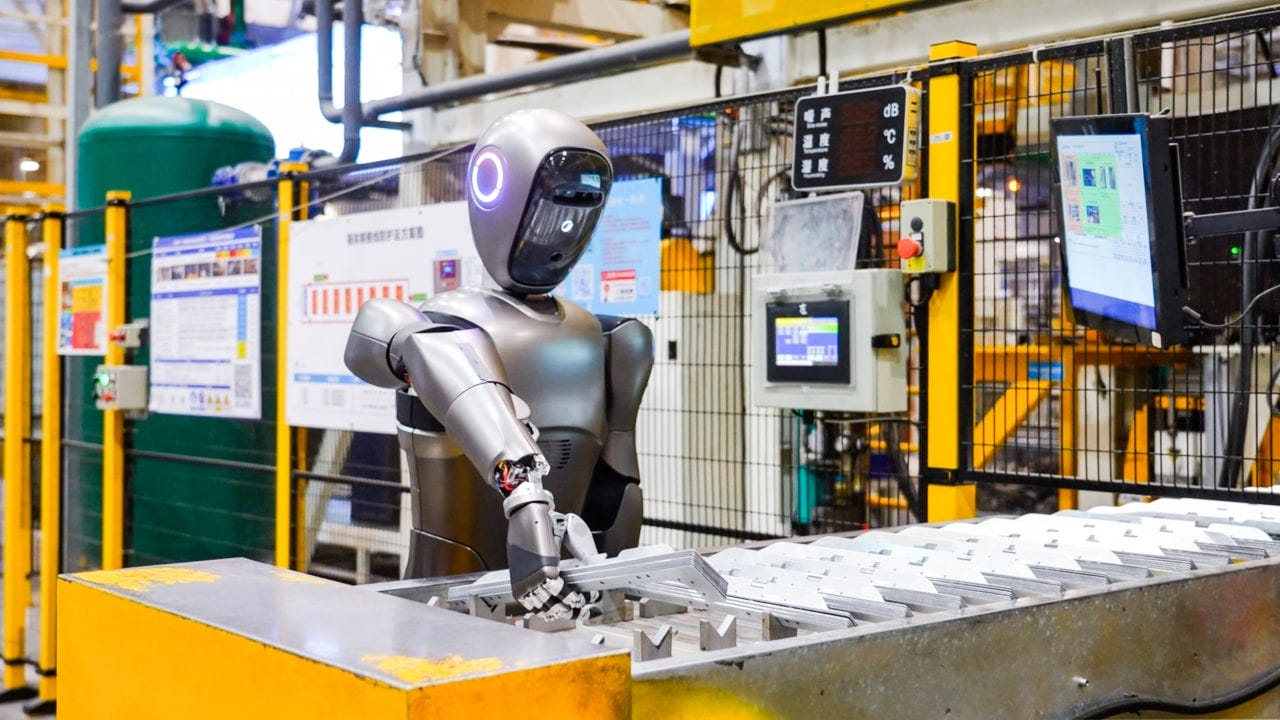
For reasons I don’t understand, some actually believe AI is dumb. “Well, ChatGPT gave me a wrong answer when I asked it this…”
The fact that we are even debating this still in the US means we are falling behind against China, which is using AI to drive productivity gains at levels never seen before.
While China’s long-term AI goals are no less ambitious than the U.S. tech titans, its near-term priority is to shore up its role as the world’s factory floor for decades to come. With exports under threat from rising costs at home and tariffs abroad, that is no longer assured.
The push can be seen across the giant country in scores of companies—fueled by billions of dollars in government and private technology development—that are transforming every step of making and exporting goods.
A clothing designer reports slashing the time it takes to make a sample by more than 70% with AI. Washing machines in China’s hinterland are being churned out under the command of an AI “factory brain.”
At one of China’s biggest ports, shipping containers whiz about on self-driving trucks with virtually no workers in sight, while the port’s scheduling is run by AI.
Executives involved in China’s efforts liken the future of factories to living organisms that can increasingly think and act for themselves, moving beyond the preprogrammed tasks at traditionally-automated factories. It could further enable the spread of “dark factories,” with operations so automated that work happens around the clock with the lights dimmed.
China installed 295,000 industrial robots last year, nearly nine times as many as the U.S. and more than the rest of the world combined, according to the International Federation of Robotics. China’s stock of operational robots surpassed two million in 2024, the most of any country.
Nearly a decade ago, Midea made clear its ambitions to automate by acquiring control of German robotics specialist Kuka. Today, Kuka’s robots at Midea’s Jingzhou washing-machine factory work under what Midea calls an AI “factory brain,” which acts as a sort of central nervous system running much of what happens in the plant.
The computerized brain manages 14 virtual agents inside the factory that communicate with each other to figure out the best way to carry out tasks, with orders flowing down to robots and other machines on the factory floor. It’s a step toward Midea’s goal of using AI to more holistically automate processes at its factories.
“You feed in all the data, and let AI figure it out,” said Xi Wei, director of the Midea Humanoid Robot Innovation Center. With a Ph.D. from the University of Maryland, Xi spent years living in Silicon Valley before returning to China to develop advanced robots for Midea.
Where human workers are still required, some have been outfitted with AI-powered glasses that can flag common product errors based on inspection history. Processes that previously took 15 minutes now can be done in 30 seconds.
In a sign of how the company wants to use technology to drive efficiency, Midea reports that its revenue per employee grew by nearly 40% between 2015 and 2024.
A special priority for Xi has been upgrading the nation’s ports, a crucial step in reinforcing China’s dominance as the world’s manufacturing power.
The port of Tianjin, among China’s largest, has teamed up with Huawei to launch a fleet of unmanned trucks and a system dubbed OptVerse AI Solver, which optimizes tens of millions of variables and constraints such as ship arrival times and crane capacity to manage scheduling.
Planning that previously took 24 hours now takes 10 minutes, according to Huawei.
By last year, the port also launched PortGPT, an AI model developed with Huawei, whose ability to analyze video and images at the site could allow them to replace human safety officers going forward, a port executive told state media.
Similar stories are playing out around China, with half of the world’s top-20 ports in terms of vessel turnaround time located in the mainland, including Tianjin, according to the World Bank and S&P Global Market Intelligence.
Just one of 10 large U.S. container ports surveyed by the Government Accountability Office had deployed driverless vehicles as of mid-2023, while only five were using AI and machine learning.
In Tianjin, more than 88% of large container equipment is already automated, state media said this year. For visitors to the port, a video sums up China’s growing AI self-belief: “We are the future,” the narrator says.
The debate is over.
We are already at the inflection point: if we don’t do something like TODAY, we will never catch up to China in manufacturing again.
China hawks are great at pounding their chest about how the US stock market (up 428%) has crushed the China stock market (up 19%)
This chart from Luke Gromen tells a different story.
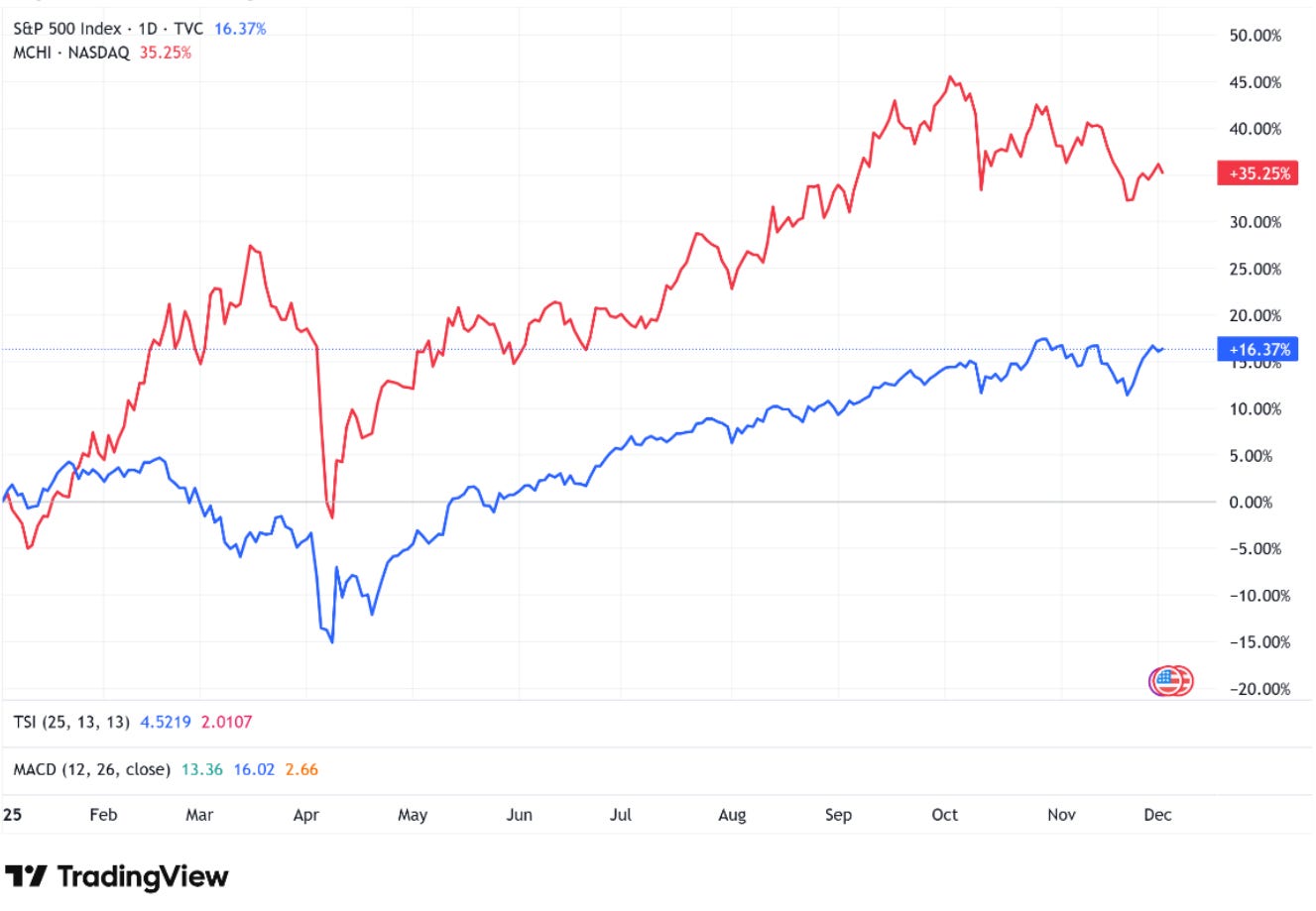
Since the trade war started, the China index has doubled the S&P.
The markets are slowly picking up what China is putting down.
China is gaining efficiencies while the US is still debating the topic.
The dollar is too strong to be competitive with China, and we need it to fall by as much as 80% for the US to be competitive.
Critical Materials: A Strategic Analysis
For the past three decades, Western economies have operated under the tacit Neoclassical assumption that control over intellectual property, financial instruments, and software code constitutes the apex of value creation. In this worldview, the physical processes of industrialism, the dirty, energy-intensive work of mining, refining, smelting, and alloying, were viewed as commoditised, low-margin utilities that could be outsourced to low-cost jurisdictions without strategic peril.
The post-Cold War era was defined by the assumption of "infinite materiality": the deeply held economic belief that, with sufficient capital and open trade routes, any physical resource could be procured in the necessary quantities, at any time, from a friction-free global market. This paradigm facilitated the rise of the "Just-in-Time" logistics model, which ruthlessly optimised supply chains for financial efficiency, stripping out inventory buffers and redundancy at the expense of systemic resilience. As of late 2025, this era of assumed abundance has definitively concluded. We have entered an era of complex constraints, where the physical availability of matter, not the availability of credit, sets the limit on national power.
This flawed intellectual framework has given rise to the “Feedstock Paradox”: the dangerous strategic illusion that possession of raw ore equates to possession of usable material. In this new era, ownership is no longer simply a matter of having a mine within a nation’s geographic borders. Actual strategic ownership includes the control of the offtake contracts coming from that mine, the national identity of its controlling shareholders, and, most crucially, the processing location where that ore is refined into metal.
While Western nations and their allies control a significant percentage of the world’s raw geology (the “Upstream”), they have systematically abdicated the critical industrial processes that convert that geology into sovereignty. China has successfully monopolised the “Midstream”, the heavy industrial capacity to refine, smelt, separate, and purify these materials into usable forms.
In this new era, intelligence, energy, and autonomy have become functions of refining capacity. It is no longer sufficient to own the intellectual property or the patent for a high-performance battery; a state must control the midstream processes that turn raw spodumene rock into battery-grade lithium hydroxide. Without that physical capability, the IP is worthless in a crisis.
This article is a must-read. It’s long, but it is worth it. Click the title.
It goes to show that the pretty boys who thought the US was too good for the dirty jobs of refining and purification just lost us the lone global superpower title with that mindset.
China realized that being the middleman was how you won, while the US was too busy trying to figure out how to bundle any financial product together to resell it on Wall Street.
It’s a complicated issue that many world superpowers have seen before. Let the rich get richer or build things.
China doesn’t even need to take action against the US. We stand in our own way with the building permit process and environmental studies.
Next time you see someone protesting over environmental issues, remember this:
Western environmental regimes function, in practice, as a hidden subsidy to the Chinese midstream. By eliminating specific emissions, particulate standards, and waste streams (such as acid separation and fluoride disposal) in the West, allied nations effectively transferred a massive cost advantage to China, which absorbed the environmental externalities as the price of strategic control.
The Domestic Kill Switch: Those same rules now act as a powerful domestic veto point on re-industrialisation. Every proposal for a new refinery, SX plant, or TNT facility to fix the impairment is caught in the crosshairs of local activism and regulatory litigation. China does not need to lobby Western governments to stop these projects actively; they only need to amplify existing Western opposition to “dirty” plants through influence operations or simply watch as the West’s own permitting bureaucracy kills the projects. Unless environmental law is re-conceptualised as a national security instrument that balances local impact against strategic survival, the political permission to build the midstream will remain blocked.
China effectively controls the world’s militaries through its control of refining these rare earth elements.
The West has been punched square in the chest by this realization, but check out the chart I posted on X last week:
This chart is in 2030!!!!
Four years from now, China will still dominate the refining of these rare earth elements.
China is not going to send rare earths so the US can build weapons to fight China; the US has already stopped receiving them for military purposes.
The only way the US fixes this is by printing MASSIVE amounts of money to build these refining plants and to discard the environmental laws and building permit processes that prevent it.
If China is going to make a military move to take Taiwan or even make the statement that they are the superpower of the world, that will come before the US has the opportunity to figure this out.
And as we all know, the US government is moving as quickly as possible to secure these rare-earth supply chains.
I hope you own gold, silver, and Bitcoin for when China makes its move.
How China built its ‘Manhattan Project’ to rival the West in AI chips —Reuters
China does not want the US to have anything to do with its supply chain.
In a high-security Shenzhen laboratory, Chinese scientists have built what Washington has spent years trying to prevent: a prototype of a machine capable of producing the cutting-edge semiconductor chips that power artificial intelligence, smartphones, and weapons central to Western military dominance.
Completed in early 2025 and now undergoing testing, the prototype fills nearly an entire factory floor. It was built by a team of former engineers from Dutch semiconductor giant ASML who reverse-engineered the company's extreme ultraviolet lithography machines or EUVs, according to two people with knowledge of the project.
EUV machines sit at the heart of a technological Cold War. They use beams of extreme ultraviolet light to etch circuits thousands of times thinner than a human hair onto silicon wafers, currently a capability monopolized by the West. The smaller the circuits, the more powerful the chips.
China’s machine is operational and successfully generating extreme ultraviolet light, but has not yet produced working chips, the people said.
In April, ASML CEO Christophe Fouquet said that China would need "many, many years" to develop such technology. But the existence of this prototype, reported by Reuters for the first time, suggests China may be years closer to achieving semiconductor independence than analysts anticipated.
The availability of parts from older ASML machines on secondary markets has allowed China to build a domestic prototype, with the government setting a goal of producing working chips on the prototype by 2028, according to the two people.
But those close to the project say a more realistic target is 2030, which is still years earlier than the decade that analysts believed it would take China to match the West on chips.
Trump may have thought it was a smart move to withhold the best chips from China, but the joke is on us.
Not having chips was by no means ideal for China, but this realization led them to develop their own chips.
Withholding anything from China gives them the chip on their shoulder required to just make it in China.
We always hear about China not protecting US intellectual property, but China doesn’t even do that for its own companies.
Competition is CUTHROAT in China.
Give them the opportunity, and they have the engineers, raw materials, work ethic, and the belief that anything can be made better within China's borders.
The Imminent Western Silver Insolvency
In 2024, the global demand for silver outstripped supply by approximately 4,600 tonnes (150 million ounces). It was the fourth consecutive year of a structural deficit that has already drained Western vaults of nearly 21,000 tonnes of metal.
We are consuming 37,300 tonnes of silver annually while digging only 31,200 tonnes out of the ground. In any other era, price would rise to stimulate production. But this is where the "Old War" logic fails.
Seventy-two percent of all silver is not mined for its own sake. It is a by-product, a chemical accident found in the ores of lead (30%), copper (26%), and gold (16%). This means silver supply is price inelastic. You cannot simply "turn on" a silver mine when the price hits $150. You must mine more copper or zinc to get the silver. And the West has decided it no longer wishes to do the dirty work of smelting either
When the "Refining Cliff" hits say ? likely in 2026? as the Western industrial deficit becomes mathematically impossible to cover with dwindling vault stocks the price of silver will bifurcate.
There will be a paper price for the speculators in London, and a "war premium" for the physical metal that simply does not exist.
We have built a civilization on materials insolvent system . The deficit is 4,600 tonnes deep, and the bottom is nowhere in sight.
Wall Street likes to engineer things to make us believe the old supply/demand markets don’t exist. That is not the case with metals.
When silver has acted like this in the past, nations have fallen, but we also didn’t have the industrial uses of today.
The common theme prevails: you can’t print real things (silver).
Maybe people will take this seriously when we tear down the less efficient giant solar farms to mine silver for weapons.
Hopefully, it doesn’t get to that point.
Venezuela: China’s Proxy and the Spark That Could Ignite World War III
Is it about oil?
A quick timeline
Washington claims the mission is to clean up narcotics routes and restore democracy in the hemisphere. Online buzz, it’s the oil. It’s neither.
Former CIA Chief of Station Gary Berntsen blew the whistle last year on Venezuela’s deeper role -- as the birthplace of election-manipulation software, exported worldwide and allegedly embedded in U.S. voting systems through companies like Smartmatic, Sequoia, and Dominion.
According to Berntsen, this isn’t just Venezuelan corruption; Beijing inherited the entire architecture. China didn’t just bankroll Caracas -- it wired it, embedding intelligence, telecom, and cyber control that may bleed directly into U.S. political infrastructure.
If true, this means the code that counts American votes may have foreign fingerprints all over it -- written by a hostile state, and running on hardware linked to China’s Huawei. The United States may not have had control of its own election machinery for the past 20 years.
Venezuela isn’t a fallen socialist state anymore -- it’s China’s forward operating base in the Western Hemisphere. By hitting Maduro, the U.S. may be severing Beijing’s political control pipeline straight into Washington.
China doesn’t lose proxies quietly. If the U.S. has moved to neutralize its influence in Latin America, Beijing may hit back -- not with tanks, but through cyber war, digital sabotage, and psychological operations on the American public.
From Beijing’s view, it’s not a Venezuelan invasion -- it’s an assault on Chinese state assets. That’s how a proxy war becomes a world war.
For now, there’s no solution to offer but this: Stay tuned. Pay attention.
The oil thesis doesn’t make sense.
As Trump met with oil executives this last week, they said what I thought the whole time: Venezuela is uninvestable with oil.
Why would American oil companies want Venezuelan oil to lower the cost per barrel so that oil companies make less money?
You always follow the money, and that does not lead us to kidnapping Maduro for Venezuelan oil.
Lifestyle
Wearing a Garmin smartwatch changed the game for me in ways I never expected.
The American health industry is great from near-death to 50% healthy, but terrible at being from 50% to 100% healthy. The more general wellness is what we are terrible at.
Hospitals are great at putting you in a bed and making sure your heart doesn’t stop.
But it’s a lot different to tell that you are impacting your well-being from poor sleep until decades down the road.
This is why we see terrible diets, sleep, and high stress go on for so long.
The Garmin watch monitors these things daily, so for the first time in my life, I actually pay attention to them.
I find myself caring about how many steps I get, the quality of my sleep, and how quickly my body battery is deteriorating thanks to stress.
It’s much easier to improve anything in life if you turn it into a game, and the Garmin watch allows you to do that.
It sets daily step goals for you, generates a daily cardio workout based on your health parameters, and lets you know exactly where your body battery is on a 1-100 scale.
I’m not saying you have to get the Garmin specifically, but do yourself a favor and get something that tracks your everyday health parameters.
Living your life well between 50-100% well-being is how you live a long life with no surprises.
Your children and grandchildren will thank you.
Investments
Listening to this podcast got me back to the basics.
I am a Warren Buffett style investor at heart, but I got a little crazy on the macro side for 6 months.
Kuppy reminded me that there is always a bull market somewhere, and my investment style needs to fit me.
Moving forward, macro will be part of my style, but finding a few good companies that can deliver 10x returns will be my focus in the near term.
Gold and Bitcoin are the foundation of my portfolio moving forward, but they will never deliver the 10x I am looking for.
Dollars
My cash position is at an all-time low, and it bothers me daily, but that's what happens when you put $50k into gold and bitcoin over the last six months.
My main focus is saving money and rebuilding it to at least 10% of my net worth.
Warren Buffett never wants to have less than $20 billion in cash, so to me, that translates to about $20k.
The world is too volatile a place right now not to have liquidity to deploy whenever I need it.
We are on the brink of a crisis at any time, and you make big money by buying when everyone else is selling.
Bitcoin
I didn’t even realize how much Bitcoin I owned until I was squeezed for cash for a second.
Realistically, Bitcoin is going to go down in the near term.
Could it hit $60k? Possibly, but I don’t really care.
I am in for the long term on Bitcoin, and once I rebuild my cash stash, I will continue buying Bitcoin every week.
Think of the Bitcoin holders that watched it fall from $20k to $3k. Or from $70k to $16k. It’s not easy holding one of these assets, but the patient has seen great wealth.
Every Iranian involved in the protests wishes they had Bitcoin and Starlink. The privatization of wealth by digital assets is the future.
Bitcoin moves with liquidity, and in 2026, we will see MASSIVE printing.
We have to print, or China will run the world by 2030.
I am still sitting on my .3 bitcoin, which is currently in the red, but as soon as my cash reserves replenish, I will buy more at the lower price.
Gold
0.17% of private portfolios hold gold as it hit $4,500/oz last week.
I remember looking at gold in 2018 at $1800, thinking I needed to be more patient.
This is a reminder for everyone that you don’t need to have a crystal ball, just buy assets when you have cash.
China is running the world and settling trade in gold.
Think of the guys who have bought gold since 1971; they have been chipping away through 2008 and even Covid, with no crazy upside to see all-time highs now. It hasn’t been easy on them.
If we keep an eye on central banks, they are buying gold at record levels.
China has bought as much as 250 tons of gold this year, while all central banks have bought as much as 850 tons for 2025.
Publicly reported buying by China’s central bank has been so low this year — 1.9 tons purchased in August, 1.9 tons in July and 2.2 tons in June — that few in the market believe the official figures. Analysts at Société Générale estimate, based on trade data, that China’s total purchases could reach as much as 250 tons this year, or more than a third of total global central bank demand.
Reported is a keyword here. Only about 30% of the gold China purchases is reported.
China and Russia will continue to buy gold so they don’t need the US dollar for anything.
Those who hold the gold make the rules.
China likes to downplay its power, while Trump will pound his chest and overestimate it at every opportunity.
Politicians all over the world will change the rules whenever they need to if it benefits them.
From the EU freezing Russian assets to the tune of 210 billion euros to Trump grabbing Maduro, central banks buying gold defends against the West doing dumb shit.
I am sitting at my 5 oz of gold and plan to add more here in the first part of 2026.
PBF Energy PBF 0.00%↑
No change, but the Venezuela news makes this position interesting as a refiner.
Venezuela's oil is dark, nasty crude that requires heavy refining to be used in our vehicles as gasoline.
Plus, refiners have taken a hit here lately with oil prices dropping into the high 50s.
If I didn’t already own PBF, I would be looking to buy some refinery stock.
PBF is shutting down operations for maintenance throughout the year.
Overall, I am very bullish on this stock with what is going on in the world.
It all goes back to the US not having built a refiner since the 1970s, and the US will need them if we are going to do anything with Venezuelan oil.
Getting back to my value-investor roots, refiners have had a tough time since Trump was elected, but that may be changing over the next three years.
Pinstripes $PNSTQ
I will not comment on this going forward unless the stock changes.
Sirius XM SIRI 0.00%↑
No change in the position, but 2026 will be a good year for this stock.
Zacks Industry Outlook Highlights Sirius XM
The renewal of Howard Stern through 2028 secures marquee content, while Zachary Coughlin’s CFO appointment brings automotive and consumer finance expertise critical for profitability optimization. Management targets $1.5 billion free cash flow by 2027, supported by $200 million annualized cost savings achieved in 2025.
The company’s dominant 90% in-car subscriber base provides defensible market positioning amid expanding automotive partnerships. Debt reduction initiatives target a 3.6x leverage ratio, while maintaining a sustainable 5% dividend yield. Combined with 31% EBITDA margins and strategic focus on core automotive subscriptions, SiriusXM offers attractive fundamentals for long-term growth.
The Zacks Consensus Estimate for 2026 earnings has moved north by 1.7% to $3.08 per share in the past 60 days. In the past six-month period, SIRI shares have declined 17.7%.
Alibaba BABA 0.00%↑
No change in the position.
I am starting to accept the fact that no Chinese stocks will ever reach their full potential on American exchanges.
America is bitter that Chinese companies are better than they are by simply outworking them.
Alibaba continues to be in the AI news headlines, and with China winning the AI war, this can’t hurt anything.
I continue to just be patient with this stock despite all the whining in months past.
I don’t plan to sell any stocks, despite the newsletters from the last few months saying Sirius and Alibaba were on my hit list.
Investing is hard, and patience pays, but the US has to print money, and the Trump administration is laser-focused on the stock market; it’d be foolish to sell any stocks until Trump is no longer in the White House.
Nam Tai Properties $NTPIF
No change in the position and no news on the audit.
Something is going on because the stock has hit three-year highs in the last few weeks, so someone knows something.
It's surprising the audit has taken this long, so maybe the results will be out shortly.
Nam Tai has the properties to be worth about $30, but it has to get back on the NYSE.
Sprott Physical Uranium Trust $SRUUF
The globe continues to need more uranium.
4 Stocks Set To Soar After The Latest Inflation Numbers
Right now, there are 436 operational reactors worldwide and 173 more under construction.
That is not going to be enough in the long run.
It has always been clear to me the path to a zero-emission future is to go from natural gas to nuclear and renewable. Wind and solar were never going to be enough to meet the world’s rising energy demand. No matter how you feel about climate change, developing renewable, clean resources is just smart.
The brain-dead politicians, misguided activists and instant experts around the world will eventually have to accept that you cannot go green without nuclear energy unless you are willing to reduce the standard of living of almost every single person on the planet.
Expanding the usage of nuclear energy is not a choice. It is a must to power the future.
We are going to need a lot of uranium.
The Uranium Landscape: Global uranium production has consistently lagged behind demand, creating a significant deficit that is expected to persist. Financial buyers like hedge funds and ETFs have also been buying uranium, further reducing the supply.
Geopolitical factors are further shaping the uranium market landscape. The Russia-Ukraine conflict has disrupted supply chains, particularly for European utilities dependent on Russian uranium. This situation has highlighted the importance of diversifying uranium sources and has led to increased interest in secure, stable supplies from other regions. As a result, producers outside of Russia may see increased demand for their uranium resources.
GameStop GME 0.00%↑
This sums up the earnings report better than I could:
House:
I figured out the furnace; it was an airflow issue. Change your filters if you haven’t done it recently.
Next on the list will be building out closets before the weather gets nice.
You can watch anything on YouTube these days, but I plan to buy some IKEA cabinets and frame them for shelves and hanging space.
Spring will be here before we know it, so I am already planning some of the outdoor projects.
It sure is a lot nicer in Minnesota in the summertime. The winter makes everything so much more difficult.
That is all for this month.
Thanks for being here, and let’s make 2026 our biggest year yet.
With love,
Casey Donaldson